



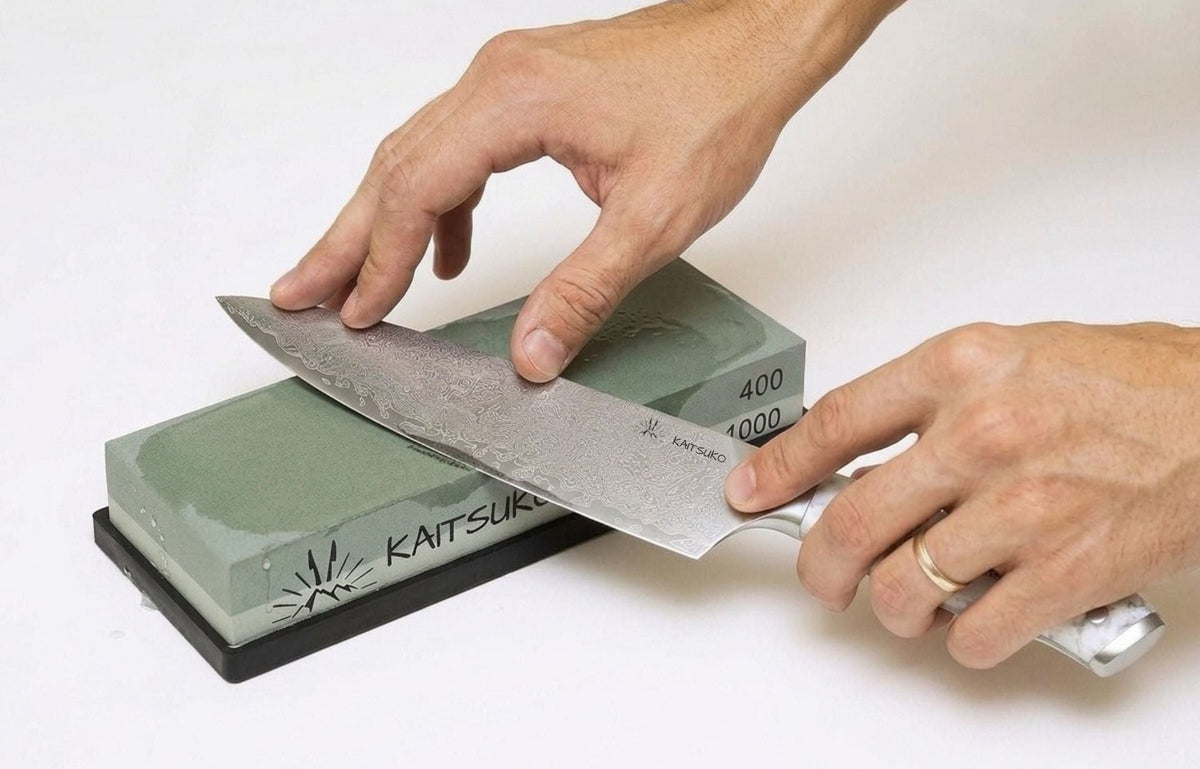
For an everyday kitchen, allow for a proper sharpening every two to six months. A Japanese knife at 60 HRC sits at the top of that range, a softer steel at the bottom. Between two sharpenings, light edge maintenance is enough: once or twice a week on the honing steel for a soft steel, every two to four weeks on a fine grit for a hard steel.
No calendar knows your cutting board, your habits or what you cut, though, and the knife remains the best judge. Here you will find the guidelines we give at Kaitsuko according to steel and use, followed by four tests that take less than a minute and tell you whether to hone, sharpen or repair.
| Your use | Honing on the steel (steel around 54 HRC) | Sharpening, steel around 54 HRC | Sharpening, steel around 60 HRC |
|---|---|---|---|
| Occasional: two or three home-cooked meals a week | Once or twice a month | Every 4 to 6 months | Once or twice a year |
| Daily: one home-cooked meal a day | Once a week | Every 2 to 3 months | Every 4 to 6 months |
| Intensive: several preparations a day | Two to three times a week | Every 1 to 2 months | Every 2 to 3 months |
| Professional, in general | Before every service | Every 1 to 2 weeks | Every 2 to 4 weeks |
Around 54 HRC, you will find our Chef Tanaka range. Most European knives, between 55 and 58 HRC, follow roughly the same rhythm. Around 60 HRC are our Damascus steel knives and the Kaito range. On these hard steels, edge maintenance is done on a fine grit or a ceramic honing rod, every two to four weeks with daily use. The frequencies in the table are orders of magnitude, to be adjusted to your knives.
Why there is no universal sharpening frequency
Two people who buy the same knife on the same day will not need to sharpen it at the same time. Five factors explain the difference.
Steel comes first. Its hardness, measured in HRC, weighs heavily on how quickly the edge deteriorates, and its composition matters too. With equal use, a 60 HRC steel can hold its edge about twice as long as a steel between 54 and 56 HRC. That is one of the advantages of a Japanese knife with a hard core, like our Damascus steel knives. Our guide to the HRC hardness of a blade explains how to read this value.
The edge angle works the other way. An edge at 15° per side cuts better than one at 20°, but it has less metal behind it and therefore copes less well with rough treatment. On a Japanese knife, a bad habit takes its toll faster than on a European blade, and that is the price of its finesse.
The cutting board is the most underestimated factor. The edge wears very little in the food itself; it wears mostly on contact with what lies underneath. Wood and soft plastic cushion it. Glass, marble, ceramic and the bottom of a plate crush it with every stroke. Carving a roast on the serving dish is enough to damage an edge. We compare the materials in our article on wood, plastic or composite cutting boards.
What you cut matters too. Herbs, fish and tender vegetables have almost no effect. Hard crusts, thick-skinned squash, half-frozen food and anything with a bone put the edge to the test. On a thin 15° blade, they can even chip it.
Then there are habits. Scraping the board with the edge to push vegetables aside, leaving the knife in the sink, putting it in the dishwasher, storing it loose in a drawer: each of these damages the edge without the knife having cut anything.
Honing and sharpening: two different rhythms
When people ask how often to sharpen a knife, they often mix up two actions that do not follow the same calendar.
First, there is edge maintenance. From repeated contact with the board, the very edge eventually bends over, without having lost any metal. The knife bites less, yet a few light strokes are enough to straighten it, which cutlers call honing. It takes a few seconds and comes round often. On a steel around 54 HRC, the honing steel does the job, once or twice a week. On a 60 HRC steel, the edge barely bends, and a few strokes on the fine grit of a whetstone or on a ceramic honing rod, every two to four weeks, do the same job gently.
Then comes sharpening itself. The edge is no longer bent over, it is worn, and only a whetstone or a sharpener can restore its shape by removing a little steel. This happens rarely, a few times a year in a family kitchen.
So it is better to maintain the edge often, which pushes back the trip to the whetstone accordingly. The day honing no longer brings back the knife's bite, it is time to sharpen. The right tools for each job are compared in our article "What to Sharpen a Knife With?".
Not every kitchen knife needs sharpening at the same rhythm
The first table applies to the knife you use most, usually a chef's knife or a santoku. The other blades in the block do not lead the same life, and their edges do not wear at the same speed.
| Knife | What wears its edge | Guideline |
|---|---|---|
| Chef's knife, santoku | The most used, always on the board | The reference frequency |
| Nakiri | Repeated vertical cutting against the board | Slightly more often |
| Paring knife | Often works in the hand, away from the board | Much less often |
| Boning knife | Contact with bones and joints | More often, keeping an eye out for chips |
| Slicing knife | Little contact with the board | Rarely, but its edge must stay perfect |
| Plain-edge steak knives | Cut on the plate, so on ceramic | Often: it is the worst surface for an edge |
| Bread knife | Serrations working through the crust | Very rarely, with a technique of its own |
In practice, there is no point sharpening the whole block on the same day on principle. Test each knife and sharpen only those that need it, which spares the metal of the others.
How to test a knife's sharpness: four tests in under a minute
Even before you test it, the knife gives you warning. You press a little harder than before. The blade slaps against the board because you are forcing the end of the cut. The skin of a pepper resists, a tomato's skin wrinkles before giving way. Sliced bread gets squashed instead of cut. Taken one by one, these signs go unnoticed, because wear is slow and your hand compensates without you realising. A test, on the other hand, does not get used to anything.
None of these tests requires any equipment. Do them on a clean, dry knife, in order. The first two are usually enough.
1. The paper test
Hold a sheet of printer paper by the top, between your thumb and index finger. Place the heel of the blade on the edge of the paper, a few centimetres from your fingers, with the cutting edge facing away from the hand holding the sheet. Draw the knife towards you and downwards, all the way to the tip.
An edge in good condition cuts the sheet in one stroke, almost silently. A worn edge tears it, folds it or refuses to bite. If the cut always catches at the same spot on the blade, you have found a damaged area, sometimes a small chip invisible to the naked eye. For a tougher test, replace the sheet with newspaper or a till receipt, which are thinner and softer.

2. The tomato test
Choose a nice ripe tomato, place the blade on it and draw the knife towards you without pressing. Its weight alone should let the edge break the skin.
This test is the most telling in the kitchen, because a tomato's skin is smooth, supple and tough all at once. When the edge is keen, the blade goes in straight away. When it is dull, it slides over the skin, forces you to press or saw, and the tomato gets squashed. As soon as you feel that slide, it is nearly time to sharpen.
3. The onion and herb test
Some signs can be read on the board. A knife that cuts well slices through cells instead of crushing them. The onion comes apart in clean slices and stings your eyes less. Basil and parsley stay green and dry.
When the edge is worn, you see the opposite. The onion crunches under the blade and releases its juice, the herbs turn black at the edges and leave a damp trace on the board.
4. The light test
Hold the knife edge up under a lamp and look at the edge head-on while slowly rotating the blade.
A sharp edge is too fine to reflect light, and you see only a dark line. A continuous reflection along the edge indicates a rounded edge. Isolated bright spots indicate chips. This test has one advantage over the others: it shows exactly where the problem is.
Two other tests are best left to professional sharpeners: the fingernail test and running a finger along the edge to "feel" whether it cuts. They tell you nothing more than the four above, and the second is the best way to cut yourself.
Reading the results
| What you observe | What it means | What to do |
|---|---|---|
| The paper cuts cleanly, the tomato opens without pressure | Edge in good condition | Nothing |
| The paper catches a little almost everywhere, the tomato needs light pressure | Bent edge or early wear | Hone the edge, then test again |
| The paper tears, the blade slides over the tomato | Worn edge, if honing makes no difference | Sharpen on 1000 grit, then refine on 3000 |
| The cut always catches at the same spot, a point shines under the lamp | Chip | If it is tiny, work the area on 1000 grit. If it is visible to the naked eye, 400 grit or a workshop |
| The knife cuts paper but gets stuck in a carrot | Blade has become thick behind the edge, after many sharpenings | Thinning, by a professional |
There is no need to do everything every time. The tomato test happens while you cook, without thinking about it. The paper test is worth repeating once a month, and after every sharpening to check the work. The light test is useful when you have doubts about a specific part of the blade.
Knife no longer cuts: where to start
A knife that no longer cuts is rarely a lost cause. Before replacing it or reaching for a coarse grit, go step by step.
Start by honing the edge, with a few light strokes on the honing steel for a soft steel, or on a fine grit for a hard blade such as a Damascus steel knife. Repeat the tomato test. If the blade goes in again without pressure, the edge was simply bent over, and you have just gained several weeks.
If not, you need to sharpen. The complete method, from preparing the stone to finishing, is described in our article "How to Sharpen a Japanese Knife". If you do not have a whetstone, a manual pull-through sharpener with diamond slots restores a decent edge in a few strokes. Start with the middle slot, and use the first one only for a very dull blade.
If the light test shows a bright spot, the problem is a chip, not wear. A tiny chip disappears on 1000 grit by working the area. A nick visible to the naked eye calls for a 400 grit. Our article on chipped Japanese knives explains when to repair it yourself and when to hand the blade over.
Finally, a new knife sometimes loses its edge within a few weeks. The steel is rarely to blame. Look first at the cutting board, the dishwasher or the drawer.
Can you sharpen a knife too often?
Yes, but not in the way you might think. Every sharpening removes steel; that is how it works. The amount depends entirely on the abrasive. A few strokes on a 3000 grit remove a layer of metal invisible to the naked eye. A session on 400 grit or in a carbide slot removes far more.
A blade therefore wears less from how often it is sharpened than from how harsh the abrasive is. A Damascus steel knife regularly honed on a fine grit and sharpened two or three times a year on 1000 grit loses almost nothing of its height, even after years. The same knife run through an electric sharpener every month visibly shrinks. So always choose the finest grit that can get the job done.
The opposite excess costs even more. Waiting until the knife no longer cuts at all means starting again from a coarser grit, and so removing more metal in one go. A dull knife is also more treacherous to use. It takes force, it slips on the food, and that is often when people cut themselves.
A blade too often reworked on a coarse grit eventually shows it. The belly flattens, the tip rises and a hollow appears near the heel. Placed on the board, the edge no longer touches it along its full length, and herbs stay joined together by a thread. The blade also becomes thicker behind the edge, because it has lost height. At that stage, it needs workshop attention.
And in a professional kitchen?
The rhythm is completely different. A chef's knife working several hours a day goes through in a week what a family kitchen knife goes through in several months. Cooks equipped with soft-steel knives generally hone their blades before every service, and use the whetstone every week or every fortnight.
Those who work with hard Japanese blades do things differently. They use the honing steel little, or not at all, and instead give a few strokes on a fine whetstone at the end of the day, so the edge never deteriorates. Knife care then becomes part of closing down the station.
At home, nobody needs that rhythm. But the idea is worth keeping, because a few regular strokes on a fine grit save you from having to rescue the blade on a coarse one.
How to space out sharpenings
All that remains is to make the edge last as long as possible. Three habits matter more than all the others.
Start with the cutting board, in wood or soft plastic. The hard surfaces mentioned above are to be avoided, including the plate or dish you might be tempted to finish carving on.
Next, watch your technique. Gathering vegetables with the edge of the blade bends the edge faster than any cutting. Turn the knife over and push with the spine, which does the same job without damaging anything. During the cut itself, slide the blade forwards or backwards rather than chopping straight down with force.
Finally, wash the knife by hand straight after use, with lukewarm water and a soft sponge, and dry it immediately. The dishwasher combines knocks against other cutlery, harsh detergents and a long stay in the damp.
Two precautions round off these habits. Store your knives in a block, on a magnetic strip or in a sheath rather than in a drawer where the blades knock against each other. On a magnetic strip, place the spine first, then let the blade settle flat. All our models are brought together in the knife holders and storage collection. And keep a sturdy knife for heavy-duty tasks, because a thin-bladed Japanese knife sharpened at 15° is made neither for bones, nor for frozen food, nor for being twisted in a squash.
The opposite mistakes, and how to correct them, are covered in 7 mistakes that ruin a Japanese knife's edge.
How often to sharpen a Japanese knife: a simple schedule
Here is the rhythm we recommend at Kaitsuko for a family kitchen, with one home-cooked meal a day. Adjust the intervals to your use with the help of the first table.
| When | Damascus steel or Kaito knife (around 60 HRC) | Chef Tanaka or European knife (around 54 HRC) |
|---|---|---|
| After every use | Wash by hand, dry, put away | Wash by hand, dry, put away |
| Every week | Nothing | A few light strokes on the honing steel |
| Every month | Tomato test, and a few strokes on 3000 grit if it weakens | Tomato test |
| Every 2 to 3 months | Nothing, unless the tests call for it | Sharpening on 1000 grit, then 3000 |
| Every 4 to 6 months | Sharpening on 1000 grit, then 3000 | Edge check under the lamp |
| Once a year | Edge check under the lamp, flattening stone | Flattening stone |
To make this schedule stick, note the date of each sharpening, on your phone or on a strip of tape stuck under the knife block. After two cycles, you will know your kitchen's rhythm better than any table. And before a festive dinner or a barbecue weekend, sharpen the day before rather than on the day itself. Allow ten minutes on the whetstone, and all of the next day's prep will feel the difference. Just remember to rinse and wipe the blade after sharpening.
FAQ: sharpening frequency and sharpness tests
How often should you sharpen a Japanese knife?
Every four to six months for a Japanese knife around 60 HRC used every day, with light edge maintenance every two to four weeks. For a softer steel, around 54 HRC, allow two to three months instead. The paper and tomato tests always take priority over the calendar.
How long does a knife stay sharp?
From a few weeks to more than six months. It depends on the hardness of the steel, the cutting board, the food you cut and how the knife is stored. With equal use, a 60 HRC steel can last about twice as long as a steel between 54 and 56 HRC.
How do you test a knife's sharpness?
With a sheet of paper and a tomato. A well-sharpened knife cuts the sheet in one stroke, without tearing it, and goes into the skin of a ripe tomato without any pressure. Looked at head-on under a lamp, its edge reflects no light. A bright spot indicates a chip, a continuous reflection a rounded edge.
How do you sharpen a knife that no longer cuts?
Start by honing the edge, with a few strokes on the honing steel for a soft steel or on a fine grit for a hard steel. If the blade still slides over a tomato's skin, sharpen on 1000 grit until you raise a burr, then refine on 3000 grit. A bright spot on the edge indicates a chip, to be reworked with a coarser grit if it is visible to the naked eye.
Should you sharpen a new knife?
No. Kaitsuko knives are delivered sharpened and ready to use. The first sharpening then depends on the steel and your use. Allow a few months in a family kitchen, less with intensive use, and rely on the paper and tomato tests rather than the calendar.
How often should you use a honing steel?
Once or twice a week on a soft steel, with five to ten light strokes per side. On a 60 HRC Japanese knife, much less often and without pressure. A fine grit or a ceramic honing rod is better suited to these hard steels.
Does a Damascus steel knife go blunt less quickly?
Yes, but the pattern has nothing to do with it. It all depends on the core steel and its hardness. A Kaitsuko Damascus steel knife has a 10Cr15CoMoV core at around 60 HRC, which holds its edge longer than a 54 HRC steel. A Damascus knife with a soft core would go blunt as quickly as an ordinary knife.
Why does my knife stop cutting a few days after sharpening?
Most often, because the burr was not removed at the end of the session on the whetstone. This thin lip of metal cuts very well at first, then bends over. The two other common causes are an angle that varied during sharpening and a cutting board that is too hard.
How to sharpen a Japanese knife: the step-by-step method