

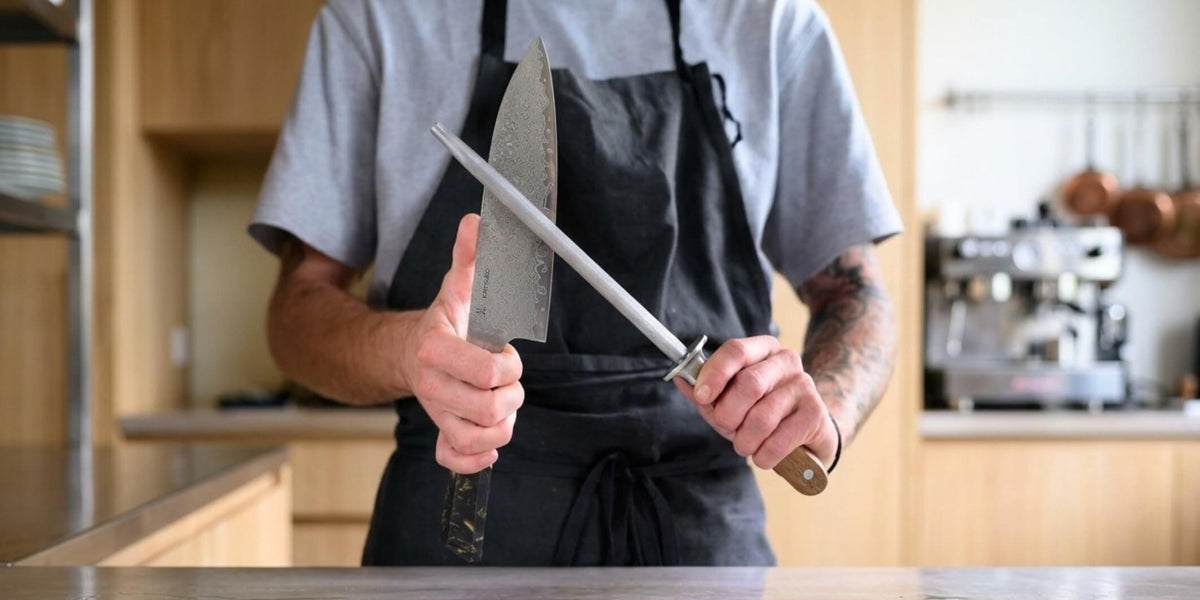
In the French dictionary, aiguiser and affûter are synonyms: in English, both simply mean to sharpen. Both refer to the action that makes a blade sharp by removing a little steel from it. Honing, affiler in French, is the word missing from most kitchens. In the dictionary, affiler means to give or restore the edge. In a workshop, the word refers to the action of the honing steel, which straightens an edge that is already formed without removing any metal. As for the burr, it is the thin lip of steel that forms along the edge during sharpening, and that must be removed for the knife to cut for a long time.
These four words come up on every product page for whetstones, honing steels and sharpeners, and they are very often misused, even by people in the trade. The result is well known. People run a worn knife over a honing steel thinking they are sharpening it, or buy a "sharpener" that sharpens nothing. The meaning of these words, their origin and the way we use them at Kaitsuko fit into a few paragraphs, before the question that really changes your sharpening: the burr.
| The word | What it means | The tool | What comes off the blade |
|---|---|---|---|
| Sharpening | Reforming the bevel of a worn edge | Whetstone, manual sharpener, sandpaper | A little steel, on each side of the edge |
| Honing | Straightening a rolled edge that is still in good condition | Honing steel, strop | Nothing, or almost nothing |
| Deburring | Removing the burr left by sharpening | Fine grit, strop, newspaper | A lip of metal thinner than a hair |
| Repairing, regrinding | Removing a chip, reshaping a tip or the geometry | Coarse-grit whetstone, workshop | A lot of steel |
Sharpening and honing: what the dictionaries say
The French dictionaries are clearer than you might think. The Larousse defines aiguiser as "to make a knife, an instrument, etc. sharp or pointed; affûter", and affûter as "to make the edges of a cutting tool sharp". The two verbs are therefore synonyms, and the first is simply the more common in everyday language. Affûter has kept a second meaning, "to set a cannon on its carriage", which tells the story of its origin. The word derives from fût, the wooden piece that holds a tool or a weapon. To affûter a tool first meant to prepare it, to make it ready for use, and the meaning of sharpening eventually won out.
Aiguiser, for its part, comes from Latin and belongs to the family of aigu, pointed. It says the same thing: to make pointed, to make sharp.
Affiler, the third verb, carries the useful nuance, and it corresponds to honing. The Larousse defines it as "to give an edge to a cutting tool after sharpening it". The dictionary of the Académie française says "to give or restore the edge". The word comes from the Latin filum, thread, which gave the French fil, the word cutlers use for the very ridge of the cutting edge. Affiler therefore means taking care of the edge, restoring or straightening it, once the bulk of the work is done.
The edge, in fact, is the key word in this whole vocabulary. A knife's cutting edge is a ridge more than a surface: the line where the two faces of the bevel meet. It is so fine that it deforms before it wears. A knife has a keen edge when this ridge is clean and straight. It loses its edge when the ridge rolls over, and it loses its sharpness when the ridge becomes rounded. Two different faults, which call for neither the same action nor the same word.
What cutlers say: three actions, and words that shift
In a workshop, nobody consults a dictionary, and the words are divided up according to the actions. There are three of them.
The first removes material. The edge is worn, rounded, and both faces of the bevel must be worn down until they meet again in a clean ridge. This is done on a whetstone, in a pull-through sharpener, on an abrasive belt or on a grinding wheel. Most French cutlers call this affûter, and the general public aiguiser. In English, both words mean the same action: sharpening.
The second removes nothing, or almost nothing. The edge is still good, but it leans. A few strokes on a steel or ceramic rod, the honing steel, bring it back into line. That is honing. The word has almost disappeared from everyday language, which is a pity, because it avoids the most common confusion in the kitchen: mistaking the honing steel for a sharpener.
The third is the finish. After sharpening, a lip of metal remains along the edge, the burr, and it must be removed. Cutlers call this deburring, or simply removing the burr, which is done on a very fine grit, on a strop or on newspaper.
These words shift between trades and regions. In a butcher's shop, people often talk about steeling for the honing steel, and grinding for a trip to the knife grinder. A cook often says sharpening for both. Some websites, and our own older French guides, swap affûter and aiguiser, giving the first the meaning of maintaining and the second that of removing metal. English splits the actions in its own way: to sharpen covers removing metal, to hone covers straightening the edge, and to strop covers the leather. It does not matter who wins the war of words, as long as you know which action your knife needs.
At Kaitsuko, we have made our choice for our product pages and guides. Sharpening means removing material, on a whetstone or in a sharpener. Honing means using the honing steel, which straightens the edge. When we write that a honing steel "does not sharpen", that is what we mean.
The vocabulary of the blade, from spine to edge
To follow a product page or a tutorial, a few more words are enough.
| The word | What it means |
|---|---|
| The edge | The ridge of the cutting edge, where the two faces meet. A blade is said to have an edge, or to have lost it |
| The cutting edge | The cutting side of the blade as a whole, from heel to tip |
| The bevel | The angled face on each side of the edge, the one you lay on the stone. A double-bevel knife has two, symmetrical on our blades, sometimes unequal on other brands |
| The sharpening angle | The tilt of a bevel relative to the axis of the blade, 15° per side on our Damascus steel blades, around 20° on a European knife |
| The micro-bevel | A second, tiny bevel at a slightly wider angle, cut right at the edge to strengthen it |
| The grind | The shape of the blade between spine and edge: flat, convex or hollow. It is set by grinding during manufacture, and sharpening does not change it |
| The spine | The thick edge opposite the cutting edge. It is what you raise to set the angle on the stone |
| The heel | The back of the cutting edge, near the handle. The stroke often starts there |
| The grit | The fineness of the abrasive on a stone or a sheet of paper. The higher the number, the finer it is |
| The burr | The lip of metal pushed over to the other side of the edge during sharpening |
Two of these words cause confusion. The sharpening angle, first, is sometimes given per side, sometimes in total. A knife advertised at 15° per side has a total angle of 30°, and two product pages showing "15°" and "30°" may describe the same blade. We cover this question in detail in our sharpening angle guide. The grind, next, is often confused with the bevel. The grind is the cross-section of the whole blade, shaped by grinding during manufacture. The bevel is the small face you touch up at every sharpening.
The burr: what it is, and why you need to remove it
When you sharpen one side of the blade on a stone, the abrasive wears the bevel down until it reaches the edge. At that point, it has no more material to wear on the opposite side, and the metal, instead of turning to dust, folds over onto the other face in a tiny lip, thinner than a hair. That lip is the burr. The French word for it, morfil, is made up of mort, dead, and fil, edge: a dead edge, which looks like an edge without having its staying power.
The burr is good news at first. It only appears when the stone has truly reached the edge, so it is the sign that one side is finished. Until it is there along the whole length of the blade, from heel to tip, the bevel has not been reformed, and there is no point turning the knife over. We make it the main reference point of our method for sharpening a Japanese knife on a whetstone, and it is better than any count of strokes.
It becomes a problem if you leave it. While it is there, the knife seems formidable, because the lip catches on everything it touches. It does not last. Within a few days it folds over to one side, or breaks off, and takes part of the edge with it. The knife seems to have gone blunt all at once, and people blame the stone or the steel. A sharpening that does not last comes from this far more often than from a bad stone.
How to feel the burr
Place the pad of your thumb on the side of the blade and slide it towards the cutting edge, perpendicular to the edge, never along its length. On the face opposite the one you have just worked, your finger catches on a rough lip. On the other, it slides. Check at three points: heel, middle and tip. A burr along the whole length means that side is finished.
You can also see it, in good light, as a shiny line right at the edge, slightly folded over. And you can hear it. A blade carrying a burr makes a tearing-paper sound when you slice a sheet, whereas a clean edge cuts silently.
How to remove the burr from a knife
The burr is removed by wear, never with a sharp jolt. The safest way is to wear it down on the finest grit you have, 3000 or higher. Five or six strokes are enough, switching faces with each pass and letting the blade bear only its own weight. The burr is pushed from one face to the other, smaller each time, until it comes away by itself.
A strop, or failing that a few sheets of newspaper folded flat on the table, finishes the job, with the blade drawn spine first, at the angle of the bevel, three or four times on each side. An old cutler's trick is to draw the edge, just once and without pressing, through a cork laid on the board, never held in the hand, or through the edge of a softwood board, to detach what is left. It works, but it takes a steady hand, and we prefer the strop on a thin Japanese blade, like those of our Damascus steel knives.
Two mistakes are common. The first is trying to remove the burr with the honing steel, with big, heavy strokes. On soft steel, that may work. On a 60 HRC steel, a steel honing rod risks breaking off the burr and taking a chip of the edge with it. The second is finishing on a coarse grit. A 400 or 1000 grit creates more burr than it removes, and the finish is always done on the finest grit you have.
The final test does not change: a sheet of paper held by the top, sliced from heel to tip, without a sound or a snag.

The vocabulary of tools
The vocabulary of tools follows that of the actions, and in the shops it is just as vague.
A sharpener refers to any tool that removes material at a guided angle, whether pull-through, roller or electric. The names on the packaging are interchangeable, and none of them guarantees that the tool respects the angle of a Japanese knife. The whetstone, or water stone when it is used wet, does the same job without a guide. The honing steel, whether it is sold as a sharpening steel or a honing rod, hones. The leather strop removes the burr and polishes the edge. We compare all these tools in our guide "What to Sharpen a Knife With?".
Two trade terms complete the picture. The knife grinder sharpens knives on a grinding wheel, once in the street, today at markets or in a workshop. The cutler makes and repairs knives, and sharpens them too. When you entrust a Japanese knife to either of them, the words that matter are the angle, 15° per side, and the finishing method, preferably on a whetstone.
Stones have their own lexicon. A water stone is soaked or wetted before use, an oil stone is lubricated with oil, and the two should not be mixed. The grit, 400, 1000, 3000, gives the fineness of the abrasive. A diamond stone is in fact a steel plate coated with industrial diamond, which never dishes. A flattening stone is used to flatten a stone that has been hollowed out by use. Finally, polishing compound, sometimes sold with a strop, is an abrasive so fine that it gives the edge a mirror polish. You will find most of these tools among our whetstones, honing steels and sharpeners, with the action each one is for stated on its product page.
Why these words matter in your kitchen
This vocabulary is no affectation, since it decides what you do to your knife.
If you confuse honing and sharpening, you run a knife with a worn edge over the honing steel ten times, twenty times, and the sharpness does not come back. The honing steel can do nothing for an edge that no longer exists. Conversely, you take out the whetstone for an edge that has merely rolled, and you remove metal for nothing. The question to ask is always the same: is the edge rolled or worn? A few strokes on the honing steel, then the tomato test, will answer it. These checks are described in detail in our article on how often to sharpen a knife.
If you ignore the burr, every sharpening disappoints you after three days, and you end up sharpening too often, and so wearing the blade down faster than you should.
Without these reference points, a product page is easily misread. People buy a "sharpener" for the daily maintenance of a Japanese blade, which needs a ceramic honing rod or a fine grit instead. Or they buy a "sharpening steel" to revive a dull knife, which needs a whetstone. That is why our product pages state, for each tool, the action it performs. Our wooden-handle honing steel, for example, is presented as a honing tool, because that is what it is.
On a Japanese knife, the distinction is even clearer. A 60 HRC steel, like that of our Damascus steel knives and the Kaito range, barely rolls. Its edge wears, or it chips. So there is little to hone and a lot to protect, and the steel honing rod is used sparingly. The action that matters for it is sharpening on a whetstone, infrequent and careful, followed by a properly removed burr. On our Chef Tanaka range, in 5Cr15MoV steel at around 54 HRC, the edge rolls like that of a European knife, and the honing steel comes into its own again, once or twice a week.
Four situations, four words
To finish, here is what these words mean in front of a cutting board.
Your new knife cuts slightly less well after three weeks, even though its edge shows no defect in the light. The edge has rolled. It needs honing: a few light strokes on the honing steel for a soft steel, a few strokes on a fine grit for a hard blade. It takes ten seconds, and we describe it in our guide on how to use a honing steel.
If the blade slides over a tomato's skin and the honing steel makes no difference, the edge is worn. Time for the whetstone, 1000 grit until you raise a burr, then 3000 grit. Whatever word you use, that is the action.
A knife sharpened yesterday that cut like a razor and is tearing paper this evening has kept its burr, and that burr has just folded over. A few alternating strokes on the fine grit, then on the strop, are enough, without redoing the whole sharpening. Cutlers would say it still needs deburring.
That leaves the knife that always catches in the same place, with a spot shining on the edge under the lamp. The edge is chipped. No honing steel and no fine grit will do anything about it. The edge must be reground on a coarse grit, which we explain in our article on chipped Japanese knives, or the blade entrusted to a workshop.
Knowing how to recognise these four situations avoids most unnecessary sharpenings, and almost all failed ones.

FAQ: sharpening, honing and the burr
What is the difference between aiguiser and affûter?
None in the dictionary. Both French verbs mean making a blade sharp by wearing down its bevel, on a whetstone or in a sharpener: in English, sharpening. Affûter is the cutlers' word, aiguiser everyone else's. At Kaitsuko, we use them interchangeably and reserve affiler, honing, for the action of the honing steel.
What does honing a knife mean?
Straightening its edge without removing metal. A knife's edge rolls over with use, especially on soft steel, and a few light strokes on a honing steel set it straight again. Honing maintains an edge that is still good. When the edge is worn, you need to sharpen.
Does a honing steel sharpen a knife?
No, it hones it. A steel or ceramic honing rod straightens a rolled edge and does not reform a worn edge, because it removes almost no metal. Only the diamond honing rod abrades steel, and it is then used like a sharpener, in moderation.
What is the burr on a knife?
A very thin lip of metal that forms on the other side of the edge during sharpening, when the abrasive reaches the ridge. It proves that the side is finished. It must then be removed, otherwise it folds over or breaks off within a few days and takes the edge with it.
How do you remove the burr from a knife?
With alternating, very light strokes on a fine grit, one per side, five or six times, then a few strokes on a strop or newspaper, with the blade drawn spine first. Never with big strokes on a honing steel on a hard blade, which could chip.
How do you know if a knife has a burr?
By running the pad of your finger from the spine towards the cutting edge, never along the edge. Your finger catches on the face opposite the one you have just sharpened. The burr can also be seen under a lamp, as a shiny line right at the edge, and heard as a tearing sound when you slice a sheet of paper.
Affûtage or aiguisage: which is the right word?
Both. Affûtage and aiguisage refer to the same operation, removing a little steel on a whetstone or in a sharpener to reform the edge: in English, sharpening. Affûtage is more common among professionals, aiguisage in kitchens. A Japanese Damascus steel knife is sharpened the same way, whichever word you use: on a whetstone, at 15° per side.
What is the difference between honing and sharpening?
Sharpening removes steel to rebuild a worn edge, on a whetstone or in a sharpener. Honing removes nothing: a few strokes on the honing steel straighten an edge that is still good but has rolled. You hone often, every week on soft steel, and you sharpen a few times a year, when the honing steel no longer brings back the knife's bite.
How Often Should You Sharpen a Knife, and How Do You Know It's Time?