



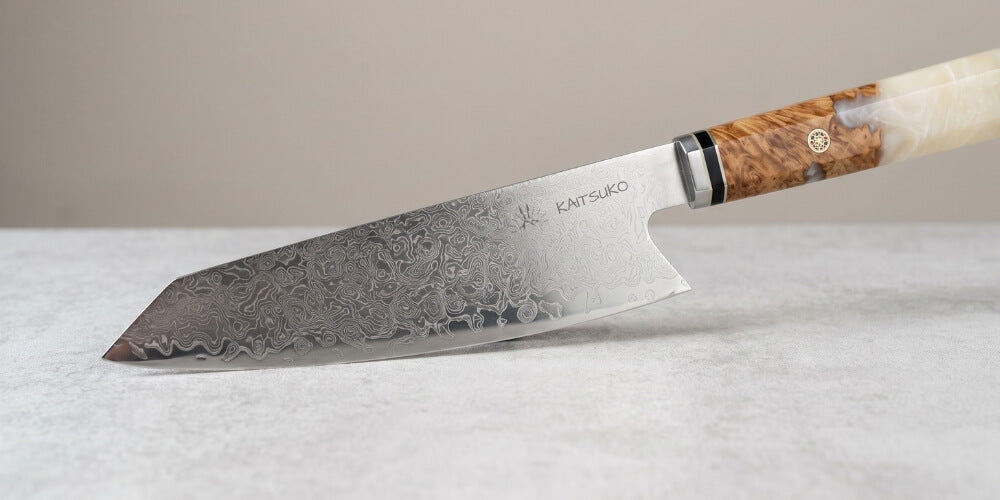
On most of our product pages, you'll find a mention like "58–60 HRC" or "53–54 HRC" next to the steel type. It's one of the questions we receive most often: what does this number actually mean, and does a higher HRC automatically mean a better knife?
The short answer: no, not automatically. This article explains what HRC actually measures, how to interpret it on a product page, and why the hardest knife isn't always the right choice.
What Is HRC, Concretely?
HRC stands for Hardness Rockwell C — hardness measured on the Rockwell scale, in its C variant. This scale is the industry standard for evaluating the hardness of hard steels, such as those used in knife-making.
The measurement principle is simple: a diamond cone is pressed into the steel under a precise and standardised load, then the depth of the indentation left is measured. The smaller the indentation, the more the steel resists deformation, and the higher the HRC. It's a reproducible physical measurement, not a marketing argument.
On kitchen knives, common values range from around 53 HRC for robust entry-level steels, to over 62 HRC for top-end Japanese steels like Aogami or Shirogami. At Kaitsuko, our collections cover a range from 53–54 HRC (Chef Tanaka) to 58–60 HRC (our Damascus steel collections like Yakumoto and Kyoto).
| HRC Range | Typical Steel Type | Characteristics |
|---|---|---|
| 53–56 HRC | Entry-level stainless steels (e.g. 5Cr15MoV) | Robust, easy to resharpen, forgiving of mistakes |
| 56–58 HRC | Mid-range stainless steels | Good sharpness / maintenance compromise |
| 58–60 HRC | Damascus steels, VG10 and equivalents | Lasting edge, requires slightly more care |
| 60–64 HRC | Premium Japanese carbon steels (Aogami, Shirogami) | Exceptional sharpness, shock-sensitive, demanding maintenance |
What HRC Actually Changes in Use
A higher HRC concretely means two things: the blade holds its edge longer between sharpenings, and it resists progressive wear better. A steel at 60 HRC can hold its edge approximately twice as long as a steel at 54–56 HRC under comparable use.
But that hardness comes at a cost. The harder the steel, the more brittle it becomes under lateral shocks: a bone, a drop, a too-hard board can chip a high-HRC blade more easily than a more moderate one. It's also harder to resharpen yourself, because you need a suitable grit stone and a little more patience to restore the original edge.
That's exactly why we never recommend the highest HRC by default. The right choice depends on your actual use, not just the number displayed.
How to Read HRC on a Product Page
When you see an HRC mention on a product page, here's how to interpret it quickly according to your profile.
If you're a beginner or want an easy-to-live-with daily knife, a range of 53 to 56 HRC is more than sufficient. It's the choice we systematically recommend for a first Japanese knife, as explained in our beginner's guide.
If you cook regularly and want an edge that lasts longer without frequent resharpening, a range of 58 to 60 HRC, like our Damascus steel collections, is a good compromise between performance and ease of maintenance.
If you're an experienced cook or enthusiast ready to invest time in care, steels above 60 HRC offer remarkable sharpness, but demand real discipline: suitable board, precise sharpening, careful handling.
Common Misconceptions About HRC
Over the years, we encounter the same confusions with buyers discovering this concept.
| Misconception | Why it's inaccurate | What to remember |
|---|---|---|
| "The higher the HRC, the better the knife" | Quality also depends on geometry, forging and intended use | HRC is one criterion among several, not an overall score |
| "A high HRC means a more solid knife" | A harder steel is often more brittle under shocks, not more solid | Hardness and shock resistance are two different things |
| "A knife's HRC never changes" | Repeated incorrect sharpening or accidental overheating can alter it locally | Careful maintenance preserves the steel's original properties |
| "All Damascus steels have the same HRC" | HRC depends on the core steel used in forging, not the visual pattern alone | Always check the HRC value specified on the product page, not just the word "Damascus" |
Why Two Knives with the Same HRC Don't Behave the Same Way
HRC is only part of the equation. Two knives displaying exactly the same HRC can behave very differently depending on the blade's sharpening angle, its thickness and the quality of the heat treatment applied during manufacturing. That's why at Kaitsuko, we always emphasise the overall coherence of a blade rather than a single isolated number. Furthermore, all our blades, across every collection, undergo a heat treatment resulting in a martensitic structure: this step is what gives the steel its final hardness and guarantees consistent performance from one blade to another, regardless of the HRC displayed.
Concretely, this means that a well heat-treated and well-sharpened 54-HRC steel can be more than adequate for demanding daily use, while a poorly maintained 60-HRC steel will lose its edge faster than expected.
FAQ – The Most Common Questions About HRC
What is the best HRC for a kitchen knife? There is no universally best HRC. For normal home use, 53 to 58 HRC is an excellent compromise. For more demanding use with regular maintenance, 58 to 62 HRC offers more lasting sharpness.
Does a high HRC mean the knife will never chip? No — in fact, quite the opposite in general: the harder the steel, the more sensitive it becomes to lateral shocks. A high HRC requires more careful use, not less.
How do you know if the HRC stated on a product page is reliable? Check that the brand specifies both the steel type and the HRC value, ideally with a realistic range (e.g. "58–60 HRC" rather than a single invariable number, since slight variations always exist from blade to blade).
Is HRC the only criterion to look at before buying a knife? No. Sharpening angle, blade thickness, handle balance and intended use matter just as much. HRC gives an indication of edge retention, not the knife's overall quality.
Is a low-HRC knife a bad knife? Not at all. A well-designed 53–54 HRC steel, like our Chef Tanaka collection, remains an excellent choice for daily use, particularly for beginners who want a knife that's easy to maintain and resharpen.
In Summary: What to Remember About HRC
HRC measures the hardness of a steel, not its overall quality. The higher it is, the longer the edge lasts — but the more care and appropriate maintenance the blade requires.
For unconstrained daily use, a range of 53 to 58 HRC is more than sufficient. For a more lasting edge with more attentive maintenance, move towards 58–60 HRC. Beyond that, it's a choice reserved for enthusiasts ready to invest in caring for their blade.
And above all: never choose a knife based solely on an HRC number. Look at the full product page, the intended use, and if possible the experience of other customers with that specific model. If you're just starting out with your first Japanese knife, our dedicated guide will help you make the right overall choice.
Discover our Japanese Damascus steel knife collections.
This article draws on the concrete experience of the Kaitsuko team: 5 years of activity, over 100,000 knives sold across France and Europe, and daily conversations with our customers about the technical characteristics of our blades. Our product pages systematically indicate the HRC range of each collection.
Updated 19 June 2026 - Written by the Kaitsuko team, after 5 years of crafting and selling nearly 500,000 Japanese knives across France and Europe.
How We Design a Japanese Knife: From Idea to Your Kitchen
Japanese Knives for Left-Handed Cooks: Which to Choose?