



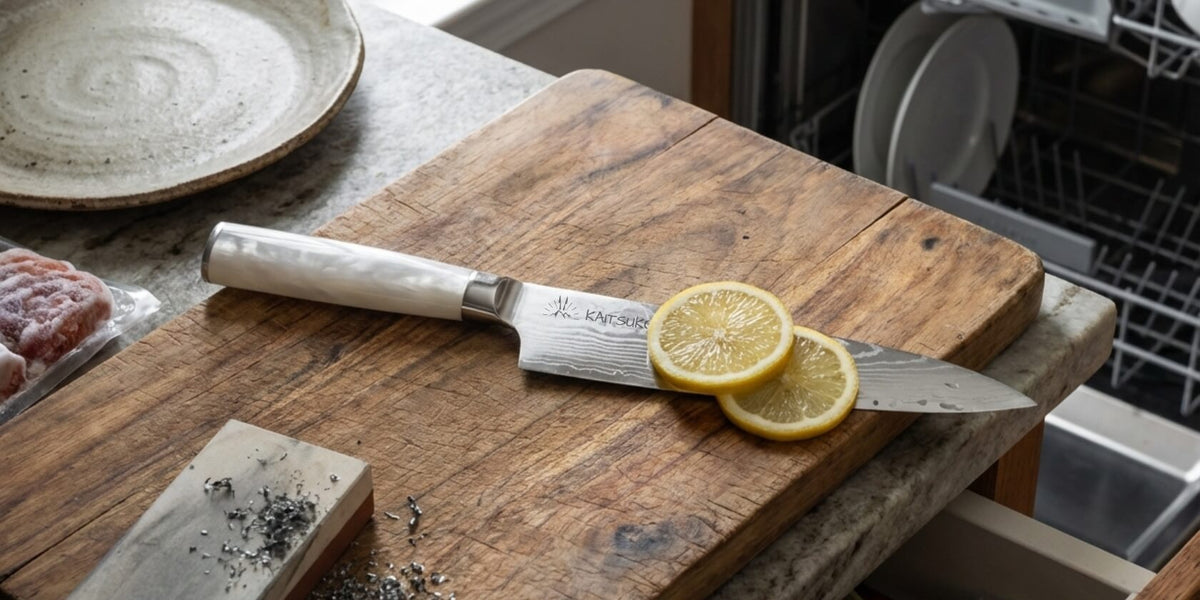
A well-designed Japanese knife can deliver an exceptional cutting experience. Thanks to their fine geometry and high-carbon steels, these blades are capable of reaching a level of precision that is hard to match.
But this performance relies on a delicate balance.
A Japanese knife typically has a very fine sharpening angle - often between 10 and 15 degrees. This fineness allows for a clean, precise, and fluid cut. However, it also means the blade must be used and maintained correctly.
In most cases, a knife doesn't lose its edge because of its steel or manufacturing quality. It loses its edge because of bad usage habits.
Some mistakes, very common in home kitchens, can dull a blade in just a few weeks.
Here are the seven most frequent mistakes and simple ways to avoid them.
1. Using the Wrong Cutting Board
The surface you cut on plays a huge role in how long your edge lasts.
Some surfaces are extremely hard: glass, marble, granite, or ceramic. These materials may look elegant, but they are brutal on fine blades.
With every cut, the blade strikes a surface almost as hard as the steel itself. The knife's edge dulls much faster as a result.
To preserve a Japanese knife, it's best to use a wooden cutting board or a suitable composite board. These materials slightly absorb the blade's impact and protect the edge.
2. Putting Your Knife in the Dishwasher
This is probably the most destructive mistake.
The dishwasher combines several highly aggressive factors: heat, prolonged moisture, and powerful chemicals. These conditions can damage the blade, the handle, and even the knife's edge.
For Japanese knives made from high-carbon steels or Damascus structures, these conditions are particularly harmful.
A quick hand wash with warm water and immediate drying is more than enough.
3. Cutting the Wrong Foods
A Japanese knife is not designed to do everything.
Some people use their kitchen knife to crack bones, cut frozen products, or open rigid packaging. These uses can create microscopic chips in the blade's edge.
Japanese knives are designed for clean, precise cuts — particularly on vegetables, boneless meat, or fish. For tougher tasks, it's better to use a more robust knife.
4. Using Poor Cutting Technique
The way you cut has an enormous influence on edge wear.
Some gestures - like slamming the board or pivoting the blade on its edge - can damage the edge very quickly.
Japanese knives are designed for smooth, controlled cutting, with a natural back-and-forth motion. This technique not only produces a cleaner cut, but also preserves the edge much longer.
5. Neglecting Sharpening
Many people wait until their knife is completely dull before thinking about sharpening. That's a mistake.
A well-maintained knife should be sharpened regularly, before the edge becomes too worn.
Whetstones allow you to restore the edge very precisely and maintain the blade's optimal angle. Japanese knives using high-carbon steels or Damascus structures respond particularly well to whetstone sharpening.
6. Storing Knives Carelessly
A knife left loose in a drawer almost always ends up damaged.
Repeated knocks against other utensils can damage the edge and cause small deformations.
To protect a blade, it's best to use a knife block, a magnetic bar, or a blade guard. These solutions preserve the edge while keeping knives easily accessible.
7. Leaving the Blade Wet
Prolonged moisture can cause oxidation, especially on high-carbon steels.
Even if some modern Damascus structures offer better resistance, it's always best to dry the blade immediately after washing. This simple habit preserves the blade and prevents rust from forming.
Why Japanese Knives Require a Little More Care
If Japanese knives are renowned for their precision, it's largely thanks to their design.
The blades are generally thinner, harder, and sharpened at more precise angles than traditional Western knives. High-carbon steels and Damascus steel structures allow for an extremely high-performing edge.
But this performance also calls for appropriate use. Fortunately, the habits required are simple and quickly become second nature.
Conclusion
A good Japanese knife can maintain a remarkable edge for a very long time.
The key lies above all in how you use and care for it.
By avoiding a few simple mistakes - wrong cutting boards, dishwashers, rough cutting techniques - it's possible to preserve a blade's performance for years.
And when a knife is crafted from premium high-carbon steel or a Damascus structure, that extra attention is richly rewarded by an exceptional quality of cut.
Knife Sets vs. Individual Knives: The Ideal 3-Knife "Capsule" in 2026
Rust on a Blade: the 7 Safe Methods to Remove It (and the Ones to Absolutely Avoid)