



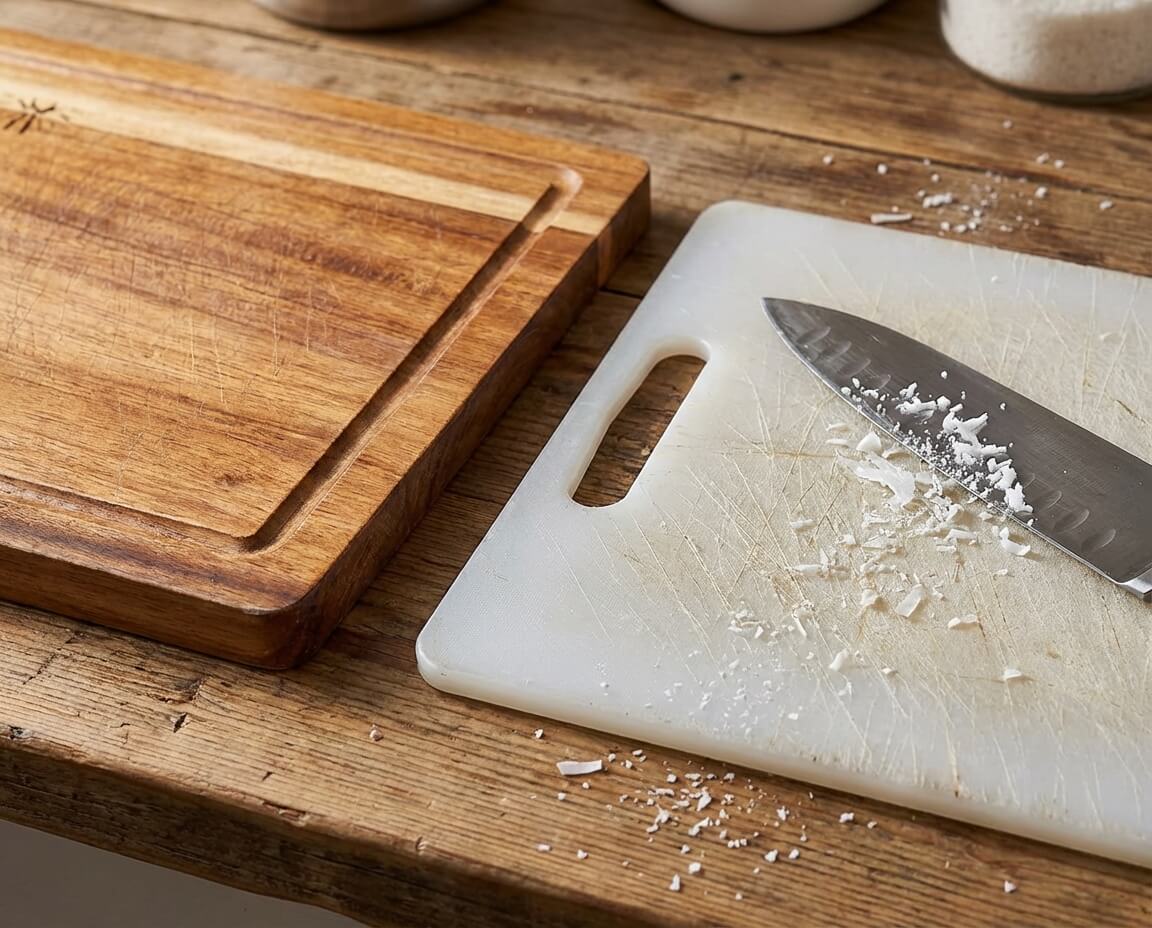
For a long time, the question was never even asked. In many kitchens - both professional and domestic - the plastic cutting board was considered the most practical and hygienic solution. Easy to clean, resistant, available everywhere… it seemed to tick all the boxes.
But over the past few years, a new topic has shaken this certainty: microplastics.
These microscopic particles resulting from the degradation of plastic are now detected almost everywhere: in water, in the air, in certain foods, and even in our bodies. This discovery has pushed many people to look more closely at their everyday objects - including the cutting boards used in the kitchen.
So the question deserves to be asked seriously: should you really stop using plastic cutting boards in 2026?
As is often the case in cooking, the answer is neither black nor white. It depends above all on how you use your tools and the type of material you choose.
Why plastic cutting boards were long recommended
To understand the current debate, we need to go back in time. If plastic cutting boards dominated for decades, it was not by chance.
In professional kitchens, they offer several very concrete advantages.
First, they are easy to clean. Unlike wood, they generally withstand dishwashers and powerful disinfectants. In an environment where hygiene is crucial - particularly for handling raw meat or fish - this is an important argument.
Next, they are inexpensive and easy to replace. A kitchen can use several of them, sometimes with a colour code (red for meat, blue for fish, green for vegetables). This organisation simplifies work enormously.
Finally, they are uniform and standardised. Unlike some handcrafted wooden boards, their behaviour is very predictable.
For a long time, these advantages were enough to make them the default choice.
But one dimension was much less discussed at the time: the wear of plastic over time.
The real problem with plastic cutting boards: wear
If you look at a new plastic cutting board, it appears perfectly smooth. But after a few months of use, its appearance changes quickly.
Marks appear. Grooves deepen. The surface becomes whitish and rough.
These marks are visible proof of a simple phenomenon: the material wears down with every pass of a blade.
Every time you cut a vegetable, a fruit or a piece of meat, the knife removes a tiny amount of material. On a single cut, this amounts to almost nothing. But over thousands of repeated movements, the wear becomes obvious.
It is precisely in this context that the question of microplastics began to be raised.
Because if the board loses material, where does it go?
In most cases, these particles are too small to be visible. They can be eliminated during cleaning, but some can also remain on the surface of the board or mix with food during cutting.
This does not mean that every meal suddenly becomes dangerous. But it explains why more and more cooks - amateur and professional alike - are looking for alternatives.
Scratches: a second often forgotten problem
The grooves created by knives do not only raise a question of wear.
They also raise a real hygiene question.
A deeply scratched board becomes harder to clean properly. Food residues can lodge in the micro-crevices and resist washing, especially if the board is used intensively.
This is why many professional kitchens consider plastic boards as consumable material. When they become too marked, they are simply replaced.
In a domestic kitchen, this practice is much less common. People often keep a board for years, even when it is very worn.
And it is generally in these situations that problems arise.
The comeback of wooden boards
Faced with these limitations, many cooks are today rediscovering wooden boards.
Contrary to popular belief, wood can be very hygienic when properly maintained. Several studies have shown that certain wood species even possess natural antibacterial properties.
But the real advantage of wood lies elsewhere: its relationship with the blade.
Wood is a slightly softer material than hard plastic. When a knife penetrates the surface, the fibres can partially close again after the cut. This limits deep marks and makes the surface more durable.
It is also excellent news for your knives.
Why the cutting board directly influences a knife's edge
Many people think that the quality of a knife depends solely on its steel or its sharpening.
In reality, the cutting surface plays an enormous role.
A Japanese knife, for example, often has a very fine sharpening angle - generally around 10 to 15 degrees. This angle allows for an extremely clean and precise cut.
But the finer an edge is, the more sensitive it is to hard surfaces.
Cutting regularly on a board that is too rigid can blunt the blade much faster. In some cases, it can even cause tiny chips invisible to the naked eye.
This is why the cutting board is an integral part of the system.
If you want to preserve the edge of your knives for a long time - particularly those in your collection - it is essential to choose a suitable surface.
Wood, plastic, composite: which board to choose today?
In 2026, the debate is no longer limited to a simple duel between wood and plastic.
Several types of boards now exist, each with their advantages.
Solid wood boards remain very popular for their gentleness with blades and their durability.
Thick plastic boards retain an advantage for intensive cleaning and rotation in the kitchen.
Finally, some modern composite boards seek to combine both worlds: a relatively knife-friendly surface, but more stable and moisture-resistant than traditional wood.
The best solution often depends on your usage.
The smartest approach: using two boards
Many chefs today use a very simple solution: two different boards.
A main board, generally made of wood or soft material, is used for vegetables, fruits or herbs.
A second board, often plastic, is reserved for more sensitive foods such as raw meat or fish.
This organisation allows you to enjoy the advantages of both materials without suffering their drawbacks.
And above all, it protects the knife edge much better.
Some common mistakes to avoid
In the kitchen, certain habits can accelerate the wear of boards and knives.
The first is keeping a plastic board for too long. When it is deeply scratched, it is often better to replace it.
The second mistake is using completely unsuitable surfaces such as glass, marble or ceramic. These materials are extremely hard and can damage an edge within minutes.
Finally, many people simply neglect maintenance: a damp, poorly dried or poorly cleaned board can quickly develop odours or deteriorate.
Simple, regular maintenance is enough to significantly extend the lifespan of the equipment.
Should you stop using plastic cutting boards completely?
The honest answer is no.
Plastic cutting boards are not inherently bad. They remain very useful in certain situations, particularly for their ease of cleaning.
But they must be used thoughtfully.
A heavily worn plastic board is no longer ideal either for hygiene or for cutting. Conversely, a quality board used correctly and replaced regularly can remain perfectly acceptable.
The key is to understand that the cutting board is a tool in its own right, just like a knife or a sharpening stone.
What to remember
In 2026, the question of microplastics has simply brought to light an essential point: kitchen equipment wears out and must be chosen intelligently.
The best choice often consists of combining several tools:
• a soft board to preserve the knife edge • a more practical board for certain preparations • regular maintenance and replacement when necessary
This simple approach allows you to cook in good conditions while extending the life of your knives.
And when using precision blades, like those in the Kaitsuko collection, choosing the right cutting surface becomes almost as important as the knife itself.
Why the sharpening angle matters more than the price
Knife Sets vs. Individual Knives: The Ideal 3-Knife "Capsule" in 2026