

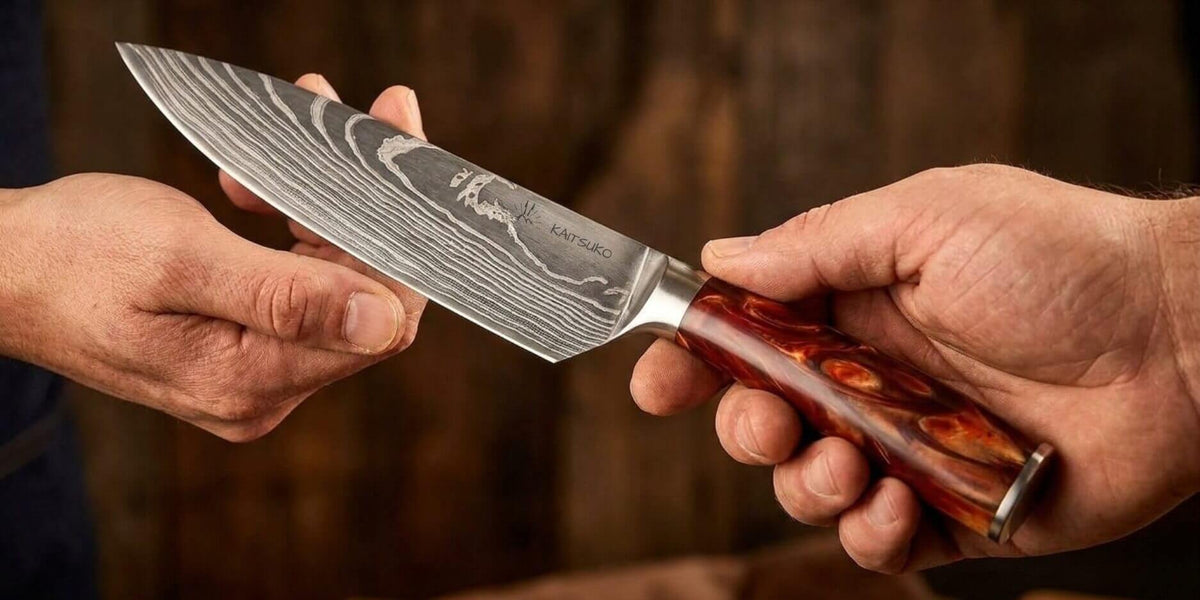
You can have your knives sharpened at a cutlery shop, by a knife grinder at a market or at home, or by sending them by parcel to a workshop. According to the price lists that sharpeners in France and Belgium publish online, collected in October 2026, a kitchen knife with a plain blade costs between €3 and €8 to sharpen on a machine. A Japanese knife costs between €6 and €18, and work on a whetstone between €15 and €30. A broken tip can be repaired for €5 or less, a badly damaged blade for €12 to €35.
Price does not tell the whole story; the method matters at least as much. A grinding wheel or an abrasive belt set at 20° restores the edge of a European knife in a minute, and can ruin the 15° bevel of a Japanese blade. At Kaitsuko, we do not offer a sharpening service, so we have no workshop to recommend to you out of self-interest. This guide tells you where to go, what it costs and what to ask the craftsman.
| Where | How they work | Price per kitchen knife | Turnaround | For which knives |
|---|---|---|---|---|
| City cutlery shop | Grinding wheel, belt or whetstone, depending on the workshop | €3 to €10 on a machine, €15 to €30 on a whetstone | Same day to one week | All, including repairs |
| Knife grinder at a market or on a round | Wet grinding wheel or belt, on the spot | €2.50 to €8 | On the spot, in a few minutes | Everyday knives, serrated knives |
| Mobile sharpener (home visits) | Same machines, in their vehicle | Same prices, with a minimum charge of €25 to €80 or travel charges | By appointment | Mainly professionals and large batches |
| Mail-in workshop | Machine or whetstone, depending on the workshop | Same prices, plus shipping costs | Returned a few days after receipt, within 24 to 48 hours at some | Handy far from towns, ideal for a blade to entrust to a specialist |
| Cobbler, shoe repair and key-cutting shop, store department | Small slotted or belt machine, fixed angle | A few euros | Immediate | Sturdy soft-steel knives, not Japanese blades |
The five ways to get your knives sharpened
The local cutlery shop is the first instinct, and often the right one. Many have a workshop at the back of the shop, or work with a sharpener to whom they hand over blades one or two days a week. Some offer two services, a quick machine sharpening and a whetstone sharpening, longer and more expensive, reserved for fine blades. Ask which one you are being offered before leaving your knife.
The knife grinder is the heir to an old trade, that of the craftsman who reground blades on a grinding wheel in the street. Today they work at markets, from a converted van or on rounds of the villages, with a wet grinding wheel or an abrasive belt. They sharpen on the spot, in a few minutes, for a few euros per blade, and are happy to take bread knives, scissors and food processor blades. Most knife grinders display a price list by blade length, and some have a separate line for Japanese knives, while others take them at the same rate.
The mobile sharpener comes to your home with the same equipment. You pay for the trip, with a minimum charge of €25 to €80 depending on the craftsman and the distance. In practice, this service is aimed mainly at restaurants, butchers and households with a lot of blades to hand over at once.
The mail-in workshop receives your knives by parcel and generally sends them back within a few days, within 24 to 48 hours at some. The prices are the workshop's own, plus shipping costs, sometimes in both directions. It is the solution for areas where no sharpener comes by, and the one we recommend for a precious blade, because it lets you choose a workshop that works on a whetstone, wherever it is.
That leaves cobblers, key-cutting counters and the departments of some stores, which offer a pass through a small machine. It is quick and cheap, and perfect for a table knife or a soft-steel paring knife. The angle is fixed, often close to 20°, and the abrasive aggressive. We advise against these machines for a Japanese knife or a Damascus steel blade, as they reopen the bevel and can chip the edge.
Finding a sharpener near you
Sharpeners are numerous, but not very visible, and many work without a shop. Three leads give good results.
A local search, with the words "knife grinder", "knife sharpener" or "knife sharpening" followed by the name of your town, on a search engine or a maps app, already yields a lot. Itinerant craftsmen generally publish their market calendar and their price list there. The nearest cutlery shop is another lead, even if it only sells pocket knives, as almost all of them sharpen or know someone who does. The safest is to ask a local butcher, fishmonger or cook who looks after their knives. Professionals know who does good work, and a knife grinder who comes by a butcher's every week often accepts knives from private customers.
In Paris as in other large cities, there is no shortage of choice and you can compare methods, and prices there stay within the ranges in this article. In a village, the travelling knife grinder is often the only option, on a fixed date each month. Everywhere, the mail-in workshop remains the fallback option and, for a Japanese knife, the best way to find someone who works on a whetstone.
How much does it cost to sharpen a knife? Prices item by item
The ranges below come from the price lists published online by seven sharpeners based in several regions of France and in Brussels, collected in October 2026. Some are shown excluding tax, in which case add 20%, and the oldest dates from 2022. Take them as orders of magnitude, and ask for the current price before handing over your blades. Prices are per knife, and they vary first with the length of the blade.
| Service | Observed range |
|---|---|
| Paring knife or table knife | €2.50 to €5 |
| Kitchen knife of 15 to 25 cm, plain blade | €3.50 to €8 |
| Long blade, over 25 cm | €4.50 to €10 |
| Japanese knife, on a machine | From the standard price to €18 for a 20 cm blade, as a flat rate by length or per centimetre. Beyond 20 cm, a per-centimetre price exceeds €20 |
| Japanese knife or fine blade, on a whetstone | €15 to €30 |
| Bread knife or serrated blade | €6 to €15 |
| Broken tip | Free with the sharpening at some, €5 at others |
| Badly damaged blade, reworking the edge or the geometry | €12 to €35, often on quotation |
| Flat rate for 5 knives | Around €24 |
| Flat rate for 10 knives | Around €49 |
| Home call-out | A minimum charge of €25 to €80 depending on the craftsman, or travel charges of €10 to €40, charged mainly to professionals |
| Postal shipping | Workshop price plus postage, at your expense |
Four things push up the bill. Almost all sharpeners charge by length, in centimetre bands. A serration is reworked tooth by tooth, and a bread knife generally costs more than a plain blade, up to double at some workshops. Whetstone sharpening weighs even more heavily, because it takes far more labour time than a pass on a machine, and it costs three to five times as much. Then there is the condition of the blade. A simply worn edge is restored at the base rate, a deep chip or a broken tip counts as a repair.
In the other direction, numbers bring the price down. Flat rates for 5 or 10 knives exist, as well as discounts from around fifteen blades, and a market knife grinder does not charge for travel.
Knives some sharpeners refuse
Before you set off, be aware that not all blades are accepted everywhere. Ceramic knives require a diamond abrasive and are only taken by some workshops, often for a surcharge. Serrated steak knives are sometimes refused, because the time spent on their fine serration is not profitable, and some sharpeners decline single-bevel knives because they are not used to them. A bent blade, a broken tang or a loose handle are a job for a cutler; the knife grinder does not have the tools for that. A phone call before your visit saves you a wasted trip.
Getting a Japanese knife sharpened: machine, belt or whetstone?
A sharpener has three families of tools, and not all of them suit every blade.
The wet grinding wheel turns slowly in a water trough that cools the steel. It removes metal quickly, at an angle the sharpener holds by hand, and leaves an even edge, often finished on a leather wheel. Handled well, it suits a Japanese knife. Handled badly, it opens the bevel to 20° or rounds the tip.

The abrasive belt, mounted on a backstand, is the most common tool in workshops. It is fast and versatile, and gives a slightly convex edge that holds well. Its weak point is heat. A belt running fast without water cooling heats the edge in a few seconds, and steel that has turned blue has lost its temper. A good sharpener works in short passes, dips the blade in water between passes and checks the temperature with a finger.
Finally, the whetstone is the slow method. The sharpener reproduces by hand what we describe in our article on sharpening a Japanese knife on a whetstone, with experience on top. It respects the original angle, does not heat the steel and gives the finest edge. It is also the most expensive, and not every workshop offers it.
The method matters little on a soft-steel blade, but it decides the result on a Japanese knife. Our Damascus steel blades have a core of 10Cr15CoMoV steel, and our Kaito range is made from the same steel. In both cases, around 60 HRC and a symmetrical double bevel at 15° per side. This hard steel copes poorly with the heat of a dry belt and the coarse abrasive of a slotted machine, and its fine bevel disappears if it is reground at 20°. Our Chef Tanaka range, in 5Cr15MoV steel at around 54 HRC, is more forgiving and copes with a well-adjusted wet grinding wheel. If in doubt, the instruction note you enclose with the knives can simply say "Kaitsuko knives, double bevel, 15° per side, whetstone finish".
What to ask the sharpener before entrusting them with a Japanese knife
A few questions are enough, and a good professional answers them without taking offence.
The first concerns the angle. Say that you want to keep the original one, 15° per side on a Japanese blade. A sharpener who tells you they "put everything at 20°" will sharpen your European knives very well, and you will entrust the others to someone else.
The second concerns the finish. The right answers are the whetstone or a fine belt under water cooling. If you are told about a dry grinding wheel, take your knives back. Also ask whether the workshop removes the burr, the thin lip of metal left by sharpening which, if forgotten, makes the edge go in a few days.
Finally, point out anything particular about your blade. A single-bevel knife, such as a yanagiba or a deba, is sharpened almost entirely on one face, the other being only lightly passed flat on the stone, and it needs a workshop that knows these blades. A Damascus steel knife must not be polished on its sides, or the pattern may fade. Our article on the sharpening angle will give you the reference points to discuss it with them.
A good habit is to photograph the blade before handing it over, face-on and in profile, and to note its length. When you collect it, you will know whether the tip has been shortened or the angle changed.
Getting knives sharpened or sharpening them yourself: the maths
The calculation is worth doing once. A family kitchen generally has three knives that really get used: a chef's knife or a santoku, a paring knife and a bread knife. The first two are sharpened two to four times a year, the third once every two or three years. At a sharpener's, at €5 to €8 per plain blade on a machine, that comes to €20 to €60 a year, not counting the trips. On a whetstone, three to five times more.
A double-sided whetstone in 1000 and 3000 grit costs around €60, a manual sharpener with diamond slots around €40, and both last for years. The whetstone pays for itself in one to three years, and it has an advantage the price does not show. You sharpen when the knife needs it, without waiting to pass by the cutlery shop, and a blade maintained in time needs less metal removed each time.
The professional nevertheless keeps three areas where they remain the right choice. Repairs first of all, a deep chip, a broken tip, a bevel deformed by years of passes through a cheap sharpener, which we cover in detail in our article on repairing a chipped Japanese knife. Serrated blades too, starting with the bread knife, whose maintenance requires specific tools. And the blades you do not want to learn to sharpen, a single-bevel knife or a restaurant's full set of knives.
| Your situation | The right choice |
|---|---|
| Two or three kitchen knives, routine maintenance | The whetstone or a manual sharpener, at home |
| A bread knife, scissors | The sharpener, once every two or three years |
| A chip, a broken tip, a deformed bevel | The sharpener, on a whetstone or a wet grinding wheel |
| A block of ten knives and no time | A flat rate with a knife grinder, then maintenance with the honing steel |
| A single-bevel Japanese knife | A specialist workshop, by post if need be |
| A Damascus steel Japanese knife, worn edge | The whetstone at home, or a workshop that works on a whetstone |
We compare tools for sharpening at home, their prices and their limits, in our guide "What to Sharpen a Knife With?".
Between two visits to the sharpener
Whatever option you choose, most of the work is done at home, between two sharpenings. A maintained edge lasts for months, a neglected edge calls for the workshop far more often, and each pass on a machine takes away a little of the blade.
On soft steel, a few light strokes on the honing steel once or twice a week are enough to straighten the edge. On a Japanese Damascus steel knife, the steel honing rod has little effect, and a few strokes on the fine grit of a whetstone every two to four weeks are a better substitute. A double-sided whetstone in 1000 and 3000 grit covers this need as well as full sharpenings. Add a wooden or soft plastic board, hand washing followed by immediate drying and storage that protects the edge, and you will only see the sharpener for repairs. The maintenance tools are gathered in our collection of sharpeners for Japanese knives.
Sending your knives to a workshop: how to pack them
A knife travels well, provided it is packed with the care due to a sharp object.
Wash and dry the blade, then protect the edge. A blade guard does the job, otherwise a strip of cardboard folded in two over the edge and held with adhesive tape, which must not touch the blade. Wrap each knife separately in bubble wrap or newspaper, and place them in a rigid box, wedged so they cannot move. Never a padded envelope, which a tip can pierce. Slip in a note with your contact details, the list of blades, the angle you want and any special requests. Ship as a tracked parcel, and check the carrier's conditions for sharp objects. Mail-in workshops generally explain the procedure on their website.
Factor shipping costs into your calculation. For a single knife, they can exceed the price of the sharpening. For three or four blades, they are spread out.
Recognising good work when you collect your knives
Do the sheet of paper test before leaving the shop, or the same evening for a parcel. The knife must slice a sheet held by the top in one stroke, without snagging, from heel to tip. Then look at the edge face-on under a lamp. It must not reflect any light. A continuous shiny line betrays a rounded edge, and isolated points, chips. The four sharpness tests, and what they reveal, are in our article on when to sharpen a knife.

Look at the sides as well. Wide scratches near the edge, a bevel whose width varies from heel to tip, a rounded or shortened tip, a bluish or golden area on the steel are the marks of work that was too fast or too hot. A narrow, shiny second bevel right at the edge shows, for its part, that the angle has been opened. An opened angle can be corrected by regrinding the blade at 15°, at the cost of a little steel. A shortened tip does not come back. A blued area means the edge has lost its temper at that spot and will no longer hold. On a Damascus steel blade, check that the pattern has not been polished away right up to the edge.
Finally, one point worth knowing about the warranty. A chipped edge or an angle opened by sharpening, whether at home or by a professional, is not a manufacturing defect, and is therefore not covered by our knives' warranty, the terms of which are on our FAQ page. All the more reason to choose the workshop carefully, and to ask, before handing over the blade, the questions in the section "What to ask the sharpener".
FAQ: getting your knives sharpened
Where can I get my knives sharpened?
At a cutlery shop, from a knife grinder at markets or on rounds, from a sharpener who comes to your home, or by parcel at a workshop that works by mail. For a Japanese knife, choose a workshop that keeps the 15° angle and finishes on a whetstone or a water-cooled belt.
How much does it cost to sharpen a kitchen knife?
Between €3 and €8 for a plain-blade kitchen knife on a machine, according to the price lists published online by sharpeners in France and Belgium, collected in October 2026. A paring knife costs €2.50 to €5, a long blade up to €10, a bread knife €6 to €15. Flat rates for 5 or 10 knives bring down the unit price.
How much does it cost to sharpen a Japanese knife?
Between €6 and €18 on a machine, depending on length, and between €15 and €30 for whetstone work. Some sharpeners charge the same rate as for other knives, others a higher flat rate or a price per centimetre. Always ask for the 15° per side angle to be kept.
Can you get a bread knife sharpened?
Yes, and it is actually the knife best entrusted to a professional, as its teeth are reworked one by one with suitable tools. Allow €6 to €15 depending on the workshop. A well-maintained bread knife only needs this once every two or three years.
Can you send your knives by post to be sharpened?
Yes, several workshops work by mail and return the blades within a few days, within 24 to 48 hours at some. Protect each edge, wedge the knives in a rigid box, enclose your instructions and ship as a tracked parcel, after checking the carrier's conditions for sharp objects.
Does Kaitsuko offer a sharpening service?
No. Our knives are delivered sharpened, and we offer the tools to maintain them at home: whetstones, honing steels and manual sharpeners. For a repair or a whetstone sharpening you would rather not do yourself, a cutlery workshop or a mail-in sharpener will do the job, provided they keep the 15° angle.
How often should you have your knives sharpened by a professional?
Two to four times a year for a kitchen knife used every day, more like twice for a hard 60 HRC steel, more like four times for a soft steel, if you maintain the edge in between. A bread knife every two or three years. A blade that slides over a tomato's skin despite the honing steel is ready for the workshop, or for your whetstone.
Where can I get my knives sharpened in Paris?
As in any large city: at a cutlery shop with its own workshop, from an itinerant sharpener at the markets, or by parcel at a workshop in the provinces that works on a whetstone. Paris prices stay within the ranges in this article. For a Japanese knife, ask for the 15° angle and a whetstone finish.
Where can I get a Japanese knife sharpened?
At a cutlery shop or a workshop that keeps the 15° per side angle and finishes on a whetstone, or on a fine water-cooled belt. Avoid the small fixed-angle machines in cobblers' and shops. Far from towns, sending it by parcel to a specialist workshop is the safest solution, at €15 to €30 on a whetstone.
Sharpening vs Honing a Knife: What Is the Difference, and What Is the Burr?
Real or Fake Damascus Knife: How to Recognise a Genuine Damascus Blade