

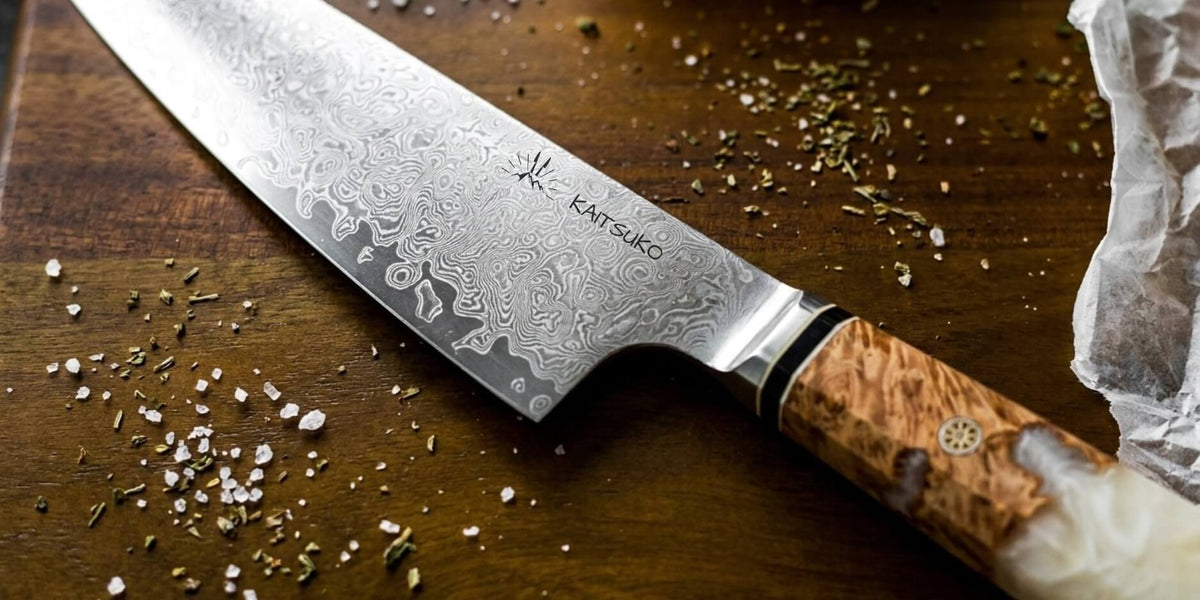
A real Damascus knife gets its pattern from layers of steel that are actually stacked and welded through the mass of the blade. A fake one bears a design that has been laser-engraved, acid-etched or printed onto a homogeneous steel, and goes no deeper than the surface. Five visual checks, cross-referenced with the spec sheet, almost always settle the question.
The word "Damascus" has become a sales pitch, and on many blades it now refers to nothing more than a decoration. This article sets out the reliable signs, the useless tests circulating online and the lines to read on a product page before buying. We sell Japanese-style kitchen knives in Damascus steel: we have every interest in you knowing how to recognise them, ours and everyone else's.
| The check | On real Damascus | On fake Damascus |
|---|---|---|
| The spine and cross-section of the blade | Fine layers, visible in section | A plain surface, with no layers at all |
| Two knives from the same series | Similar but never identical patterns | A strictly repeated pattern |
| The loupe (10× magnification) | Irregular lines that split apart and join up again | A regular grid, uniform dots or lines |
| Towards the edge | The design stretches and changes scale | The design keeps the same scale throughout |
| The edge of a San Mai blade | A band of core steel, distinct from the sides | A pattern that runs right to the edge, unbroken |
| The spec sheet | Core steel, construction, layers and hardness stated | "Damascus steel" alone, without a single figure |

Real Damascus knife: what are we talking about?
A modern Damascus knife is a blade forged from several steels of different compositions, stacked and then hot-welded together. The billet is drawn out, folded and the process repeated until a block of dozens of layers is obtained. Once the blade has been ground, an acid bath (most often ferric chloride) reveals the design: each steel reacts in its own way, one darkening while the other stays light. A nickel-alloyed steel, for example, keeps a light shade, whereas a steel with more carbon darkens markedly. The pattern is therefore not added to the blade; it is the visible trace of its construction.
The name most often refers to the city of Damascus, where blades famous for their wavy patterns were traded in the Middle Ages, although the exact origin of the term remains debated. These blades were mostly forged from wootz, a crucible steel produced in India and Sri Lanka. Their design came from fine bands of carbides formed within the metal, not from stacked layers. Today, the word covers several realities. Before buying, it is best to know which one is meant.
| The family | The principle | Where you find it |
|---|---|---|
| Pattern-welded Damascus | Different steels stacked and welded, throughout the blade | Artisan cutlery, art pieces |
| San Mai Damascus | A hard core between two layered sides, which carry the pattern | Japanese and Japanese-style kitchen knives |
| Wootz | A crucible steel with a natural pattern, without stacking | Historical reproductions, collector's pieces |
At Kaitsuko, all our Damascus blades belong to the second family. In a San Mai construction, the edge is carried by a hard steel in the centre of the blade, and the layered steel wraps around it on each side. We explain in detail what this structure changes in use in our article on 67-layer Damascus and San Mai construction.
If you are new to the subject, our page "What is Damascus steel?" covers the history and the main stages of the process.
Fake Damascus knife: laser engraving, chemical etching or printing
A fake Damascus is a blade whose steel is the same from one edge to the other, and to which a surface design has been added. There are three ways of doing this, from the most widespread to the crudest.
Laser engraving comes first. A beam engraves or blackens the surface according to a file, very quickly. The result can be very convincing, with waves that imitate layers to perfection, but it is a digital design: it is reproduced identically, knife after knife.
Next comes chemical etching with a mask. A varnish protects certain areas of the blade, an acid attacks the rest, and the design appears recessed. The technique is an old one. Yet it rests on the same principle: creating a surface difference on a metal that has none.
Printing or coating, finally, deposits an ink or a coloured film that imitates the waves. It is the cheapest version, and the least durable, since the design wears away with sponges and washing.
It should be made clear that acid, on its own, is not the mark of a fake. All real Damascus blades go through an acid etch; it is even the step that reveals their pattern. Everything depends on what the acid finds beneath the surface. On a layered blade, it brings out a contrast that already exists in the material. On a homogeneous blade, it merely draws.
If manufacturers choose this route, it is because it is far cheaper. Welding layers takes time and real forging work, with a significant reject rate. Engraving a pattern on an already finished blade costs next to nothing. A fake Damascus can, incidentally, be a perfectly decent knife. The problem is not the quality of the steel; it is that you are paying for a construction that does not exist.

The five reliable signs of real Damascus
No single sign is enough on its own. Cross-referenced, they give a solid answer. If you are buying online, ask the seller for photos of these areas: a serious seller will send them without any difficulty.
- Look at the spine and cross-section of the blade. In a layered blade, the layers are stacked through the thickness of the metal, not just drawn on the surface. Looking at the spine of the blade or the heel side-on, you should see fine layers, like the pages of a closed book. On a fake, the spine is smooth and uniform, because the design does not go below the surface. Bear one nuance in mind: some spines are polished, and on a San Mai blade the centre of the spine is taken up by the core steel. The absence of layers therefore does not prove a fake, but their presence is a very good sign.
- Compare two blades from the same series. A pattern obtained by forging is never reproduced exactly. Two knives from the same workshop look alike in style, but they do not have the same design. If photos supposed to show different pieces present strictly identical waves, the pattern is very probably a file. A shop may, however, reuse the same photo for every piece of a model: in that case, ask for a photo of the piece you will receive.
- Get out a loupe. A jeweller's loupe with tenfold magnification costs a few euros and changes the way you look. On real Damascus, the lines are fine and irregular; they split apart, join up again, break off. On an engraved pattern, you often spot an overly regular grid, aligned dots or lines of constant thickness.
- Follow the pattern towards the edge. The grind, that is, the grinding that thins the blade towards the edge, cuts across the layers at an angle. On a layered blade, the design stretches and changes scale as it approaches the edge, like the contour lines on a map. An engraved pattern generally keeps the same scale over the whole blade, because it was applied to an already ground surface. This sign is subtler than the others and is best cross-referenced with them.
- Look for the core line. If the spec sheet states a San Mai construction, the core steel should be visible along the edge, as a line or band with a shade and finish different from those of the sides. If the pattern runs uniformly right to the edge, unbroken, ask the seller about it.
When you buy online, some of these checks are done on screen. Zoom in on the shop's photos and look for those showing the heel, the spine of the blade or the edge close up. Photos posted by customers in reviews are the most useful: they show different pieces, unretouched. If the pattern overlaps line for line from one knife to another, that is a strong indication. On delivery, take five minutes with a loupe and good raking light, before removing the protective covers and using the knife. A return remains simpler for a blade that has never cut anything.
There is a definitive test, used by cutlers: sand the surface until the pattern disappears, then etch the blade with acid again. On real Damascus, the design comes back. On a fake, it does not. This test is destructive, it damages the knife's finish, and we do not advise you to try it on a blade you want to keep.
Tests that prove nothing
Several checks are repeated on forums and in videos. Most of them do not settle the question.
The magnet. Knife steels are almost all magnetic, whether layered or not. A magnet sticking to the blade says nothing about its pattern.
The finger feeling for relief. Acid etching creates a micro-relief on real Damascus, but laser engraving creates one too. Touch cannot tell the two apart.
The cloth that turns black. Ink that rubs off gives away a printed pattern. But a real, freshly etched blade can also leave a black film on a cloth. The test gives an indication, never a certainty.
The weight. It depends on the dimensions, the handle and the thickness of the blade. It says nothing about its construction.
Colour and contrast. A very black, very sharply defined pattern is no more authentic than a subtle one. Contrast depends on the steels combined, the length of the acid etch and the finish chosen afterwards. Some manufacturers lightly polish the blade for a satin look, others leave a deep contrast.
The price. A very low price should catch your attention, without proving anything: layered blades are produced in volume in good workshops, and a high price does not guarantee an authentic construction.
Counting the layers. It is impossible with the naked eye. A stated number of layers, 33, 67 or 101, cannot be verified by looking at the blade. It is read on the spec sheet and relies on the trust you place in the seller, hence the importance of the next section.
Reading a product page: what a serious seller should state
The best check happens before purchase, on the product page. A seller who knows their blade gives figures. One who is selling a decoration stays vague.
| The information | Why it matters | What we state |
|---|---|---|
| The core steel | It forms the edge | 10Cr15CoMoV |
| The construction | It distinguishes San Mai Damascus from simple cladding or mono-steel | San Mai Damascus |
| The number of layers | It describes the structure of the blade | 67 layers |
| The hardness | It determines edge retention | 60±2 HRC |
| The sharpening angle | It determines the fineness of the cut | 15° per side on our Damascus blades |
| The weight and handle | They allow a real comparison | Stated on our product pages |
| The place of manufacture | An honest seller specifies it | Yangjiang, as stated in our FAQ |
A few warning signs should make you slow down. The term "Damascus steel" used on its own, with no core steel or hardness. Photos supposed to show different pieces, for example in customer reviews, where the pattern overlaps line for line. A description that talks about "hand-forged" without saying where, by whom or how. A range described as "Japanese-style" without the origin being made explicit. Taken one by one, these signs condemn no one; together, they deserve a question to the seller before you place an order.
If the product page remains vague, five questions are enough to clear things up. A seller who knows their product will answer them in a few lines.
- What is the core steel, and what is its hardness in HRC?
- Does the pattern come from layers actually stacked through the thickness of the blade, or from a design applied to the surface?
- Is it a San Mai construction, and if so, how many layers does it have in total?
- Where is the blade forged and assembled?
- Can you send me a close-up photo of the spine of the blade and the heel?
An evasive answer to the second question is enough, on its own, to justify caution.
And if doubt arises after purchase? First write to the seller and put these questions to them, with photos of the spine and heel to back them up. For an online purchase from a professional seller, the 14-day right of withdrawal generally allows you to return the knife. If it was wrongly presented as Damascus, you can report it on SignalConso, the DGCCRF's service.
Is a real Damascus necessarily a good knife?
No. The pattern tells you how the blade is built, not how well it cuts. What makes a good knife comes down to four things: the core steel, its heat treatment (and therefore its hardness), the geometry of the blade and the quality of the factory sharpening. A layered blade with a core that is too soft or poorly treated cuts less well than a well-designed mono-steel blade.
Conversely, a good-quality mono-steel, properly hardened and well sharpened, makes an excellent knife. That is the case with our Kaito range, whose 440C steel blade is hand-hammered: a hardness of 60±1 HRC, comparable to that of the core of our 67-layer Damascus blades, and no layering. Choosing between the two is a matter of taste, use and budget. Our Damascus blades add two things: the resilience of San Mai construction, whose sides wrap around the core, and a pattern unique to each blade.
Finally, there is an in-between that is often confused with fake Damascus: the clad blade. It too combines a hard core with softer sides, often in three layers, but without a layered pattern. It offers most of the mechanical advantages of a sandwich construction, without the aesthetics. It is not a fake as long as it is not sold as Damascus. If a product page mentions "clad steel" or "3 layers" without talking about Damascus, it most often belongs to this family, and any pattern visible in the photos deserves a question.
Where authenticity really matters is in the relationship between the price and what you get. Paying a premium for Damascus assumes that the structure really exists. That is the whole point of the checks described above. Once the knife has been bought, the question that comes up most often concerns its care, and rust in particular. We answer it in detail in our article on Damascus knives and rust.
What we state on Kaitsuko product pages
All the blades in the Kyoto, Yakumoto, Yellow Sea Series and Prestige collections are Damascus blades of San Mai construction, with 67 layers and a 10Cr15CoMoV steel core. Their hardness is 60±2 HRC on most product pages, and 58 to 60 HRC for the Kiritsuke Spectre. The product pages also specify the weight and the handle material, G10 or stabilised wood combined with epoxy resin depending on the collection.
You can browse the whole range in our collection of Damascus steel knives, and compare the product pages with each other using the grid in the table above.
For a first Damascus knife, the Kyoto chef's knife is the most versatile. It weighs 226 g, its G10 handle is unaffected by moisture, and its blade is designed for meat, fish, herbs and vegetables.
For a slender blade with an angular tip, look at the Kiritsuke Spectre. Its 21.5 cm blade is shared by six handle variants in stabilised wood and epoxy resin.
Our Kaito and Chef Tanaka ranges are not Damascus blades, and we want to say so clearly. The Kaito range is in hand-hammered 440C mono-steel. The Chef Tanaka range, in 5Cr15MoV steel at around 54 HRC, may carry decorative laser engravings, and it is not sold as Damascus. If you are unsure, our FAQ on materials and manufacturing answers the most common questions. And if any doubt remains about a specific model, write to us: we would rather answer ten questions than let a customer choose the wrong blade.
FAQ: real or fake Damascus knife
How do you recognise a real Damascus knife?
Look at the spine of the blade for layers, compare two blades from the same series (their patterns should not be identical), examine the design under a loupe and read the spec sheet. A real Damascus states its core steel, its construction, its number of layers and its hardness.
Is a laser-engraved Damascus knife a fake?
Yes, if it is sold as Damascus. A laser pattern is a design on a homogeneous steel, with no layers underneath. It is not a defect in itself when the seller clearly states that it is an engraved decoration. The problem arises when the word "Damascus" suggests a structure that does not exist.
Can the stated number of layers be checked?
Not with the naked eye. Each layer measures only a few hundredths of a millimetre, and grinding cuts across them at an angle: the pattern reads like a design, not like a stack to be counted. The stated figure, 33, 67 or 101, appears on the spec sheet. It is cross-checked against the spine of the blade and the seller's answers.
Does the magnet test work?
No. Most knife steels are magnetic, whether layered or not. A magnet sticking to the blade proves neither the presence nor the absence of layers. To decide between real and fake Damascus, rely on visible layers, the irregularity of the pattern and the figures on the spec sheet.
Does a real Damascus cut better than a standard knife?
Not automatically. Cutting performance depends on the core steel, the hardness, the geometry of the blade and the sharpening. Damascus adds sides that protect the core and a unique pattern. A good, well-hardened mono-steel cuts as well as a Damascus blade with an identical core steel.
Why don't two Damascus knives from the same series have the same pattern?
Because the pattern comes from forging and grinding, two operations that are never reproduced exactly. The layers sit slightly differently in each blade. Knives from the same series share a style, with comparable waves, but each piece has its own design.
Can the Damascus pattern fade over time?
On a genuinely layered blade, the pattern comes from the material and does not wear away with use. Its contrast can, however, dull under the effect of abrasive sponges or acidic products. A pattern that is merely printed or engraved on the surface may, on the other hand, wear off or disappear when polished.
How much does a real Damascus knife cost?
The price depends on the core steel, the finish and the size of the blade. At Kaitsuko, a chef's knife in San Mai Damascus steel currently costs between 120 and 160 euros depending on the collection. A much lower price is not proof of a fake, but it justifies reading the product page carefully.
Are Kaitsuko Damascus knives real Damascus?
Yes. Our Kyoto, Yakumoto, Yellow Sea Series and Prestige collections are of San Mai construction, with 67 layers and a 10Cr15CoMoV steel core, as stated on our product pages. You can apply the same checks to them as to any others. For a question about a specific model, our team answers by email, with photos if necessary.
Where to Get Your Knives Sharpened, and at What Price?