



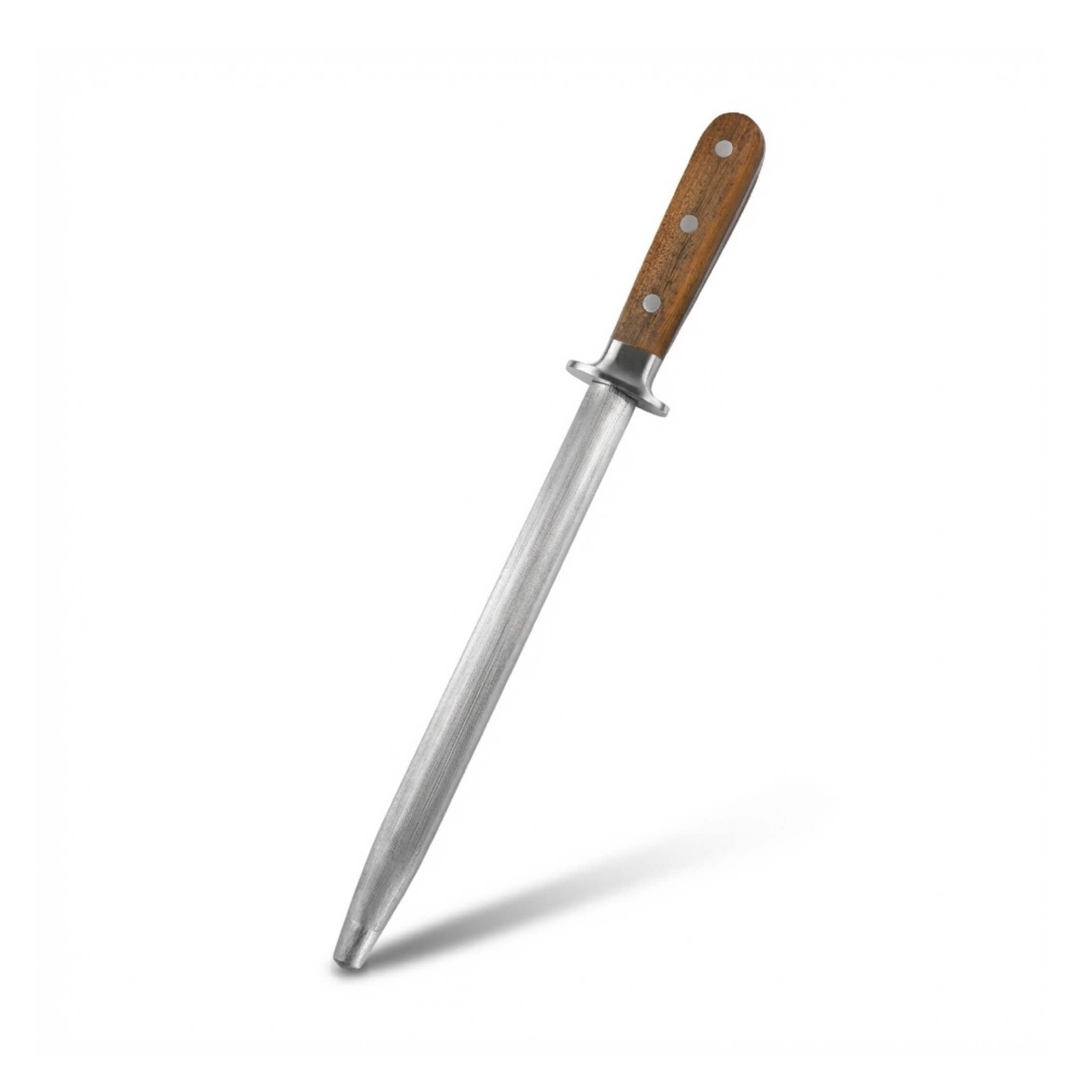
Sharpening steel - Wooden handle
Sharpening steel - Wooden handle
Description and technical specifications
Honing Steel with Wooden Handle: The Indispensable Tool for Professional Edge Maintenance
The expert's verdict at a glance:
- Function: Honing (realigning the edge) — not sharpening (removing material).
- Material: 100C6 carbon steel rod with hard chrome coating (63-66 HRC).
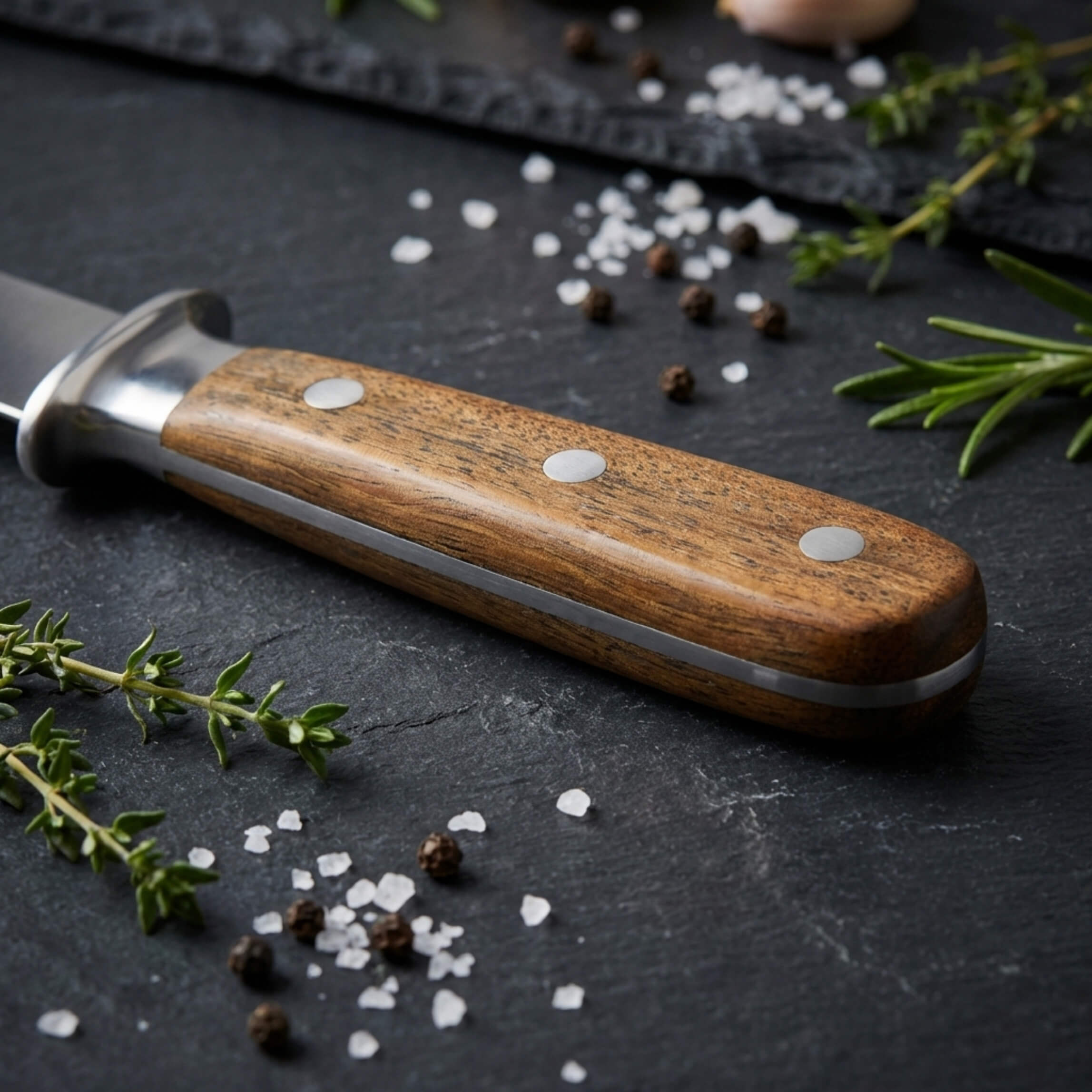
- Design: Ergonomic handle in solid acacia wood, combining traditional aesthetics and durability.
- Compatibility: Ideal for 5CR15MoV-type steels (Tanaka range), European steels and premium Damascus steels.
Understanding the real difference: Honing vs Sharpening
Confusing honing and sharpening is the enemy of your blades. One realigns the edge (honing steel), the other removes material (whetstone). Mastering this distinction is what guarantees the longevity of your tools:
- Honing (The Steel): During cutting, the edge of your knife undergoes micro-alterations and eventually "rolls over". The honing steel realigns the edge without removing any material. This is daily maintenance.
- Sharpening (The Stone): When the edge is worn or dull, the bevel must be rebuilt by removing steel. This is a periodic operation.
Why choose a hard chrome steel rod?
Our honing steel uses high carbon steel 100C6 with a fine cut. Its hardness of 63-66 HRC is superior to that of most kitchen knives, allowing it to act effectively on the edge. The hard chrome coating provides protection against corrosion and increases wear resistance.
Technical Guide: Choosing and using your honing steel
Which rod length to select?
The golden rule is simple: your honing steel rod must be at least as long as the blade of your largest knife.
- 20 cm: Ideal for home use, perfect for paring knives, utility knives and smaller Santokus.
- 30 cm: The professional standard. Essential for honing a chef's knife or a 20 cm Kiritsuke in a single fluid stroke.
The technique of the perfect gesture
To guarantee an optimal edge without risking blade damage, follow this method:
- The angle: Maintain an angle of 15° to 20°. Too open an angle risks creating an irregular new bevel, while too closed an angle will be ineffective.
- The movement: Slide the blade from the heel to the tip of the knife, alternating each side.
- The pressure: Be light. The weight of the knife is sufficient; excessive pressure could create micro-fractures in harder steels.
Ergonomics and Construction
At Kaitsuko, we prioritise build quality. Our wooden-handled honing steels are the product of artisan craftsmanship:
- Acacia wood: A dense wood with natural resistance to kitchen moisture.
- Hand guard: An essential safety element to protect your hand during fast strokes.
- Ergonomic handle: Designed for a stable grip, preventing any accidental slipping.
Maintaining your honing steel
A honing steel needs care to remain effective:
- Cleaning: After use, wipe the rod with a dry cloth to remove micro steel particles.
- Washing: Use soapy water if necessary, but the dishwasher is strictly forbidden to protect the acacia wood.
- Storage: Use the hanging loop to prevent the rod from knocking against other utensils.
The Kaitsuko Expert Verdict
The wooden-handled honing steel is the most cost-effective investment for extending the life of your knives. It is the indispensable companion to Kaitsuko knives. For extremely hard steels (Damascus 60 HRC), we recommend using the honing steel sparingly, or opting exclusively for a fine-grit whetstone to avoid weakening the bevel.
Technical Specifications
| Feature | Detail |
|---|---|
| Rod Material | Carbon steel 100C6 / Hard chrome |
| Hardness | 63-66 HRC |
| Cut | Fine (precision honing) |
| Handle | Solid acacia wood |
Our History
Kaitsuko knives are specially selected by our team of enthusiasts. They are designed to offer optimal comfort of use to those who use them. The blades are of impeccable quality .
The strength and durability of our knives will allow you to use them again and again!
They maintain an exceptional sharpness despite daily use.
Kaitsuko knives allow for clean and precise cutting of all your foods. Proper maintenance of your knives will extend their lifespan. This involves careful washing and good sharpening.
Do you have a question? Check out our FAQ to find the answer! If you have another question, our customer service will be happy to answer you from Monday to Friday at info@kaitsuko.fr
-
CUSTOMER SERVICE
Contact us Monday to Friday from 8am to 6pm at info@kaitsuko.fr
-
FAQ
The answer to all your questions HERE .
LEARN MORE
The use of each knife
Kiritsuke Knife : The Kiritsuke knife is a versatile knife that can be used for cutting a variety of foods. Its angled blade allows for precise cuts for slicing vegetables, meat, and fish.
Chef's Knife : The Chef's knife is a versatile tool that features a long, sharp blade, as well as a fine tip for precise and efficient cuts. It is an ideal knife for slicing, chopping, and chop all types of food.
Slicing Knife : The slicing knife is designed specifically for cutting thin slices of meat, poultry, or fish. Its long, narrow blade allows it to glide easily through food. It allows for precise cuts without tearing the food.
Bread Knife : The bread knife is designed to cut through different types of bread without crushing or tearing them. Its serrated blade allows you to slice cleanly through the crispy crust, without crushing the crumb inside.
Santoku Knife : The Santoku knife is also a versatile knife that is ideal for slicing, chopping and cutting different foods. With a wide, straight blade with a rounded tip, it has a large cutting surface. In short, the This knife is perfect for making multiple preparations in the kitchen.
Nakiri Knife : The Nakiri knife is specialized in cutting vegetables. Its straight, rectangular blade offers a wide cutting surface that is ideal for chopping, slicing and mincing precisely. It can also be used as a shovel knife to transfer vegetables into the flat.
Utility Knife : The utility knife is versatile. It is designed to perform several types of tasks in the kitchen. Its size, halfway between a chef's knife and a utility knife, makes it perfect for medium-sized cutting tasks, such as slicing fruit. , vegetables, cheese, peel, or even cut food into small pieces.
Boning Knife : The boning knife is specially designed to remove meat from bones with precision. Its rigid and narrow blade allows it to follow the contour of the bones, thus reducing meat waste.
Paring knife : The paring knife is ideal for precision tasks thanks to its small size and short, pointed blade. It is perfect for peeling and cutting fruits and vegetables, as well as for making delicate cuts. Versatile and handy, the paring knife is often used for detailed work that requires great precision. Whether it's for removing seeds from a fruit, coring tomatoes or chopping herbs, this knife is an essential companion for amateur and professional chefs.
Steak Knife : Steak knives, also called "table knives," are knives designed specifically for cutting cuts of meat during meals. They have a serrated blade that makes it easy to slice through pieces of meat without tearing the fibers.
Knife maintenance
- Never put knives in a dishwasher.
- Wash knives by hand and wipe the blade thoroughly with a soft, dry cloth to maintain the efficiency and quality of the blade.
- Clean the blades with soapy water.
- If the knives have wooden handles, dry them thoroughly before storing.
- Knives do not stay sharp for life, no matter the blade; it is therefore advisable to sharpen them as soon as the edge becomes less sharp.
- Do not use the edge of the knife to push food onto the board. Use the back of the blade instead.
- Never use the abrasive side of sponges to clean blades.
- Cut food on a wooden board to avoid damaging the blade of your knives.
- Do not make any cuts in a pan or baking dish to avoid damaging the blade of the knives.