



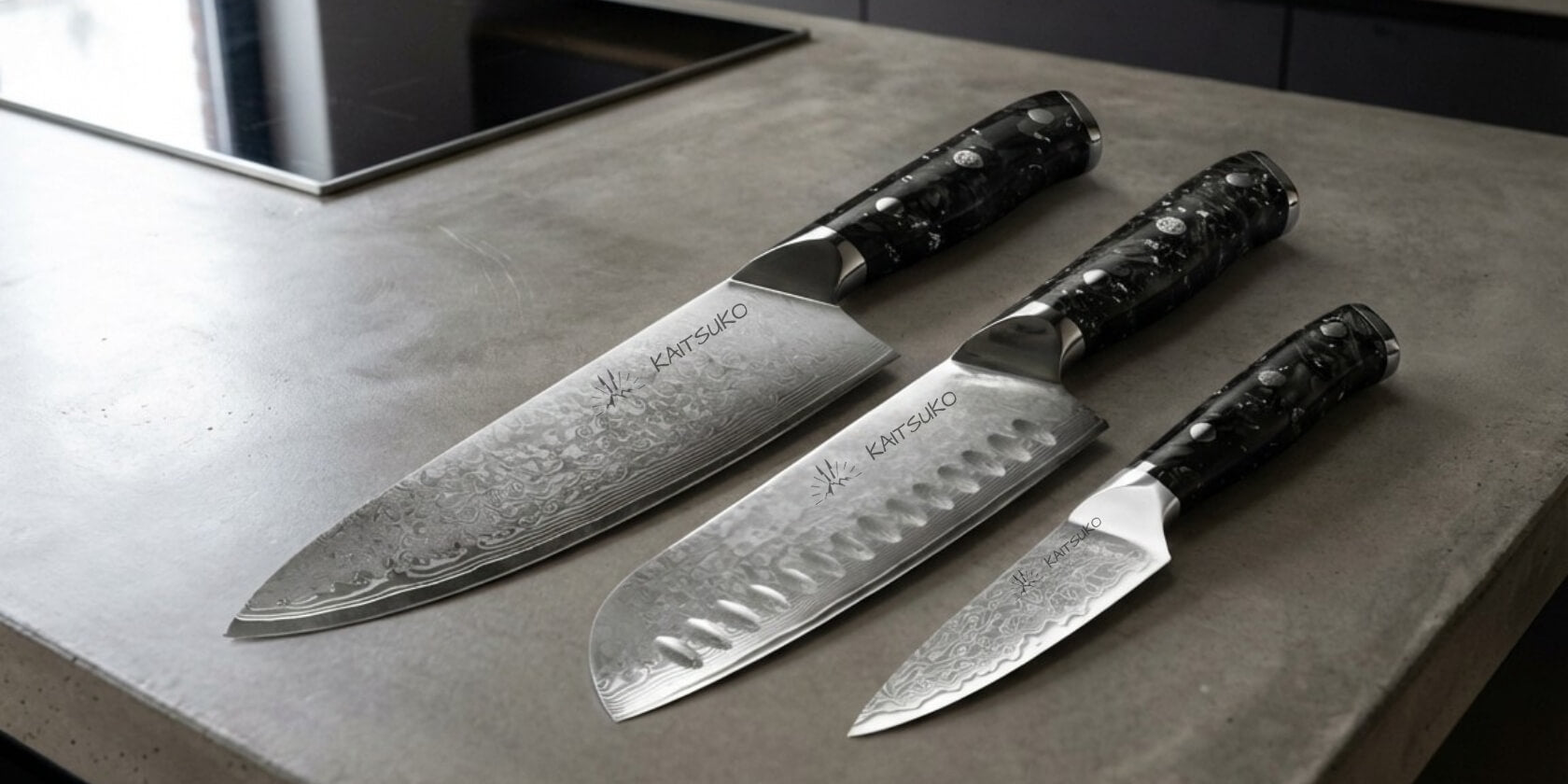
When you start building a serious kitchen knife collection, one question almost always comes up: should you buy knives one at a time, or invest straight away in a complete set? For a long time, the answer seemed obvious. Knife blocks filled with ten or fifteen blades sat proudly on kitchen counters, giving the impression of a perfectly equipped kitchen.
Over time, many cooks - home chefs and professionals alike - came to a fairly simple realization: most of those knives are almost never used. In many kitchens, two or three blades do the bulk of the work, while the others sit untouched in the block for years.
This observation gave rise to a far more modern approach to knife ownership: the knife capsule. The concept is simple. Rather than accumulating blades, you choose a handful of perfectly complementary knives capable of covering the vast majority of kitchen tasks.
And in practice, three well-chosen knives are more than enough for everyday cooking.
This minimalist philosophy has been embraced by many chefs and cooking enthusiasts. It means investing in fewer knives — but in significantly higher-quality blades, often made from high-carbon steels or multi-layer Damascus structures capable of delivering remarkable cutting precision.
Why Large Knife Blocks Are Often Overkill
Knife sets have long been popular for one very simple reason: they give an impression of abundance and completeness. When you open a block filled with different blades, you feel like you have the perfect tool for every situation.
In reality, the kitchen rarely works that way.
Most cooking tasks rely on simple gestures: mincing, slicing, chopping, prepping vegetables or a cut of meat. These tasks can all be accomplished with just a few well-designed knives.
It's a point you hear often from professional chefs. In a restaurant kitchen, the main knife does the overwhelming majority of the work, while two or three complementary blades come out for more specific tasks.
This is exactly the logic that inspired the modern approach to compact knife sets: offering genuinely useful knife combinations rather than boxes filled with tools that rarely see the light of day.
The Knife Capsule Concept
The knife capsule is built on a very simple principle: bring together three perfectly complementary blades.
- A main knife for everyday cutting tasks.
- A smaller knife for precision work.
- And a third knife that rounds out the set based on your cooking habits.
With this trio, you can prepare almost any dish: vegetables, meat, fish, herbs, fruit - the majority of kitchen tasks can be handled efficiently and precisely.
This is also the logic driving the design of many modern Japanese knife sets today, including those offered by specialist brands like Kaitsuko. Rather than stacking blades, these sets are conceived as a coherent combination of complementary tools.
The result is almost always more logical — and far more enjoyable to use on a daily basis.
The Main Knife: The Cornerstone of the Kitchen
In a three-knife capsule, the main knife is naturally the most-used tool. In Japanese cutlery, this role is typically filled by a Gyuto or a Santoku.
The Gyuto is often considered the Japanese equivalent of the Western chef's knife. Its relatively long blade makes it easy to work with vegetables, meat, and fish. It's particularly valued for long, fluid slicing motions.
The Santoku, on the other hand, is slightly more compact and exceptionally versatile. Its name actually means "three virtues" — reflecting its excellence at cutting vegetables, meat, and fish.
In many home kitchens, the Santoku quickly becomes the most-used knife. Its size is very comfortable to handle, and its wide blade makes it easy to scoop chopped ingredients off the cutting board.
A little story from the Kaitsuko team: whenever someone cooks at the office, there's almost always a moment when the Santoku mysteriously disappears. You set it down on the board, turn around for two minutes - and someone has already grabbed it to slice onions on the other side of the kitchen.
That's usually a sign that a knife is truly versatile.
The Precision Knife: The Small but Essential Tool
The second knife in the capsule is the precision knife.
In Japanese tradition, this role is often filled by a petty knife — a small, highly maneuverable blade built for precise work. Peeling fruit, removing sinew from meat, working directly in your hand, or cutting small ingredients all become much easier with this type of blade.
Many cooks discover the value of this knife late in the game. But once you start using it regularly, it quickly becomes indispensable.
The small knife brings something the main knife can't always deliver: control and precision.
The Third Knife: The One That Completes the Set
The third knife often depends on your personal cooking habits.
For some kitchens, it will be a bread knife that glides through a crust without crushing the crumb. For others, it might be a Nakiri, highly effective for vegetable prep.
In some modern sets, this third knife is chosen to perfectly complement the first two, covering as many kitchen scenarios as possible.
This is where the set approach becomes particularly interesting. When a set is well designed, blade lengths, geometries, and intended uses are all built to work together.
You no longer have to choose each knife separately - you get a coherent, balanced collection right out of the box.
Why Steel Quality Is Everything
When you adopt a three-knife capsule, the quality of the materials becomes even more critical. Every blade needs to deliver reliable performance.
Modern Japanese knives frequently use high-carbon steels that can reach significant hardness levels after heat treatment. This hardness allows for an extremely fine edge - and helps that edge last longer.
In premium models, you'll also find Damascus steel blades, made from multiple layers of steel forged together. This construction combines a very hard core - responsible for the cutting edge - with outer layers that enhance the blade's overall toughness.
The result is a highly balanced blade capable of exceptional cutting precision while maintaining impressive durability.
This is precisely the type of steel found in many high-end Japanese knives, including sets designed around the capsule concept.
The Modern Cooking Philosophy
Today, many cooks are taking a much simpler approach to their kitchen equipment. Rather than accumulating tools, they prefer to invest in a few reliable, well-designed pieces.
This philosophy also reflects the way people cook today. Recipes rely on straightforward techniques, well-prepared ingredients, and tools that allow for precise work.
Three well-chosen knives are more than enough to handle these tasks.
And when those knives are crafted from high-performance steels with a thoughtfully designed blade geometry, the experience in the kitchen becomes simply much more enjoyable.
The Ideal Capsule in 2026
If you were to sum up the ideal knife capsule today, it would typically look like this: a versatile main knife like a Santoku or Gyuto, a small precision knife for delicate work, and a complementary third knife based on your cooking habits.
With this combination, you can prepare almost any dish efficiently.
And as we like to say at the Kaitsuko team whenever a new knife arrives at the office: if a knife cuts really well, you always end up finding something to cook.
Microplastics and cutting boards: should you stop using plastic in 2026?
The 7 mistakes that ruin a japanese knife's edge (and how to avoid them)