



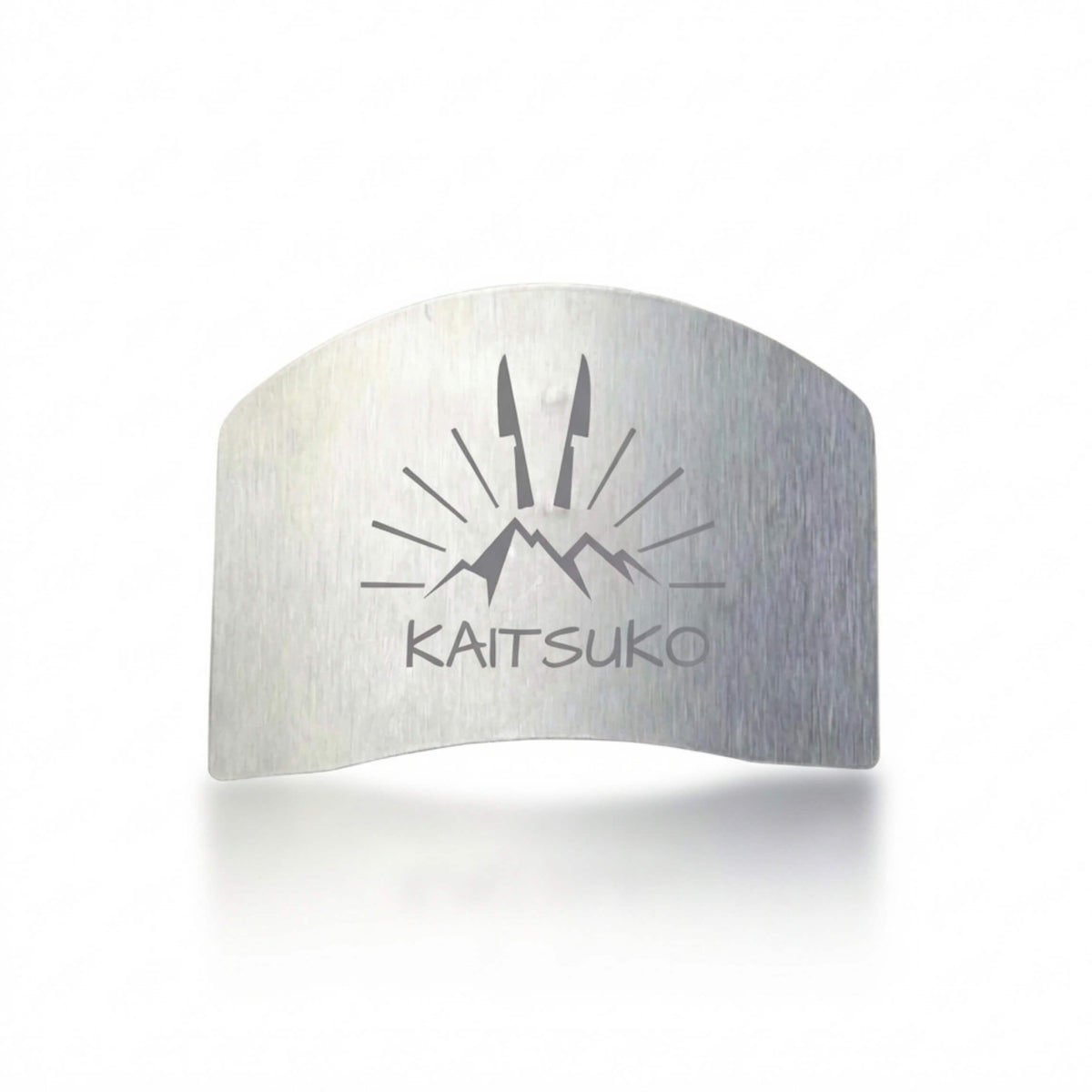
Stainless Steel Finger Guard
Stainless Steel Finger Guard
Description and technical specifications
Stainless Steel Finger Guard: Safety in the Service of Precision
The essentials in 3 points
- Infallible Safety: Stainless steel construction, offering a rigid, impenetrable barrier against the sharpest blades (60+ HRC).
- Intuitive Ergonomics: Compact design (6.5 cm × 4.5 cm) adjusting to all hand shapes for total hand mobility.
- Hygiene & Durability: Inert material, corrosion-resistant and easy to clean, guaranteeing a virtually unlimited lifespan.
The technical assurance of the culinary gesture
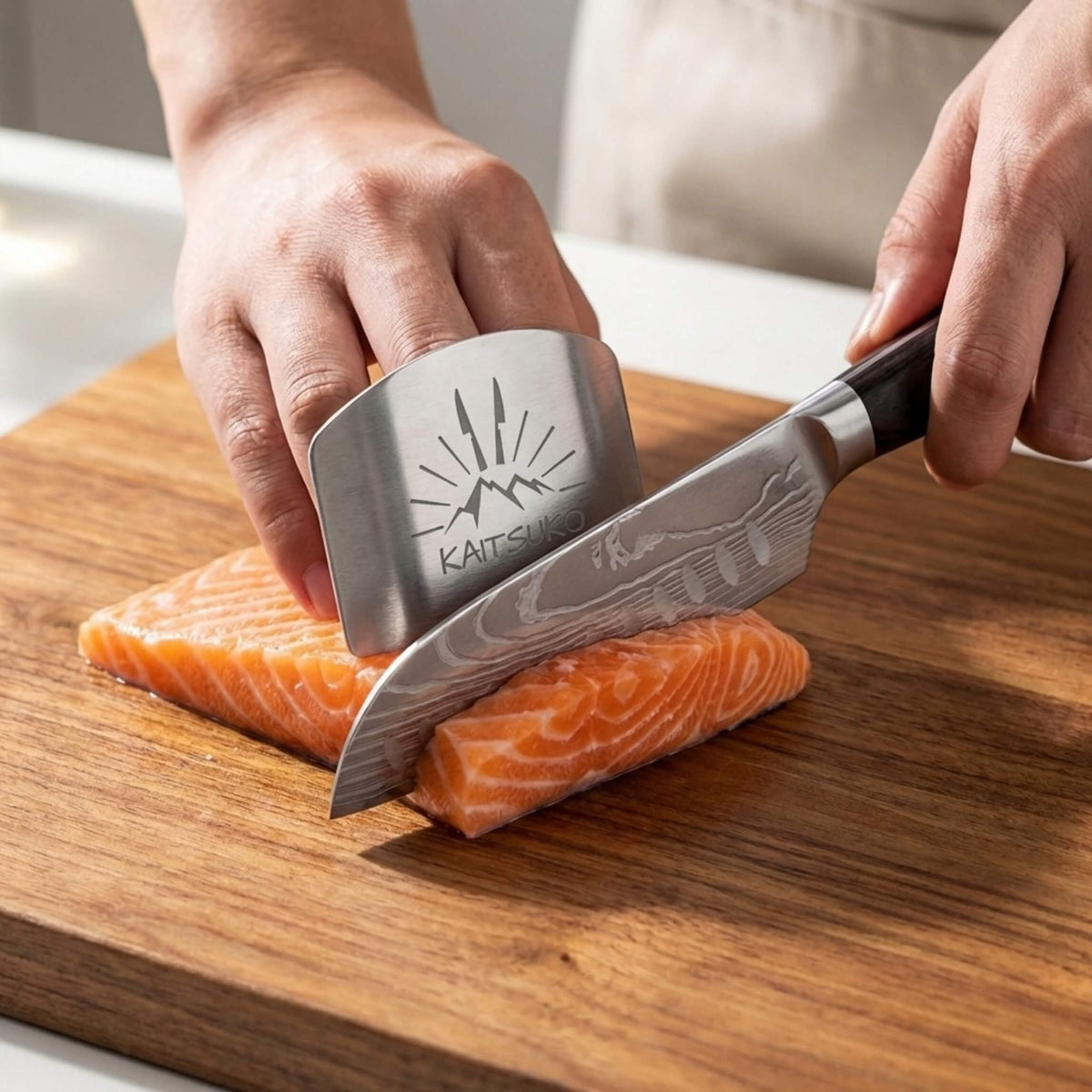
The precision of a Japanese blade tolerates no approximation. Our steel finger guard acts as a mechanical guide: it secures the contact point between the blade and the ingredient, allowing an acceleration of the cutting gesture without risk.
Materials and Structural Resistance
We selected grade 304 stainless steel (food-grade) for its superior mechanical properties:
- Corrosion resistance: A crucial property during prolonged contact with moisture and the acidity of vegetables.
- Surface treatment: Smooth finish with rounded edges to guide the blade without creating friction or micro-scratches on your precious steel.
- Robustness: A material that does not degrade, designed for intensive daily use, whether in amateur or professional kitchens.
From a hygiene standpoint, grade 304 steel offers decisive advantages over polymer or silicone guards:
| Feature | Advantage |
|---|---|
| Porosity | Inert surface, zero retention of food particles or bacteria |
| Odours | Stainless steel helps neutralise persistent odours (garlic, onion) on fingers |
| Thermal stability | Does not deform upon contact with hot foods, unlike plastics |
True to our transparency commitment, this finger guard comes from our partner workshops selected for their mastery of metalwork. Each piece undergoes strict quality control: edges are precisely rounded and polished to ensure no sharp angle can scratch the surface of your Japanese blades, preserving the hammered finish or the 67 layers of your collector's knives.
Use and Cutting Precision
The finger guard doesn't just protect — it serves as a guide for impeccable precision during chopping and mincing. For maximum efficiency, we recommend the "claw" technique:
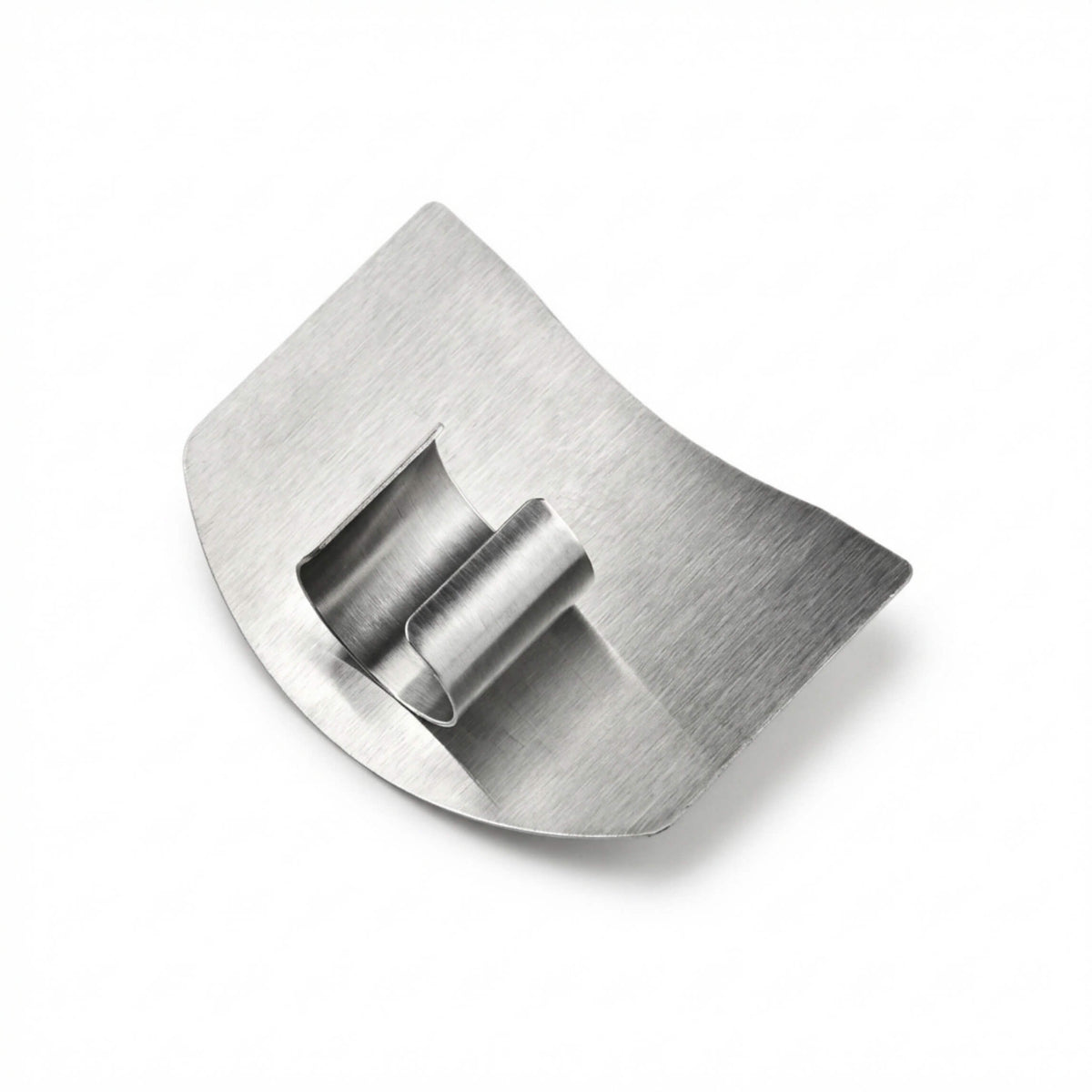
- Adjustment: Slide your middle finger (or middle and index finger) into the adjustable ring at the back. Your fingers should form a natural arch behind the shield.
- Contact: Press the convex face of the shield firmly against the ingredient.
- Cutting: The knife blade rests against the steel wall — the shield guides the blade height, enabling millimetre-precise cuts for your julienne and brunoise, even at high speed.
It is the ideal ally for:
- Finely chopping fresh herbs at speed
- Creating ultra-thin vegetable julienne
- Safely learning Japanese cutting techniques
Maintenance and Longevity
Grade 304 steel is renowned for its simplicity of maintenance. To preserve the quality of the accessory:
- Cleaning: A simple rinse under soapy water after each use.
- Drying: Wipe with a soft cloth to avoid limescale deposits that could, over time, create unnecessary friction against your Damascus blades.
- Dishwasher: We strongly advise against the dishwasher. Aggressive detergents and excessive heat can dull the polished finish of the accessory.
- Storage: Store away from direct moisture to preserve its optimal glide properties.
The Kaitsuko Expert Verdict
"The steel finger guard is the 'must-have' for every cooking enthusiast looking to increase their speed of execution without compromising their physical safety. The expert verdict: a tool of precision as much as safety. It is the indispensable complement for maintaining a constant cutting angle on the Tanaka (5CR15MoV) or Prestige (10CR15CoMoV) ranges. Essential alongside your Tanaka or Prestige knives."
Technical Specifications
| Feature | Technical Data |
|---|---|
| Material | Grade 304 Stainless Steel (Anodised) |
| Dimensions | 6.5 x 4.5 cm |
| Weight | Approx. 20g (Light and comfortable) |
| Adjustment | Pressure-adjustable ring |
| Compatibility | Universal (left and right-handed) |
Dispatched within 24-48h.
"Technicality in the service of the gesture."
Our History
Kaitsuko knives are specially selected by our team of enthusiasts. They are designed to offer optimal comfort of use to those who use them. The blades are of impeccable quality .
The strength and durability of our knives will allow you to use them again and again!
They maintain an exceptional sharpness despite daily use.
Kaitsuko knives allow for clean and precise cutting of all your foods. Proper maintenance of your knives will extend their lifespan. This involves careful washing and good sharpening.
Do you have a question? Check out our FAQ to find the answer! If you have another question, our customer service will be happy to answer you from Monday to Friday at info@kaitsuko.fr
-
CUSTOMER SERVICE
Contact us Monday to Friday from 8am to 6pm at info@kaitsuko.fr
-
FAQ
The answer to all your questions HERE .
LEARN MORE
The use of each knife
Kiritsuke Knife : The Kiritsuke knife is a versatile knife that can be used for cutting a variety of foods. Its angled blade allows for precise cuts for slicing vegetables, meat, and fish.
Chef's Knife : The Chef's knife is a versatile tool that features a long, sharp blade, as well as a fine tip for precise and efficient cuts. It is an ideal knife for slicing, chopping, and chop all types of food.
Slicing Knife : The slicing knife is designed specifically for cutting thin slices of meat, poultry, or fish. Its long, narrow blade allows it to glide easily through food. It allows for precise cuts without tearing the food.
Bread Knife : The bread knife is designed to cut through different types of bread without crushing or tearing them. Its serrated blade allows you to slice cleanly through the crispy crust, without crushing the crumb inside.
Santoku Knife : The Santoku knife is also a versatile knife that is ideal for slicing, chopping and cutting different foods. With a wide, straight blade with a rounded tip, it has a large cutting surface. In short, the This knife is perfect for making multiple preparations in the kitchen.
Nakiri Knife : The Nakiri knife is specialized in cutting vegetables. Its straight, rectangular blade offers a wide cutting surface that is ideal for chopping, slicing and mincing precisely. It can also be used as a shovel knife to transfer vegetables into the flat.
Utility Knife : The utility knife is versatile. It is designed to perform several types of tasks in the kitchen. Its size, halfway between a chef's knife and a utility knife, makes it perfect for medium-sized cutting tasks, such as slicing fruit. , vegetables, cheese, peel, or even cut food into small pieces.
Boning Knife : The boning knife is specially designed to remove meat from bones with precision. Its rigid and narrow blade allows it to follow the contour of the bones, thus reducing meat waste.
Paring knife : The paring knife is ideal for precision tasks thanks to its small size and short, pointed blade. It is perfect for peeling and cutting fruits and vegetables, as well as for making delicate cuts. Versatile and handy, the paring knife is often used for detailed work that requires great precision. Whether it's for removing seeds from a fruit, coring tomatoes or chopping herbs, this knife is an essential companion for amateur and professional chefs.
Steak Knife : Steak knives, also called "table knives," are knives designed specifically for cutting cuts of meat during meals. They have a serrated blade that makes it easy to slice through pieces of meat without tearing the fibers.
Knife maintenance
- Never put knives in a dishwasher.
- Wash knives by hand and wipe the blade thoroughly with a soft, dry cloth to maintain the efficiency and quality of the blade.
- Clean the blades with soapy water.
- If the knives have wooden handles, dry them thoroughly before storing.
- Knives do not stay sharp for life, no matter the blade; it is therefore advisable to sharpen them as soon as the edge becomes less sharp.
- Do not use the edge of the knife to push food onto the board. Use the back of the blade instead.
- Never use the abrasive side of sponges to clean blades.
- Cut food on a wooden board to avoid damaging the blade of your knives.
- Do not make any cuts in a pan or baking dish to avoid damaging the blade of the knives.