

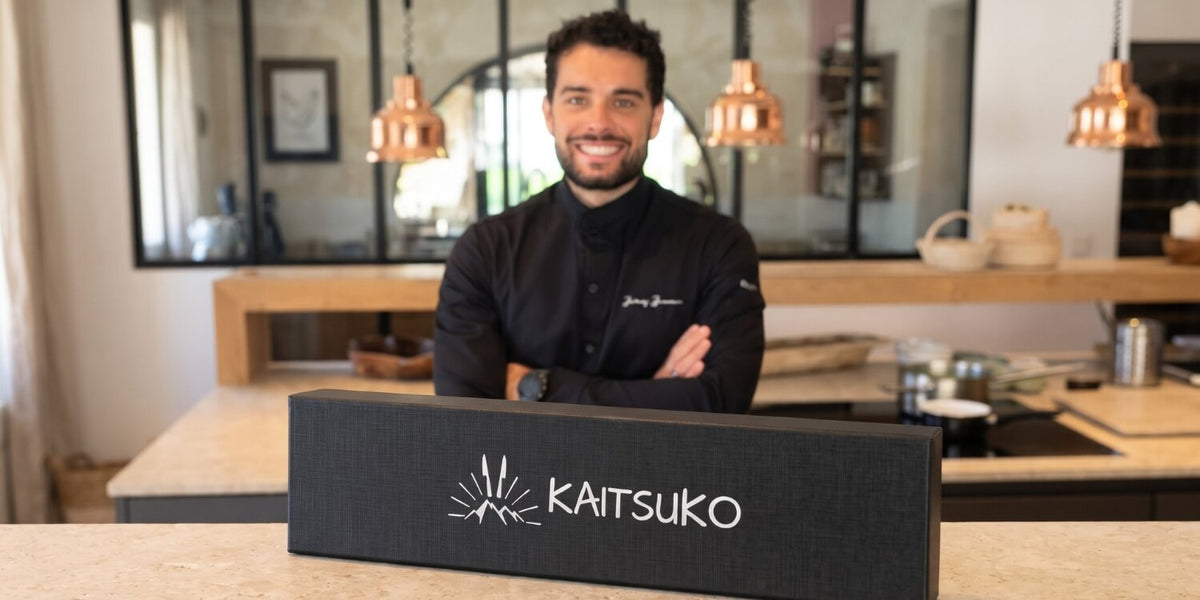
In 2019, in an interview, Jérémy Jouanen is asked whether there is one tool he cannot do without. He is 22, and he has left a Michelin-starred restaurant in Marseille to set up Maison Jouanen, his private chef business. He replies that he brought a Japanese knife back from a trip to Japan and that it never leaves his side when he is cooking for clients.
So when we sent him a Kaitsuko set, we did not need to explain what a Japanese knife is. On that front, he is more likely to have things to teach us.
Today, Jérémy is a private chef based in Pourrières, in the Var. He cooks in his clients' homes between Aix-en-Provence and Marseille, and he is one of Kaitsuko's partner chefs. We wanted to introduce him to you properly, with his background, his cooking and, inevitably, a bit of technique, because the way he cuts and plates shows very clearly what you should expect from a good Damascus steel knife.

Jérémy Jouanen, from catering college in Marseille to Maison Jouanen
Jérémy says he fell into cooking as a small boy. What followed is fairly logical: catering college in Marseille, a vocational baccalaureate in cookery, then an additional qualification in catering. It was during his catering studies that he entered the "Un des Meilleurs Apprentis de France" competition (one of France's best apprentices). He came back with two gold medals, at département and regional level.
Let's pause on that for a second. In this kind of competition, it is above all the execution that is marked. Are the cuts even, does the workstation stay clean, does everything go out on time? If you have ever tried to cut two carrots into strictly identical dice, you have an idea of the level required.
Two years at L'Épuisette
Next comes L'Épuisette, in the Vallon des Auffes. For those who do not know Marseille, it is a tiny fishing harbour tucked beneath the Corniche, and the restaurant looks straight out over the sea. At the time, the restaurant held one Michelin star and the head chef was Guillaume Sourrieu. Jérémy spent two years there and worked his way up the ranks.
He sums up what he took away from it in three words: "perfection, rigour and precision". Put like that, it could sound like a slogan. In a fish kitchen, it covers some very concrete things. The fish arrives whole, and someone has to scale it, gut it, fillet it, pull out the pin bones with tweezers and portion it (that someone is rarely the head chef). With a knife that no longer cuts, the flesh tears, and it shows on the plate. You learn to look after your blades fast.
Provençal cooking, his grandmothers' cooking
After L'Épuisette, he decided to cook directly in people's homes and set up Maison Jouanen. He describes what he does as Provençal cooking, his grandmothers' cooking, brought up to date with what he learnt in fine dining. He adds what he brings back from his travels, around Europe and above all in Japan.
There is one story we are particularly fond of. One evening, he serves a reworked octopus daube. A guest grabs his arm and whispers in his ear that it is her grandmother's sauce, exactly the same taste. He says that it is for moments like that that he does this job, and we can well believe it.
On the menu you will find rack of lamb with asparagus, scallops served several ways, an autumn sea bream, onion ravioles and a Black Forest gâteau reworked his own way. The menus come in three, five or seven courses. France 3 had him on in December 2019 on the programme "Ensemble c'est mieux". Since then, he has added another string to his bow with consultancy for restaurant owners: opening a restaurant, creating a signature menu, training the teams. It is all set out on the Maison Jouanen website.
Private chef, or cooking without a safety net
In a restaurant, there is a door between the dining room and the kitchen. In a client's home, there is not. The guests watch the crates arrive, pop their heads in during the mise en place, watch the cutting while they have their aperitif, and at the end of the evening they also see what state the kitchen is left in.
Add to that the fact that nothing is his. Not the oven, not the hob, not the worktop, which is sometimes the size of an ironing board. Jérémy still sends out seven-course menus in these conditions, and as he says himself, few chefs take the risk. Do the maths for a table of eight: that makes fifty-six plates.
The only two things he controls from start to finish are his produce, which he describes as 100% fresh, and his knives. You can see where we are going with this.
We have read the reviews his clients leave online. They talk about the dishes, of course, but they talk almost as much about him. He explains what he is preparing, he knows how to fade into the background when the table is chatting, and some mention that he left the kitchen spotless, washing-up done. You can tell he is someone who genuinely loves cooking for others, and that is not something you can fake.
What a private chef's knife work tells you
We are going to get a little technical in this part. This is where the link with our knives comes in.
When you watch a cook trained in a Michelin-starred restaurant at work, the first thing that strikes you is that everything is the same size. The reason is simple: identical pieces cook at the same time. If your carrot dice measure anything between three and eight millimetres, the small ones are mush while the big ones are still crunchy, and no amount of seasoning will rescue that.
Vegetables and herbs
On vegetables, a Japanese knife above all brings clean cuts. The blade is thin, sharpened to 15° on each side, and it goes through the food instead of crushing it. You can see it straight away on an onion, which releases less juice. You can see it even more on herbs: basil chiffonaded with a tired blade turns black before it reaches the plate, whereas with a good edge it stays green until service.
Fish
Fish is where you see who knows how to handle a knife. Jérémy comes from a seafood kitchen and it shows in his menus, with sea bream, octopus and scallops. To lift a sea bream fillet, the blade has to run along the backbone in a single stroke. If you go at it three times, the fillet ends up stepped. A thinly sliced scallop needs a flawless edge, otherwise it tears and turns dull. As for the octopus in his daube, which has cooked for a long time, it falls apart at the first hesitant cut.
One of his clients writes that the fish was cooked perfectly. We bet she did not wonder why. Part of the answer lies on the chopping board, because a fillet cut to an even thickness cooks evenly.
Meat
Take his rack of lamb. Before cooking, it has to be trimmed, the bones French-trimmed (that is, scraped clean so they look neat) and the excess fat removed without cutting into the eye of the meat. After resting, you slice between the ribs in one go. With a blade that drags, you end up sawing, and sawn meat leaves its juices on the board.
And what about plating?
People often picture plating as a matter of tweezers and edible flowers. For a private chef, it is first and foremost about organisation. Sending out eight identical plates in a few minutes, then doing it again six times in the evening, takes preparation well in advance: every element is cut, cooked, seasoned and lined up in the order it will be placed on the plate.
One of Jérémy's clients says his plates made an impression on her, finding them both original and understated. We like the word understated. An understated plate holds few things, so you see everything. The slice a little thicker than the one next to it, the vegetable cut crooked, the ragged edge of a fish fillet: none of that can hide under an emulsion.
That is why we never really separate plating and cutting. Citrus segmented with no trace of white pith, shavings of raw vegetable thin enough to be translucent, a herb placed whole because it is beautiful: all of that is done with a paring knife or a chef's knife, a few seconds before the plate goes out. Jérémy keeps up that level of precision from the amuse-bouche to the dessert, over seven courses, and frankly, that takes some doing.
The Yakumoto White Stone Japanese knife set we sent him
We sent him a Chef Yakumoto set in the White Stone finish, the one with the white handle. Yakumoto is our most professional-kitchen-oriented range. For those who like to know what they are holding, here are the details.
The blade
It is a 67-layer Damascus steel knife, built using San Mai construction. There is nothing mysterious about the San Mai principle. You take a core of hard steel, 10Cr15CoMoV here, and sandwich it between softer layers. The core forms the edge, the outer layers absorb the knocks. The hardness is 60 HRC, plus or minus 2.
In practice, 60 HRC allows a 15° edge on each side that holds over time. For someone sending out seven courses in a row, having a knife that cuts as well at dessert as it did at the starter means comfort, and a bit of safety too. As for the Damascus patterns, every blade has its own. They do not make the knife cut better, let's be honest, but we are not going to pretend we do not find them beautiful.
The five knives in the range
| Knife | Weight | What it is for |
|---|---|---|
| Chef's knife | 259 g | Chopping herbs, cutting vegetables, preparing meat and fish |
| Santoku | 243.5 g | Slicing, chopping, cutting meat, fruit and vegetables |
| Boning knife | 125 g | Following the bone, trimming, freeing a rack or a bird |
| Utility knife | 127 g | Fine cuts on medium-sized pieces |
| Paring knife | 118 g | Peeling, segmenting, finishing touches |
The set comes as three pieces (chef's knife, Santoku, paring knife) or five, with the boning knife and the utility knife. For a private chef, it is easy to picture how the work is shared out. The chef's knife and the Santoku handle most of the mise en place, the boning knife comes out for the lamb or the poultry, and the utility and paring knives take care of the finishing touches. The other pieces are in the Chef Yakumoto collection.
Why a white handle
The handle is made of G10, a composite of fibreglass and resin. It does not absorb water and does not slip when your hands are wet. When you are washing your knives four or five times in an evening, in a sink you do not know, you appreciate that.
We stand by the white. On a white handle, the slightest mark shows, so you keep it clean. For a chef who cooks in front of his clients, we think that sends the right message.
Why Kaitsuko works with private chefs
Kaitsuko is a small team. A group of friends, to put it plainly, who love knives and good food. We do not have the budget to pay celebrities to pose with our blades, and between ourselves, we would rather put that money into better steel or a nicer handle. So we send knives to people who really cook, and we listen to what they tell us, even when it stings.
Private chefs are perfect for this. They have the standards of a restaurant cook, with hours of cutting under their belt. And they work in the same conditions as you, with a normal worktop, a normal sink, and knives that have to be carried around and washed by hand. If a blade holds up at Jérémy's, we are pretty confident about your kitchen.
More than 100,000 customers cook with our knives, but it is feedback like this that moves us forward on the next ranges. If the subject interests you, we have written an entire guide on Japanese knives for private chefs.
Chef habits you can borrow from him
We are not going to promise that you will cook like him just by changing knives. On the other hand, a few professional reflexes can be picked up in a weekend.
The first is to prepare everything before you turn on the heat. Cut, weigh, set out in bowls. Cooks call this the mise en place, and it is the only reason a chef can send out seven courses without running around everywhere.
The second is to aim for consistency before speed. Speed will come by itself. Pieces of the same size, on the other hand, are something you can decide on today, and your cooking will feel the difference straight away.
Third, stop pressing down. You let a Japanese knife glide through the food, you go along with its weight, and that is all. If you have to force it, it needs a pass on the stone.
Think about your chopping board too. Wood, always. Glass and stone ruin an edge within a few weeks, and scraping vegetables across the board with the edge of the blade does it no favours either (turn the knife over and use the spine).
That leaves care. Hand wash, dry straight away, never the dishwasher. The day the blade skids on a tomato skin, get out the stone and bring the edge back to 15° on each side. We have set out the method in our article on how to sharpen a Japanese knife.
To wrap up
We are delighted to count Jérémy among the chefs who work with our knives. His cooking has something very personal about it, with those family recipes he takes towards fine dining, and he has the rigour of someone who has been through a great kitchen. The two together are not something you come across that often.
If you are in Provence and have a dinner to organise, take a look at the Maison Jouanen website or his Instagram, @maison_jouanen. And if it is his set that has caught your eye, the Yakumoto Pierre Blanche is available from us, with a 2-year guarantee and shipped from our stock in France.
FAQ: Maison Jouanen, private chefs and Japanese knives
Who is Jérémy Jouanen?
The chef and founder of Maison Jouanen. He went to catering college in Marseille, won two gold medals (at département and regional level) in the "Un des Meilleurs Apprentis de France" competition, then spent two years at L'Épuisette, in Marseille, before setting up as a private chef. He also works as a consultant for restaurant owners.
Which area does Maison Jouanen cover?
Jérémy is based in Pourrières, in the Var. He works across Provence, mainly around Aix-en-Provence and Marseille. For a specific address, the best thing is to ask him through his website.
What budget should you plan for a private chef?
It depends on the number of guests, the number of courses and the produce. At the time of writing, Maison Jouanen lists bespoke menus from €60, in three, five or seven courses. Ask him for a quote and you will have an exact figure.
Which knives does a private chef really need?
Three already do almost everything: a chef's knife, a Santoku and a paring knife. Those who work a lot with meat on the bone add a boning knife, plus a utility knife for fine cuts. That is exactly how our three- and five-piece Japanese knife sets are put together.
Which Kaitsuko knife does the chef at Maison Jouanen use?
A set from the Chef Yakumoto collection, in the Pierre Blanche finish. The blades are made of 67-layer San Mai Damascus steel, with a 10Cr15CoMoV core at 60 ± 2 HRC, and the white handle is made of G10.
Is a Damascus steel knife only for professionals?
No, not at all. It simply needs to be treated properly, with a wooden board, hand washing and sharpening from time to time. As its blade is thin, you avoid twisting it, knocking it against bone or tackling frozen food. For everything else, it makes cutting easier, whether you are a chef or not.
How do you look after a Yakumoto Japanese knife?
By hand, straight after use, and you dry it immediately. Store it on a stand or in a sheath rather than loose in a drawer. As soon as the edge starts to drag, give it a pass on the whetstone at 15° on each side. Our knives come with a 2-year guarantee, and you can pay in 3 or 4 instalments with Alma.
Real or Fake Damascus Knife: How to Recognise a Genuine Damascus Blade