

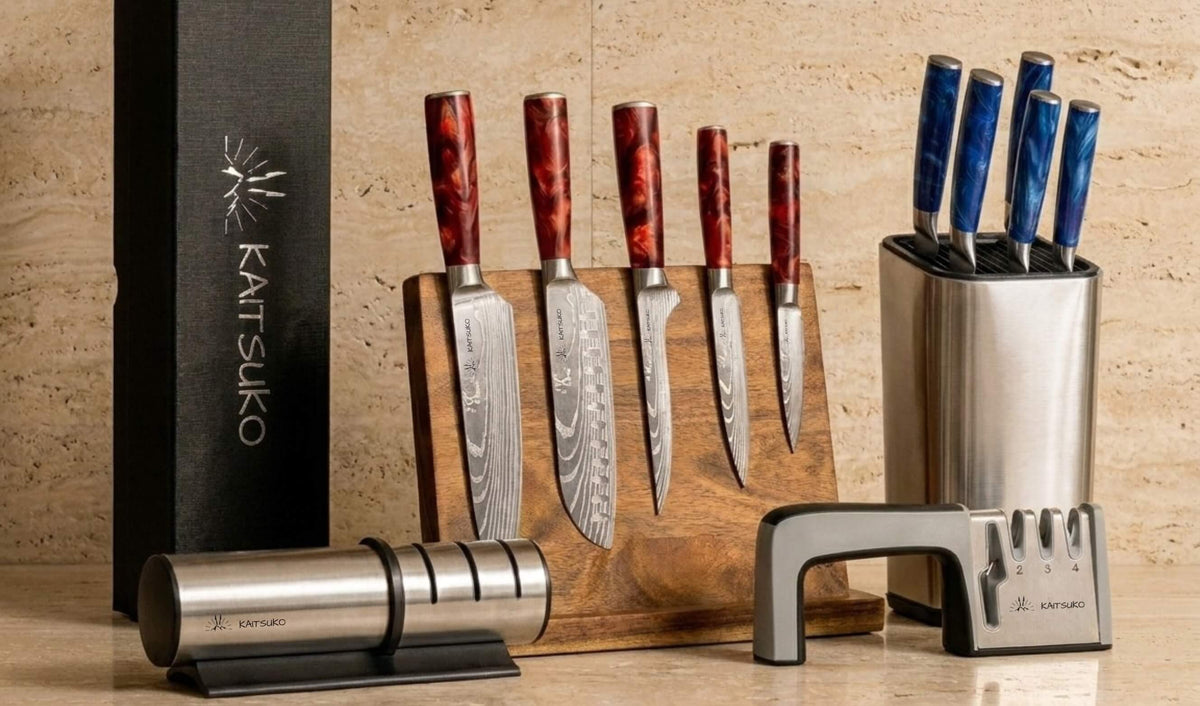
To store your Japanese knives, choose a solution where the edge touches nothing: a wall-mounted magnetic strip, a magnetic block, a block with slots that are wide enough, or a drawer fitted with an insert or blade guards. The blade should always go into it clean and thoroughly dry. Rule out the jumbled drawer, where blades knock against each other and chip.
A Japanese knife naturally loses its edge through cutting, and that is what sharpening is for. But a lot of avoidable damage happens between uses: at the bottom of a drawer, against a saucepan, or in the slot of a block where it was put away still damp. Storage is therefore part of care, just as much as washing. The table below compares the possible solutions for a thin blade.
| Storage | Suits | Strengths | Points to watch |
|---|---|---|---|
| Wall-mounted magnetic holder | Small kitchens, collections on display | No friction, air drying, clear worktop | Solid fitting, height out of children's reach |
| Freestanding magnetic block | Renters, kitchens with no free wall | Nothing to drill, blades visible and aired | Takes up space on the worktop |
| Slotted block | Complete sets supplied with their block | Blades hidden, classic storage | Slots hard to clean, sometimes too narrow for a Japanese blade |
| Universal block | Knives of different shapes | Takes any blade | Insert needs regular cleaning |
| Drawer with insert or blade guards | Kitchens where nothing should be on show | Blades out of sight and protected | One slot or one guard per knife, dry blades |
| Knife bag or roll | Private chefs, cookery classes, moving house | Every blade in its own slot | Not for everyday storage |
Why storing your Japanese knives properly matters
A thin edge that is sensitive to knocks
Our plain-edge blades are sharpened to 15° per side, a more acute angle than that of many Western kitchen knives. This thin edge cuts cleanly, but it does not like knocks. A knock against another blade, a fork or the rim of a saucepan is enough to mark it.
The steel changes the nature of the damage. Our Kaito knives, in 440C steel at around 60 HRC, and our Damascus blades in the Kyoto, Yakumoto, Yellow Sea Series and Prestige ranges, with a 10Cr15CoMoV core at around 60 HRC, are hard blades. A hard steel holds its edge for a long time, but when it hits a rigid object, it tends to chip rather than bend. Our Chef Tanaka knives, in 5Cr15MoV at around 54 HRC, favour toughness: their edge rolls rather than chips, and can be straightened on a honing steel.
In both cases, the damage is sometimes invisible to the naked eye, but you can feel it when cutting. The blade drags, tears the skin of a tomato or slides off an onion. Good storage keeps the edge away from any contact with metal or a hard surface.
Moisture, the enemy of blades
A blade put away damp can stain, or even rust, especially in an enclosed space where the air circulates poorly. The Damascus blades in our Kyoto, Yakumoto, Yellow Sea Series and Prestige ranges have a high carbon content and need careful drying. No steel, not even stainless, is safe from staining if it stays wet. If an orange mark appears despite everything, our methods for removing rust from a blade will help you treat it without damaging the steel.
For a knife that is rarely used, apply a very thin film of camellia oil or food-grade liquid paraffin to the clean, dry blade before putting it away. It shields it from the moisture in the air.
Keeping the storage itself hygienic
Even if it only ever holds clean blades, any storage ends up getting dirty. In its 2013 study of germs in the kitchen, the independent organisation NSF International found yeasts and moulds in the knife blocks of the households tested, as on other utensils analysed. The slots of a block collect crumbs and moisture, away from the light. Storage that dries quickly and is easy to clean limits this problem.
Safety for the whole household
A knife left loose is a danger to the hand rummaging in the drawer, and to children. Your storage should let you take each knife by the handle, without ever going near an edge.
Storing knives in a block: slotted, universal or magnetic
The knife block is still the most common form of storage. There are three types, and they do not affect a Japanese blade in the same way.
The slotted block
This is the traditional model, often supplied with sets. Each knife slides into a slot cut into the wood. The principle works for Japanese blades on two conditions. The slot must be wide enough and deep enough, which is not always the case with a santoku or a nakiri, which have a tall blade. And the way you handle the knife must spare the edge.
Look at the direction of the slots. If the blade rests on its edge, insert it spine down, edge up. Its weight then rests on the spine, and the edge does not rub against the wood every time it goes in and out. If it lies flat on its side, slide it in slowly, without pressing, keeping it straight.
The weak point of this block is cleaning. Empty it regularly, turn it upside down to shake out the crumbs, then brush the inside of the slots with a thin bottle brush and hot soapy water. Rinse quickly and leave it to dry completely, upside down, before putting the knives back. If you want to compare the models on the market, our guide to choosing a knife block goes through the materials and sizes.
The universal block
This block has no cut slots. Its inside is filled with tightly packed rods or bristles, into which you push a blade of any shape. It is handy if your knives come from several ranges. Just check that the insert can be removed for washing, and let it dry completely before putting it back.
The wooden magnetic block
This is the block best suited to Japanese blades, because it has no slots at all. The knives cling to a magnetic surface covered in wood and stay on view. Nothing rubs against the edge, air circulates around the blades, and cleaning comes down to a wipe with a cloth.
Our double-sided teak magnetic block holds up to eight knives. Its stated dimensions are 23 × 25 cm. It is wiped with a barely damp cloth and kept away from heat and moisture.
For a more contemporary look, our black magnetic holder on a stainless steel base works on the same principle, in the same format.
The compact block
For a smaller format, our knife block, in wood-fibre board, measures 24 × 10.5 × 9.2 cm. Whichever block you choose, only put dry blades in it.
Wall-mounted magnetic strip: the solution that is kindest to the edge
The magnetic strip, also called a magnetic knife holder, combines the advantages of the magnetic block and frees up the worktop. The blades are visible, easy to grab, and dry in the air. It is also the best showcase for a collection of Damascus knives.
Wooden or stainless steel magnetic strip: what makes a good holder
The contact surface matters as much as the magnet. A bare metal strip can mark the sides of a blade, especially on polished Damascus steel. A wooden surface gives gentler contact. The magnets then need to be strong enough to hold a chef's knife or a nakiri without slipping, even when someone brushes the handle in passing.
Our 40 cm magnetic wall holder meets both these points. Its surface is teak and its magnets are neodymium. It holds from three to ten knives and is fixed with screws, with the wall plugs supplied. On tiles, glass or polished metal, its product page also allows for fitting with an extra-strong adhesive. Choose one whose stated load clearly exceeds the weight of the loaded strip, and leave it to set for 24 hours before hanging your knives on it.

Putting a knife on and taking it off without damaging the edge
To put a knife on, first place the spine of the blade against the strip, then let the blade pivot gently until it lies flat. To take it off, do the reverse: lift the blade away by tilting it onto its spine, edge facing outwards, then pull.
Avoid sliding the blade flat along the strip to move it or take it off. This repeated rubbing ends up scratching the sides. And a strong magnet can snap the blade against the surface if you bring it in edge first.
Where to fit the strip
Choose a wall above the worktop where you cut, at a height that is comfortable for you but out of children's reach. Keep the strip away from the hob: steam and grease splashes settle on the blades and on the wood. Also avoid the wall just above the sink, where splashes are frequent.
Looking after it
Regularly wipe the strip with a cloth dampened with hot water and a little mild soap, then dry it straight away. The teak appreciates a drop of mineral oil every six months. Above all, never hang a wet knife: dry it carefully with a soft cloth before placing it on the magnet.
Storing knives in a drawer without damaging the blades
The drawer is often the default storage, for lack of space elsewhere. It can work for a Japanese knife, provided the blades are never left bare and loose.
Why a jumbled drawer is the worst solution
In a jumbled drawer, every time it is opened the knives move. They slide, knock against each other and against other utensils, and the edge gradually chips. The risk of cutting yourself is real: you reach in for a ladle and find a blade. If your knives currently live in a cutlery drawer, that is the first thing to change.
Drawer inserts
A drawer insert is a slotted or notched board placed in the bottom of the drawer. Each knife has its own place, with the blade lying flat and held still. Check the length and width of the slots before you buy: a chef's knife of around twenty centimetres or a wide nakiri will not fit every model. As with a slotted block, take the insert out regularly to clean it and let it dry.
Blade guards
A blade guard covers the blade and keeps it from any contact. They come in wood, rigid plastic or thick fabric. In Japan, the traditional wooden sheath is called a saya. A well-fitting blade guard lets you store a knife in any drawer, or carry it with you.
Choose one that fits the blade exactly: too wide, and the blade moves around inside and rubs; too narrow, and it has to be forced in. Never slide a damp blade into a closed blade guard, and clean the inside from time to time. A sheath that holds moisture against the steel does more harm than good.
The original box or presentation case
A storage box, or the case your knife was delivered in, suits blades that are rarely used: a collector's knife, a knife received as a gift, a spare. Each blade stays still and protected. Put it away thoroughly dry, and open the box now and then to check the steel.
A drawer just for knives
Whatever protection you choose, keep one drawer for knives only. Mixed in with whisks, graters and spatulas, they remain exposed to knocks, even when protected.
Carrying your knives: bag, roll and the rules to know
A private chef, a student on a cookery course or an enthusiast cooking at friends' homes needs portable storage. The principle stays the same: one place per knife, with no contact between the blades.
The knife bag or roll
A knife bag rolls up or folds, with a slot for each knife. Our knife carrying bag holds up to ten knives with blades of up to 24 cm. It weighs 205 g. For maximum protection, add a blade guard to the thinnest knives before sliding them into their slot.

What the law says
In France, the regulations class knives, including kitchen knives, as category D weapons. Outside your home, carrying and transporting them is prohibited without a legitimate reason, assessed case by case depending on the place and circumstances.
So only carry your knives when you need them, for example for a class or a job, and always packed in a closed bag, so that they cannot be used immediately. A closed bag does not replace a legitimate reason.
When flying, your knives travel only in the hold, in checked baggage, with each blade protected to avoid injury during handling.
When moving house
Wrap each blade separately in folded cardboard or thick paper, held in place with a rubber band or tape. Group the knives together in a box marked "knives", to be opened with care. A knife bag, if you have one, also does the job.
Storage mistakes that damage your knives
Putting a blade away still damp
This is the most common mistake. A knife that is rinsed and put away straight away carries its moisture into the block's slot, the blade guard or the drawer. Wash the blade by hand, dry it with a tea towel or microfibre cloth, from the spine towards the edge, then put it away. Our guide to washing and caring for a Japanese knife goes through the technique.
Leaving the knife in the sink
A knife waiting in the sink, under the washing-up or in the water, combines every risk. The blade knocks against the plates, water sits on the steel, and whoever reaches in cannot see it. Wash it straight after use, or set it aside on the worktop.
Storing everything in the same drawer
This is one of the mistakes that ruin the edge of a Japanese knife, along with the dishwasher and the wrong chopping board.
Forcing a blade into a slot that is too narrow
A blade that is too wide for its slot rubs every time it goes in or out, and a blade that is too long sticks out of the block. Keep the slots for knives that fit without forcing, and store the others elsewhere.
Neglecting to clean the storage
A block, insert or blade guard that is never cleaned ends up holding crumbs and moisture. Make cleaning it part of your routine, just like cleaning your chopping board.
Fitting your storage near heat
The heat and steam from a hob or oven damage the wood of a block, a holder or a handle, and leave grease on the blades. Keep your knives away from sources of heat.
Which storage to choose for your kitchen
A small kitchen with little worktop space
Choose the wall-mounted magnetic holder. It takes up no space on the worktop and keeps your knives within reach, right where you cut.
A home where you cannot drill
Go for a magnetic block standing on the worktop. You keep the essentials: no friction and air drying. A strip fixed with adhesive is still possible on a smooth surface, with an adhesive rated for the load.
Children in the house
Fit the wall strip high up, or choose a drawer that closes securely, with blade guards. A block on the edge of the worktop remains within reach of small hands.
Two or three knives
A compact block is enough. If you limit yourself to a chef's knife, a paring knife and a santoku, there is no need to invest in large storage.
A complete set or a collection
For a set of seven knives, the 40 cm strip, which holds up to ten, or the double-sided block, which holds up to eight, gives each blade room. Beyond eight knives, choose the strip. Both show off the Damascus patterns, which no drawer will ever do. To complete your setup, our accessories collection brings together holders, chopping boards and sharpening tools.
In a professional kitchen
In a professional kitchen, many cooks keep their own knives in a roll or a case, and during service place them on a magnetic strip at their station, away from where people pass. At the end of service, the blades are washed, dried and put back in the roll rather than left on the worktop.
A cook on the move
If you often cook away from home, combine two types of storage: a holder or block at home, and a knife bag for when you are out and about.
FAQ: storing kitchen knives
How should you store kitchen knives?
Store them clean and dry, somewhere the edge touches nothing: a wall-mounted magnetic strip, a magnetic block, a slotted block suited to your blades or a drawer with an insert or blade guards. Avoid the jumbled drawer, where blades knock against each other and against utensils, and where it is easy to cut yourself.
Does a magnetic strip damage knives?
Not if its surface is wood and you place the blade spine first before letting it lie flat. What scratches the steel is sliding the blade along the strip, especially if it is bare metal. Take the knife off by tilting it onto its spine.
Can you store a Japanese knife in a block?
Yes, if the slot is wide enough and long enough for the blade. When the blade rests on its edge, insert it edge up, so that its weight rests on the spine. Always put it away dry and clean the slots regularly. A magnetic block, with no slots, is still gentler on the edge.
How should you store knives in a drawer?
Never loose. Use a drawer insert, where each knife has its own place, or slide each blade into a blade guard that fits it. If possible, keep one drawer for knives only, so they do not knock against other utensils every time it is opened.
Does a Japanese knife need a blade guard?
It becomes necessary as soon as the blade has no dedicated place, in a drawer or on the move. Choose one that fits the blade exactly, and never slide a damp knife into it. On a magnetic strip or in a block, it is not needed day to day.
What is the most hygienic way to store knives?
Storage without slots, such as a magnetic strip or magnetic block, dries in the air and cleans with a wipe of a cloth: it is the easiest to keep clean. The slots of a classic block trap crumbs and moisture, and need regular cleaning with a brush.
Wooden or stainless steel magnetic strip: which should you choose?
For Japanese knives, go for a wooden surface. It gives gentler contact to the sides of the blade, especially on polished Damascus steel, whereas a bare stainless steel strip can mark them over time. Either way, check the strength of the magnets and always place the blade spine first.
How do you protect a knife from rust when storing it?
Always put it away clean and thoroughly dry, in well-ventilated storage: a magnetic strip or a magnetic block rather than a closed sheath. For a knife that is rarely used, apply a very thin film of camellia oil or food-grade liquid paraffin to the blade, and check it regularly to catch a stain in time.
How should you store a knife collection?
Choose storage that shows them off without exposing them to knocks: one or more wall strips with a wooden surface, or a double-sided magnetic block. Keep them away from moisture and heat, and regularly check the blades that are rarely used, to catch a stain in time.
How should you carry kitchen knives?
In a knife bag or roll, with one slot per knife and, if possible, a blade guard on each blade. In France, carrying a knife requires a legitimate reason, and it must stay in a closed bag. When flying, knives travel only in the hold.
Maison Jouanen: a portrait of Jérémy Jouanen, private chef and Kaitsuko partner