

This is a question we receive regularly: "I'm left-handed, will a Japanese knife work for me, or are they only designed for right-handed people?" The answer is reassuring, but it requires some explanation, because it depends entirely on the type of knife we're talking about.
And the answer, specifically for our catalogue, is even simpler: at Kaitsuko, this question simply doesn't arise. From day one, we made the decision to offer only double-bevel symmetrical knives. Concretely, that means none of our models - from the entry-level Gyuto to our highest-end Damascus steel collections - is oriented for one hand over the other. You won't find a Yanagiba or Usuba in our range, the two traditional knife families that genuinely cause problems for left-handers, and that's no accident: they're specialist knives, poorly suited to everyday use, and systematically right-hand oriented by default.
This article explains in detail: why this question exists for Japanese cutlery in general, why it doesn't apply to you if you buy from us, and how to spot a right-hand-oriented knife when shopping elsewhere.
Why This Question Comes Up Specifically for Japanese Knives
With a classic Western knife, the question almost never arises: the vast majority of European kitchen knives are sharpened with a symmetrical double bevel — sharpened identically on both sides of the blade. A left-hander and a right-hander use them in exactly the same way.
Japanese cutlery has developed a parallel tradition: the single bevel, or kataba. On this type of blade, only one side is sharpened, while the other face remains flat, sometimes slightly concave. This asymmetry allows an extremely precise cut, particularly on raw fish, but it has a direct consequence: the knife becomes oriented for a specific hand and doesn't perform as well in the other.
It's this Japanese characteristic — absent from Western cutlery — that explains why the question "does this work for a left-hander?" arises almost exclusively with traditional Japanese knives.
Symmetrical Double Bevel: The Good News for Left-Handers
The vast majority of Japanese knives used daily, and every one you'll find at Kaitsuko, have a symmetrical double bevel. This covers the Gyuto (chef's knife), the Santoku, the Nakiri, the Petty (paring knife), the Kiritsuke and the bread knife.
On these blades, the sharpening angle is identical on both sides, generally around 15°. The knife penetrates food symmetrically, without favouring a trajectory to the right or left. Concretely, that means a left-hander can use any of these knives exactly like a right-hander — no technique readjustment, no loss of precision.
That's precisely why our collections, whether Chef Tanaka, Kaito or our Damascus steel ranges like Yakumoto, are natively suited to left-handed and right-handed use alike, without any specific version being needed.
Single Bevel: Where the Question Really Matters
Things get more complicated with traditional single-bevel knives, like the Yanagiba (for sashimi), the Usuba or the Deba. On these blades, the sharpened side is almost always oriented for a right-hander by default: the bevelled face sits on the right, and the flat face on the left.
For a left-hander, using such a knife in their dominant hand would produce a cutting path that systematically deviates, because the blade geometry isn't designed for that direction of use. This is a genuine technical problem, not merely a comfort issue: the precision this type of blade is designed for disappears almost entirely if the orientation doesn't match the hand being used.
Some Japanese craftsmen offer versions specifically bevelled for left-handers on these specialist knives, but they remain rare and often more expensive, as they're made to order or in smaller batches.
Summary Table: What Suits, What to Check
| Knife Type | Bevel | Suitable for Left-Handers Without Adaptation? |
|---|---|---|
| Gyuto (chef's knife) | Symmetrical double | Yes, natively |
| Santoku | Symmetrical double | Yes, natively |
| Nakiri | Symmetrical double | Yes, natively |
| Petty (paring knife) | Symmetrical double | Yes, natively |
| Kiritsuke | Symmetrical double (most modern models) | Yes, natively |
| Bread knife | Symmetrical double | Yes, natively |
| Yanagiba | Single, right-hand oriented by default | No, except specific left-handed version |
| Usuba | Single, right-hand oriented by default | No, except specific left-handed version |
| Deba | Single, right-hand oriented by default | No, except specific left-handed version |
Why Kaitsuko Knives Are a Safe Choice for Left-Handers
At Kaitsuko, we made the decision to offer exclusively double-bevel symmetrical knives across our entire range. That's no accident: these are the most versatile, easiest-to-maintain knives — and above all, the ones that work identically regardless of your dominant hand.
Concretely, here's what that means for each of our ranges. The Chef Tanaka collection in 5Cr15MoV stainless steel consists entirely of double-bevel blades: Gyuto, Santoku, Nakiri, Petty and bread knife are used equally left- or right-handed, with no difference in precision or grip. The same applies to the Kaito collection in hammered steel, designed for cooks who want to step up without sacrificing that versatility of use.
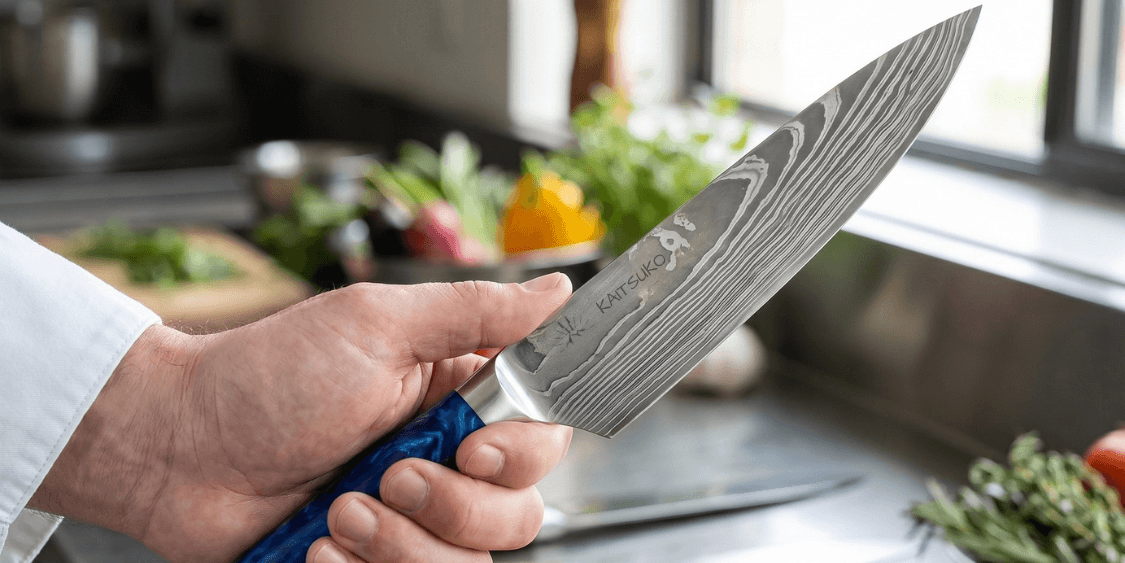
In our Damascus steel collections, like Yakumoto, Kyoto or Yellow Sea, the principle remains identical: the characteristic multi-layer pattern of Damascus steel has no bearing on bevel symmetry. These are two independent characteristics, and at Kaitsuko, Damascus steel is always sharpened with a double bevel.
Even our Prestige collection, with its Kiritsuke knives featuring an asymmetric tip and resin handles, retains a double bevel on the blade. Only the shape of the tip is asymmetric, not the edge itself: the cut therefore remains perfectly neutral, regardless of your hand.
If you're left-handed and hesitating to invest in a Japanese knife for fear of ending up with a right-hand-oriented blade, you can completely set that concern aside when buying from Kaitsuko. It's an argument we regularly put forward with our left-handed customers: no need to look for a more expensive or harder-to-find "left-handed version" our entire catalogue works natively for you.
If you're just starting out with your first Japanese knife and want to know which to prioritise, our beginner's guide remains valid, left- or right-handed: the recommendation doesn't change.
Why We Made This Range Choice at Kaitsuko
People sometimes ask why we don't offer a Yanagiba or Usuba, since these are iconic knives in Japanese cutlery. The answer comes down to two words: versatility and accessibility.
Our catalogue is built around knives you will actually use, every day, regardless of your dominant hand: Gyuto, Santoku, Nakiri, Petty, Kiritsuke and bread knife. These are blades designed to adapt to your kitchen, not the other way around. A beautiful Yanagiba oriented for the wrong hand, or simply left unused because you don't make sashimi every week, has no real practical value.
This approach particularly benefits left-handers, who normally don't have to question whether their equipment is compatible. With us, that question simply disappears, and you can choose a knife based on the use and steel that interest you, with no constraint linked to your hand.
How to Recognise a Single Bevel Before Buying
If you're buying outside our catalogue and want to verify for yourself that a knife suits your hand, here's the check to make. Look at the blade closely in the light: on a single bevel, only one side has a true sharpened slope, while the other face remains virtually flat, sometimes slightly hollowed. On a double bevel, both faces present an identical, symmetrical slope.
If the product page doesn't clearly state "double bevel" or "double edge", and the knife belongs to a traditional family like the Yanagiba or Usuba, it's worth asking the seller for confirmation before buying - particularly if you're left-handed.
Common Mistakes to Avoid
Thinking all Japanese knives are right-hand oriented. That's false for the vast majority of modern double-bevel knives, which account for the bulk of sales and everyday use.
Buying a single-bevel specialist knife without checking the orientation. This is the most costly mistake, since it can render a premium knife unusable in your dominant hand.
Confusing the handle orientation with that of the blade. Some asymmetric handles (notably the traditional Japanese D-shape) are also oriented for a specific hand, independently of the blade bevel. Check both elements separately if you opt for this type of handle.
FAQ – The Most Common Questions About Japanese Knives for Left-Handers
Does a double-bevel Japanese knife genuinely suit a left-hander 100%? Yes. Since the sharpening angle is identical on both sides, the cut behaves symmetrically, without favouring one hand over the other.
Are all Kiritsuke knives suitable for left-handers? Most modern Kiritsuke knives intended for versatile use have a double bevel and are therefore suitable for left-handers. The more traditional single-bevel versions are rarer and generally reserved for very specialised use.
How do you know if a knife you already own has a single or double bevel? Observe the blade in the light: a double bevel has an identical slope on both sides, while a single bevel only has a true sharpened slope on one side.
Are there Japanese knives specifically made for left-handers? Yes, for traditional single-bevel knives like the Yanagiba, some craftsmen offer reversed versions for left-handers, generally made to order or in small batches, and therefore at a higher price.
Should left-handers avoid Japanese knives entirely? No — quite the opposite. Simply favour double-bevel knives, which represent the vast majority of the current offering, including our entire catalogue at Kaitsuko.
Do I need to choose a specific "left-handed model" at Kaitsuko? No, and that's precisely the advantage of our catalogue: no distinction is necessary. All our knives, from the Chef Tanaka Gyuto to the Yakumoto and Prestige collections, have a double bevel and work identically for left- and right-handers.
Why doesn't Kaitsuko sell Yanagiba or Usuba knives? They're specialist knives, right-hand oriented by default, and poorly suited to versatile everyday use. We chose to build our catalogue around knives that everyone can use without constraint, left- or right-handed.
In Summary: What Left-Handers Need to Know
The vast majority of everyday Japanese knives — Gyuto, Santoku, Nakiri, Petty, modern Kiritsuke and bread knife — have a symmetrical double bevel and are therefore perfectly suited to left-handers, with no adaptation needed.
Only traditional single-bevel knives, like the Yanagiba, Usuba or Deba, require prior checking of the orientation, or a specific left-handed version if one exists. For everyday kitchen use, you can choose a Japanese knife with full confidence, regardless of your dominant hand. To know precisely which ones to add to your kitchen first, our top 5 essential Japanese knives list remains valid for left- and right-handers alike.
This article draws on the concrete experience of the Kaitsuko team: 5 years of activity, over 100,000 knives sold across France and Europe, and regular conversations with our left-handed customers about their questions before purchase.
Updated 1 July 2026 - Written by the Kaitsuko team, after 5 years of crafting and selling nearly 500,000 Japanese knives across France and Europe.
Knife HRC Hardness Explained: How to Read a Product Spec
Top 5: The Essential Japanese Knives for Your Kitchen