



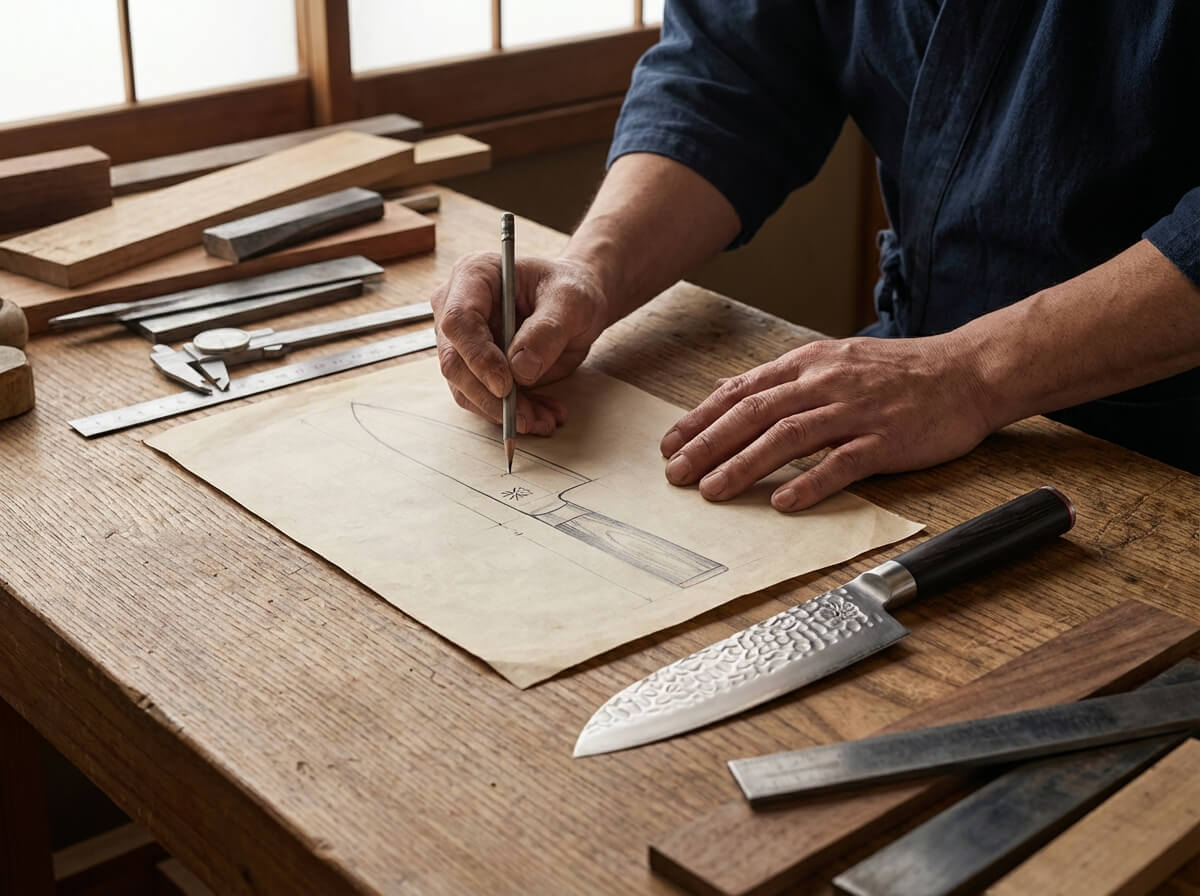
Behind every Kaitsuko knife, there isn't simply a blade and a handle put together. There is a succession of decisions, tests, adjustments and validations, guided by a single obsession: to create a tool that is genuinely pleasant to use every day, capable of delivering precision, comfort and durability, without unnecessary compromises or marketing gimmicks.
Designing a knife isn't purely an aesthetic exercise. It's a subtle balance between performance, ergonomics and reliability. And that balance is precisely what we aim for with every new model.
It Always Starts with Use
Before we even talk about steel or design, we ask ourselves a simple question: what is this knife actually going to be used for? Is it a versatile knife for daily prep work? A more specialised blade for meat or fish? A compact model for fine cutting? Every type of use brings its own constraints, its own balance, its own geometry.
That reflection is where the first idea is born. We define the blade profile, its ideal length, its thickness, the shape of the edge, and the way the knife should feel in hand. At this stage, nothing is fixed. It's a working basis, a starting point.
The Design Phase
Then comes the actual design phase. We work on the knife's overall design, looking for a natural balance between blade and handle — because a good knife should never "fall" forward or pull backward. The weight must distribute harmoniously so that the movement stays fluid, even after several minutes of cutting.
At the same time, we select the steel based on the intended use. This choice is decisive. It directly influences cutting performance, edge retention, ease of maintenance and the knife's longevity. We favour steels known for their stability and performance, combined with precise heat treatments, to achieve a balanced hardness: high enough to maintain a lasting edge, but not excessive to avoid unnecessary brittleness.
The Prototype Stage
Once these elements are validated, we move to the prototype stage.
These first versions serve to test the knife under real conditions. We evaluate the grip, cutting precision, the feel during repetitive movements, and the blade's responsiveness on different foods. Vegetables, meats, herbs, more delicate products… every test allows us to identify micro-adjustments: a few grams less on the handle, a slightly different angle on the edge, a subtle modification to the blade's curve.
It's often at this point that the real difference is made between a decent knife and one that is genuinely pleasant to use.
We don't aim for theoretical perfection : we aim for practical rightness.
A knife can look excellent on paper and disappoint in hand. That's why every model goes through several iterations before being definitively approved.
Production and Quality Control
Once the final design is set, production can begin. But here too, nothing is left to chance. Blades are shaped, heat-treated, then sharpened at a precise angle chosen to offer an optimal compromise between immediate sharpness and durability. Handles are assembled with care, with attention paid to ergonomics, stability and the solidity of the whole.
Every batch is then checked. We verify the regularity of the edge, the alignment of the blade, the overall finish, and the feel in hand. This quality control work is essential: a good knife isn't just a matter of materials — it's also a matter of consistency.
A Coherent Range for Every Profile
This approach is what allows us today to offer a coherent range, designed for different cook profiles, from the passionate home cook to the demanding professional. We have brought all our models together in a dedicated selection so that everyone can find the knife that truly matches their way of cooking.
But designing a knife doesn't stop at its manufacture.
We also think about how it will live in your home. How it will be used every day. How it will age. How it can be maintained easily. A good knife should accompany its user for years, without becoming a burden. That's why we place so much importance on ease of sharpening, resistance to wear and long-term comfort.
Sets for Every Need
Rather than accumulating average knives over time, many of our customers prefer to start with a solid foundation of complementary models capable of covering the essentials from day one. That's the case with our Kaito knife set, designed to offer a balanced and durable collection for everyday cooking.
For those who want to go further and fully equip their kitchen with blades designed to work together, we have also developed complete sets, such as our Yellow Sea 7-knife set, which immediately provides a coherent range without compromise on ergonomics or performance.
Many also start with a versatile model capable of handling vegetables, meat and fish alike. That's often the first contact with the Kaitsuko world, and the one that immediately makes you feel the difference a well-designed knife brings to everyday cooking.
A Companion for the Long Term
Over time, we always observe the same phenomenon: once a user gets used to a good knife, their old models often end up at the back of a drawer. Not out of snobbery, but simply because the comfort, precision and fluidity become hard to give up.
At Kaitsuko, we don't claim to reinvent cooking. We simply aim to provide honest, well-thought-out tools, designed with rigour, capable of concretely improving everyday life. Every knife is the result of a design process, tests and successive adjustments, with one clear objective: that you enjoy cooking, day after day.
Because in the end, a good knife is not a decorative object. It's a working companion. A tool that accompanies your movements, respects your effort and elevates your skill, whether you're preparing a quick meal or a more elaborate dinner.
And that's exactly the philosophy that guides each of our creations, from the first idea to the moment the blade arrives in your kitchen.
Chef's Knife or Santoku: Which to Choose for Everyday Cooking?
Knife HRC Hardness Explained: How to Read a Product Spec