

This is the question that comes up most often in our customer service. Someone wants to get serious about cooking, understands that a good knife changes everything, and finds themselves looking at two similar-sounding options: the chef's knife and the Santoku. Different blade, different size, different cutting technique, but largely overlapping uses. Which one to choose when you want a single knife for everything?
The answer depends on your level, your cooking style, and the space you have on your worktop. This article will give you the real decision criteria, without pushing a universal answer that doesn't exist. By the end, you'll know exactly which of the two to choose.
The Essential Difference Between the Two Knives
The chef's knife and the Santoku share the fact that both are versatile knives. They can cut meat, fish, vegetables and herbs : and that's precisely what creates the confusion. But they are designed according to two different philosophies.
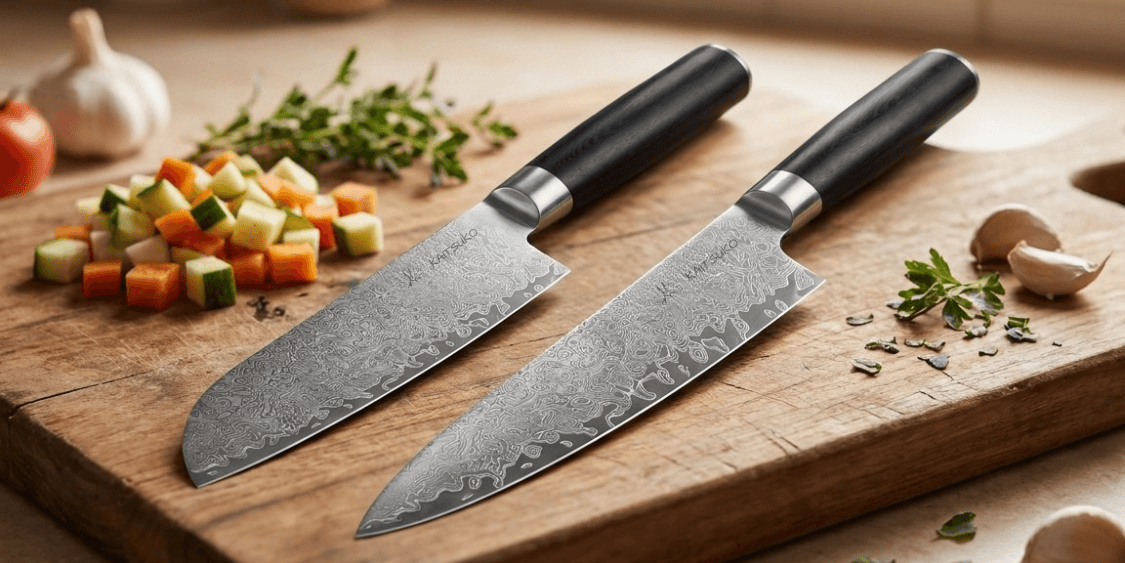
The Japanese chef's knife has a slender, willow-leaf-shaped blade, typically measuring between 20 and 24 centimetres. Its tip is pronounced, and the curve of its blade allows a smooth rocking motion on the board. It's the knife closest to a classic Western chef's knife, but with a much finer edge (15 degrees versus 20 or 22 degrees on a Wüsthof or Zwilling). If you're used to European knives, the transition happens naturally.
The Santoku is shorter (typically between 17 and 18 centimetres) and wider. Its blade is almost rectangular, with a rounded tip sometimes called a "sheep's foot" profile. The word "Santoku" literally means "three virtues" in Japanese, referring to its three main uses: slicing, dicing and mincing. Its shape requires a vertical cutting technique : the push-cut, where you push the blade forward rather than rocking it.
They are two tools designed for the same versatile function, but requiring two different movements. That nuance is what will guide your choice.
The Chef's Knife in Detail
With its longer and more curved blade, the Japanese chef's knife offers more cutting surface. In practice, you can tackle larger pieces without having to reposition them constantly. A roast to trim, a chicken to carve, a large onion to mince — all of this is done with a fluidity the Santoku can't match.
The rocking motion technique, where the tip stays in contact with the board while the heel rises and falls, is extremely effective once mastered. It allows you to chain cuts quickly with minimal effort. That's why this type of knife is found in professional kitchens worldwide, both Western and Japanese.
The other advantage is the tip. It's fine and precise, allowing incisions, boning a bird, separating delicate pieces, and tackling difficult starting cuts. On a Santoku, that precision is sacrificed in favour of a wide blade that serves a different purpose.
On the other hand, the chef's knife requires a little more learning. The rocking motion doesn't come naturally. And its length can intimidate people cooking in a small kitchen, on a small board, or who have never handled a blade longer than 18 centimetres.
At Kaitsuko, chef's knives are available across all our collections. The Tanaka Forest Wood chef's knife is our best-selling entry-level model, in 5CR15MoV steel at HRC 54±2, robust and easy to maintain. The Yakumoto chef's knife steps up with a 67-layer 10CR15CoMoV Damascus steel blade at HRC 60±2.
The Santoku in Detail
The Santoku is the reassuring knife. Its compact shape and rounded tip make it less intimidating than a 24-centimetre chef's knife, and it forgives many technique errors. If you've never really learned to handle a knife, the Santoku is probably your best entry point into the world of Japanese knives.
Its wide blade naturally guides the cut. You rest the tip on the board, press down, and the knife does the rest. No complex rocking motion, no technique to learn. It's intuitive, fast and precise from day one.
For vegetables, it's unbeatable. The tall blade leaves room for fingers, which is reassuring when you're slicing an onion or cutting a carrot. For meat, the Santoku cuts as cleanly as a chef's knife, as long as the piece isn't too thick. For fish, it works wonders on fillets and portions.
Where it struggles is on large pieces and precision work with the tip. If you want to bone a whole chicken, trim a duck breast, or make incisions in meat to marinate, you'll find the Santoku frustrating. Its rounded tip isn't made for that.
In our range, the Chef Tanaka Santoku at €61.99 is our entry-level reference, in 5CR15MoV steel, ideal for discovering the format without a big investment. Above that, the Yakumoto Santoku at €119.99 offers 67-layer 10CR15CoMoV Damascus steel with significantly superior edge retention.
How to Choose Between the Two
This is the part that matters to you. Rather than giving a theoretical answer, here's how we reason in practice, starting from your actual profile.
If you're a beginner in the kitchen, or have never really learned to handle a professional knife, go for a Santoku. You'll be comfortable from day one, you'll progress quickly, and you won't experience any frustration. It's also the best option if you cook on a modest-sized worktop or board, because its compact blade is easier to manoeuvre in a limited space.
If you already cook regularly, are used to European knives and want to upgrade while keeping your existing habits, go for a Japanese chef's knife. The transition happens naturally, you gain immediately in cutting precision, and you'll keep this knife for a long time. It's also the default choice if you cook a lot of meat, poultry, or regularly work with larger pieces.
If you mainly cook vegetables, the Santoku has a slight edge. Its wide blade allows you to transfer cut ingredients directly to the pan or a bowl, something a narrower chef's knife doesn't do as well. For a cook who frequently prepares slices, julienne or brunoise, it's a genuine daily advantage.
If you cook a lot of meat, whole fish, or enjoy precision work, the chef's knife wins. Its tip and blade length give you a versatility the Santoku can't match.
If you simply want one quality knife to handle 95% of what you cook at home and are still undecided, take the Santoku. It's the safest choice for someone who doesn't want to make a mistake.
What About Getting Both?
That's a legitimate question, and it's actually what we observe with many of our long-term customers. Initially they buy one knife, usually a Santoku. Six months or a year later, they come back for a chef's knife, because they've understood what each one brings.
The chef's knife and the Santoku don't really compete in a kitchen. They complement each other. The chef's knife for larger pieces, precision, the rocking motion. The Santoku for everyday vegetables, quick chopping, mincing. With these two knives, you cover the essentials of what you do in a kitchen.
That's also the logic behind most of our sets. A 3-knife Japanese set typically includes a chef's knife, a Santoku and a paring knife. This three-piece combination is what we call a complete "starter kit", and what we recommend to the majority of customers who want to equip themselves seriously.
The Steel Question
Whatever your choice between chef's knife and Santoku, the question of steel will come up at purchase time. And it's probably more important than the choice of blade type.
A Santoku in 5CR15MoV steel at HRC 54 will do better daily work than a chef's knife in poorly maintained Damascus steel. Conversely, a chef's knife in 67-layer 10CR15CoMoV Damascus steel at HRC 60 will hold its edge twice as long as the same blade in standard steel. Steel hardness changes your maintenance rhythm, not the quality of the cut on first use.
To start, a robust stainless steel like 5CR15MoV (our Chef Tanaka collection) is more than sufficient. You learn to use the knife, discover the maintenance routine, and see if you really connect with the Japanese format. If so, you then step up to a 10CR15CoMoV Damascus steel, as found in our Kaito, Yakumoto, Kyoto, Yellow Sea or Tokyo collections.
If you really want to understand what changes from one steel to another, we have a complete guide on Japanese knife steels that goes into the technical details.
Mistakes to Avoid
When you advise customers every day, you see the same mistakes come up. Here are the most common ones when choosing between a chef's knife and a Santoku.
The first: choosing a chef's knife because it "looks professional", without having ever learned the rocking motion. You'll use it like an ordinary kitchen knife, benefit from none of its advantages, and end up frustrated. If you're not ready to spend ten minutes watching a tutorial and practising the movement, the Santoku is more forgiving.
The second: getting a Santoku that's too short because it seems "more manageable". A Santoku under 17 centimetres quickly becomes limiting the moment you tackle anything other than vegetables for two people. Stick to 17–18 centimetres minimum for versatile use.
The third: thinking a Santoku can do everything. It's versatile, yes, but it has its limits. If you regularly cook large cuts of meat or whole fish, don't force it. Add a chef's knife, or switch format from the start.
The fourth, more general mistake: neglecting the cutting board and maintenance. A Japanese knife at HRC 60 is very sharp but also more fragile than a Wüsthof. A glass or ceramic board will damage it within weeks. And a knife that's never resharpened, however expensive, will lose its edge. If you invest in a good knife, invest in a proper whetstone and a wooden board too.
FAQ
Can the Santoku really replace a chef's knife? For 90% of domestic uses, yes. The Santoku is perfectly suited to daily cooking for two to six people with standard-sized ingredients. The real limits only appear on large cuts of meat, whole birds to carve, and precision work with the tip.
What size chef's knife to choose? For home use, a 20 or 21 cm blade is an excellent compromise. Shorter and you lose cutting surface on large pieces. Longer and it becomes unwieldy in an average-sized kitchen. Professional chefs often work with 24 cm, but that's rarely justified at home.
What size Santoku to choose? The standard format, 17 or 18 centimetres, suits almost all home kitchens. Avoid 14 or 15 cm models if you want a genuinely versatile knife — they quickly become limited. The small Santoku around 14 cm makes an excellent second knife, not a first.
What steel to choose for a first purchase? A stainless steel like 5CR15MoV in the HRC 54–56 range, like our Chef Tanaka collection. It's robust, forgiving of maintenance mistakes, and more than sharp enough to discover the Japanese world. If you connect with it, you then step up to 67-layer 10CR15CoMoV Damascus steel, found in our Kaito, Yakumoto, Kyoto, Yellow Sea or Tokyo collections.
Is the Santoku only for beginners? Not at all. Many professional Japanese chefs use a Santoku daily. It's a versatility knife, not a beginner's knife. It's simply more technically accessible than a chef's knife, which makes it particularly suitable for beginners, without making it a lesser tool.
Granton edge or smooth blade? Granton dimples, sometimes called hollow-ground or anti-stick indentations, prevent food from sticking to the blade during cutting. This is useful mainly on wet vegetables like potatoes or courgettes. On meat and fish, the effect is marginal. It's a comfort rather than a necessity.
How much does a good first Japanese knife cost? Budget between €60 and €80 for an excellent first quality knife, whether Santoku or chef's knife. Below €50, be cautious — the compromises on steel or finish become significant. Above €100, you enter premium Damascus steels, which are justified when you know what you're buying.
In Summary
The chef's knife and the Santoku are both versatile tools, but they're not used the same way and they don't shine in the same situations. The chef's knife is more versatile in theory, more powerful on large pieces, but requires a little more technique. The Santoku is more accessible, quicker to get to grips with, perfect for everyday cooking centred on vegetables and normal portions.
For a first purchase, if you're still unsure, take the Santoku. It's the safest choice. If you already cook a lot or are coming from a European knife, take the chef's knife. And in the long run, both tend to coexist in most serious kitchens.
Whatever your decision, take the time to choose the steel and collection that suit you. A good Japanese knife is a companion for ten or fifteen years. It deserves a few minutes of thought.
Explore our chef's knife collection or browse our Santoku knives.
This article draws on our experience at Kaitsuko. For five years, we have been designing, importing and selling Japanese knives across France and Europe, with more than 100,000 orders delivered. Our knives are shipped from our European warehouse and backed by customer service based in France.
Updated 27 May 2026. Written by the Kaitsuko team, after 5 years of crafting and selling nearly 500,000 Japanese knives across France and Europe.
Nakiri vs Santoku: Which Knife to Choose for Vegetables?
How We Design a Japanese Knife: From Idea to Your Kitchen