

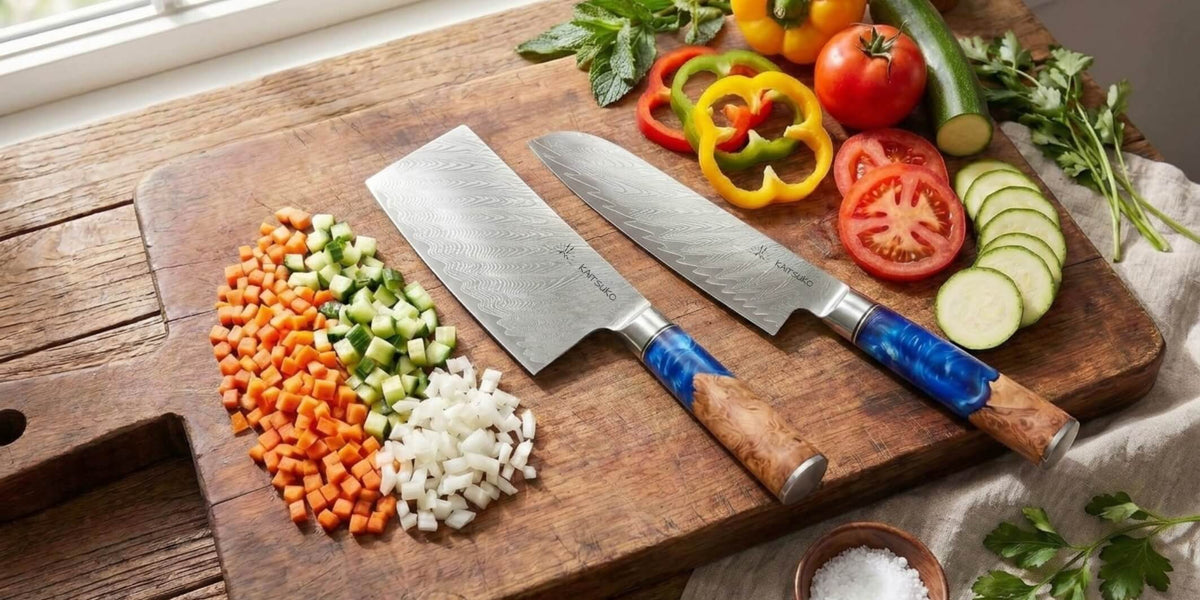
If you cook a lot of vegetables, you always come back to the same duel: Nakiri or Santoku. Both have a wide blade, both excel on vegetables, and both cost roughly the same. On paper, it's a tough call. In practice, the difference is clear.
Here's how to decide.
The real difference in one sentence
The Nakiri is a specialist. The Santoku is an all-rounder.
The Nakiri is designed for one thing, and it does it better than any other knife: cutting vegetables with a perfect vertical downward stroke, no rocking motion. The Santoku cuts vegetables very well too, but it can also handle meat, fish, and cheese. If you want the best tool for vegetables only, it's the Nakiri. If you want one knife that does everything, it's the Santoku.
The rest of this article provides the detail to help you decide which one suits your kitchen.
The Nakiri in detail
The Nakiri blade is rectangular, almost like a small cleaver. No tip, no curve — just a straight edge from 16 to 18 centimetres. This shape isn't an aesthetic whim; it has a very precise function.
When you cut with a Nakiri, the blade comes down as one unit, in full contact with the board along its entire length. No rocking, no pulling — you push straight down. The result: the cut is perfectly clean, slices are even, and most importantly the vegetable fibres aren't crushed. A tomato doesn't lose its juice, an onion doesn't make you cry as much, fresh herbs aren't mangled.
This is what's called a pure vertical push-cut. With a Santoku or a chef's knife, you always keep a slight forward motion. With a Nakiri, it's strictly vertical. That difference changes the cooking experience when you're preparing large amounts of vegetables.
Good to know: the flat surface of the Nakiri also serves to transfer cut ingredients directly from the board to the pan. Many cooks call it a "scoop knife" for this reason. It's a small detail, but one of those that makes the tool genuinely pleasant to use day to day.
On the limitations side: the Nakiri isn't made for meat, whole fish, or precision work with the tip (since it doesn't have one). Ask it to do those things and it'll manage, but poorly. That's not its job.
The Santoku in detail
We've already covered the Santoku in detail in our chef's knife vs Santoku comparison. As a reminder: 17–18 cm blade, wide, with a slightly rounded tip (the famous "sheep's foot" profile). Versatile, accessible, perfect for everyday cooking.
On vegetables, the Santoku handles things very well. Its wide blade gives you the same visual comfort as the Nakiri (fingers well away from the edge), and its push-cut technique delivers excellent results. The difference is that it retains a slight rock. On a thin courgette slice, you won't feel the difference. On long, even julienne strips, the Nakiri will be more precise.
The real advantage of the Santoku is that it doesn't lock you in. You cut your vegetables, then move on to your chicken breast, then slice your salmon fillet — all with the same knife. With a Nakiri, you'd need to reach for a second knife the moment you leave the world of vegetables.
For whom? If you eat varied meals and want a single tool, the Santoku wins. If vegetables make up 80% of what you cut, the Nakiri takes the lead.
Quick comparison
| Criterion | Nakiri | Santoku |
|---|---|---|
| Shape | Rectangular, no tip | Wide, rounded tip |
| Typical length | 16 to 18 cm | 17 to 18 cm |
| Cutting technique | Pure vertical push-cut | Push-cut with slight rock |
| Vegetables | Excellent | Very good |
| Meat | Limited | Good |
| Fish | Limited | Good |
| Precision (scoring, boning) | None | Limited |
| For whom | Very vegetable-heavy cooking | Versatile cooking |
The Kaitsuko Nakiri range
Three main collections depending on your budget and level of expectation.
Nakiri Chef Tanaka — €61.99
The accessible entry level. 5CR15MoV steel, HRC 54±2, resin handle. Our best-selling Nakiri and the ideal entry point for anyone who wants to discover the format without a big investment. Three colours available (Blue Ocean, Fire Land, Forest Wood) with a unique pattern on each epoxy resin handle.
Our verdict: perfect for getting started. More than sharp enough for home use, robust, easy to maintain. If you're discovering Japanese knives and want a Nakiri without committing to premium, this is the one.
Nakiri Yellow Sea
The next level up. 67-layer Damascus steel blade in 10CR15CoMoV, HRC 60±2, hammered and folded technique. Handle in stabilised wood and epoxy resin in beige and blue tones, original design.
Our verdict: the combination we recommend to customers who already cook a lot of vegetables and want a tool built to last. Edge retention is around twice that of the Chef Tanaka. You sharpen less often and gain in day-to-day performance.
Nakiri Kyoto
The refined premium option. Same 67-layer Damascus 10CR15CoMoV steel, HRC 60±2, but with a more modern and minimalist design. Imported resin handle, highly polished finish, premium aesthetic.
Our verdict: this is the Nakiri you give as a gift — or treat yourself to. Same technical performance as the Yellow Sea with a more contemporary visual signature. Choose based on aesthetic preference rather than technical criteria.
When the Nakiri truly replaces the Santoku
Here are the profiles where we clearly recommend the Nakiri over a Santoku.
You're vegetarian or flexitarian. 80% of what you prepare is plant-based. Your occasional meat or fish can be handled with a chef's knife or paring knife alongside. The Nakiri becomes your main knife and you gain real cutting comfort every day.
You cook Asian food regularly. Wok dishes, ramen, salads, stir-fries, julienne or brunoise vegetables. The Nakiri is designed precisely for this kind of prep work — it's its home territory.
You already have a chef's knife or Santoku. If you already own a versatile knife, the Nakiri becomes the perfect complement. The second knife that turns a "decent" kitchen into a "properly equipped" one.
You care about cutting precision. If you're the type who appreciates perfectly even slices, calibrated julienne, finely chopped herbs, the Nakiri will give you a satisfaction the Santoku simply doesn't.
When the Santoku remains the better choice
On the other hand, don't buy a Nakiri if you're in one of these situations.
You're looking for your first Japanese knife and want ONE single knife. The Santoku is more versatile, more forgiving, and will follow you across every task. The Nakiri will be too specialised for solo use.
You eat a lot of meat or fish. A Nakiri on a rib of beef is the wrong tool. On a whole salmon, it's a struggle. The Santoku handles both.
You don't want to learn a new cutting technique. The pure vertical push-cut takes a small adjustment period if you're coming from a European knife. The Santoku, by contrast, is immediately intuitive.
How Kaitsuko compares to other brands
Honestly, the Nakiri is a format where quality is fairly consistent across the €60–150 segment. Major Japanese brands like Kai (Shun range), Tojiro and Global all offer solid Nakiri in this price range. The differences come mainly from the steel chosen, the finish, and the handle design.
In the European market, DTC brands like Maison Damas or Kotai also offer their Nakiri, often positioned slightly higher in price.
Where Kaitsuko stands out is on three concrete points:
First, value for money at the entry level. Our Chef Tanaka Nakiri at €61.99 is probably one of the most accessible Nakiri on the market at this quality level. Most brands start around €80–100 for an equivalent product.
Then, French customer service and fast shipping from our European warehouse. No customs, no baffling delays, a real human to contact with questions.
Finally, the unique patterns on the resin handles in the Chef Tanaka range, which mean your knife isn't exactly identical to your neighbour's.
It's not about "who makes the best Nakiri in the world" — that's a debate that doesn't make sense. It's about what price-quality-service ratio you're looking for. Many of our customers come from Kai or Global and write to tell us they find our knives at the same level for a significantly lower price. That's also why we're approaching 100,000 sales.
Caring for your Nakiri
Three rules, the same as for all our Japanese knives.
Hand wash only. No dishwasher. Detergents and thermal shock damage both the steel and the handle, especially on Damascus models which are more sensitive.
Dry immediately after washing. A Japanese knife, even stainless, doesn't like sitting wet. One wipe with a clean cloth and back onto the block or magnetic bar.
Sharpen regularly on a whetstone. For a 67-layer Damascus Nakiri used daily, plan on sharpening every 3 to 4 months. For a Chef Tanaka used less intensively, every 6 months is enough. If you're not sure where to start, we've put together a complete guide on sharpening angles.
Absolutely avoid: glass, marble or ceramic boards. And even boards made from low-quality hard wood like poor bamboo. Soft wood such as rubber wood, maple or olive is ideal for preserving your Nakiri's edge.
FAQ
Can the Nakiri cut meat? Technically yes, on thin slices of already-boned meat. But that's not its purpose. The blade is designed for vegetables, and you risk chipping the edge on pieces that require a bit of force. For meat, a chef's knife is better suited.
What size Nakiri should I choose? The standard format, between 16 and 18 cm, suits 95% of kitchens. Below that, you lose cutting surface on larger vegetables. Above it, it becomes unwieldy. All our Nakiri fall within this range.
Do you need a Nakiri if you already have a Santoku? It depends on what you cook. If you cut a lot of vegetables every day, yes, you'll feel the difference. If your vegetable work is occasional, your Santoku is more than enough.
Is the Nakiri a good gift? An excellent gift, but only for someone who cooks regularly and knows what a Nakiri is. For a "discovering Japanese knives" gift, opt instead for a Santoku or a complete set that covers more uses.
Why does a Nakiri cost the same as a Santoku? Because the manufacturing complexity is equivalent. Same steel, same forging process, same finish. The difference in shape doesn't change production costs. You're paying for the quality, not the specialisation.
To summarise
If you take away one thing: the Nakiri is the best knife in the world for cutting vegetables, but it's a specialist. The Santoku is less specialised on vegetables but more versatile across everything else.
For a single first purchase, get a Santoku. To complement an already-equipped kitchen or for very vegetable-heavy cooking, get a Nakiri. And if your budget allows, both together in a kitchen is the winning combination.
Discover our Nakiri — Discover our Santoku
Article written by the Kaitsuko team. For five years, we've been manufacturing and selling Japanese knives across France and Europe. Over 100,000 orders delivered, mentions in Brut, Konbini, Forbes, M6, Europe 1, Le Parisien, Marie Claire, 20 Minutes. Shipped from our European warehouse, customer service based in France.
Updated 26 June 2026 – Written by the Kaitsuko team, after 5 years of crafting and selling nearly 500,000 Japanese knives across France and Europe.
Japanese Knife Buying Guide 2026: Expert Advice to Get It Right
Chef's Knife or Santoku: Which to Choose for Everyday Cooking?