



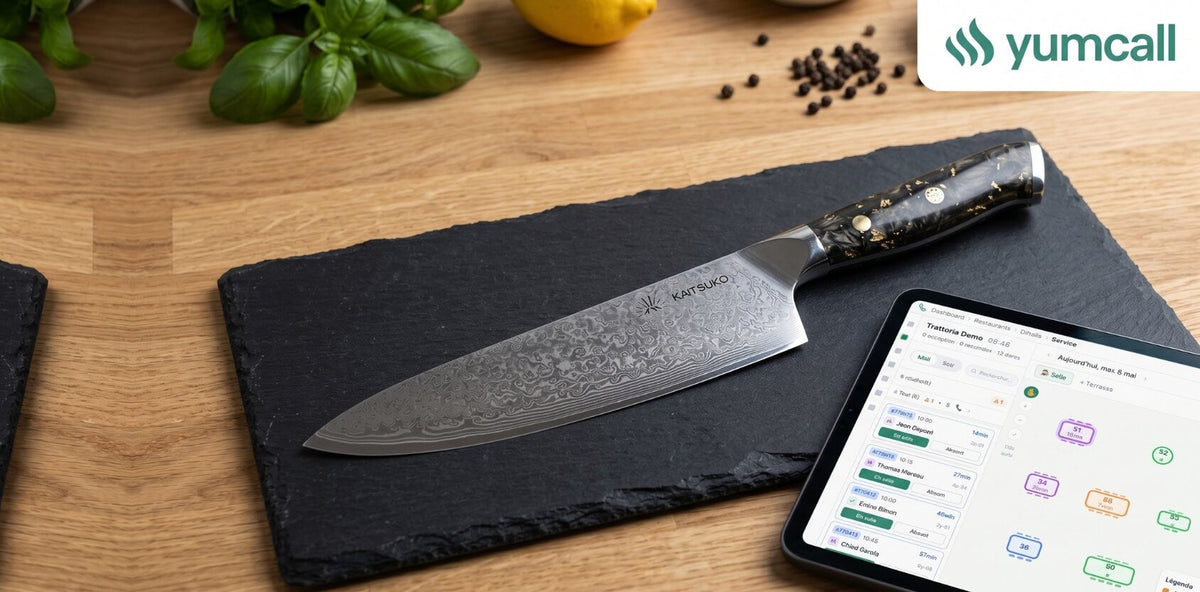
Which knives to equip a restaurant kitchen? Which ones truly matter, how to choose them, how to maintain them, and why the best equipment alone isn't enough to run a successful establishment.
Ask any cook what their most important tool is. They'll show you their knife. In a professional kitchen, it's not just another accessory: it's an extension of the hand, the first thing you reach for in the morning and the last you wipe down at night. A large part of any service is spent cutting, slicing, chopping, deboning. Repeat these movements across hundreds of covers, day after day, and you quickly understand how much the choice of blades affects work quality, service speed, and simply the fatigue of the kitchen team.
And yet, how many kitchens are poorly equipped? Drawers full of knives that never get used, budget blades repurchased every six months, steels that won't hold an edge for a week. You think you're saving money, but you're losing it: in time, energy, and cost over the long run. In this guide, we'll look at which knives are truly indispensable in food service, how to choose them well, and how to make them last. And since a restaurant doesn't live by beautiful cuts alone, we'll close with what happens beyond the cutting board — where many establishments let revenue slip away without even noticing.
Why Knife Choice is Strategic in Food Service
A good knife is first and foremost precision. A fine, well-sharpened blade cuts clean, without crushing the product. Meat stays beautiful, vegetables don't brown at the edges, plating gains refinement. For a kitchen that takes care with its dishes, this consistency is far from trivial: it's often what separates a controlled kitchen from one that's just getting by.
It's also a matter of speed and comfort. In the heat of service, a blade that bites on the first pass saves precious seconds on every preparation. A dull knife, on the other hand, forces you to push, slows the motion, and ends up wearing out the wrist over the course of a service. On a busy evening, the difference adds up in minutes gained and tendinitis avoided.
Then there's safety — and here, intuition misleads everyone. It's not the sharp knives that cause injuries, it's the others. A tired blade slips, skids, slides off a tomato skin, and the accident happens. A well-sharpened, controlled knife stays under control. Equipping your team properly also means looking out for your cooks.
The Truly Indispensable Knives
There's no need to line up twenty knives per station. In a professional kitchen, the essentials come down to a handful of well-chosen blades, each with its role. Here is the solid foundation for equipping a restaurant without excess.
The Chef's Knife (Gyuto)
This is the king of knives, the one no one can do without. The Gyuto is the Japanese equivalent of the Western chef's knife, and it's the ultimate all-purpose blade: meat, fish, vegetables, herbs — it handles almost every task. Its long, well-balanced blade allows for broad, clean cuts. If you could only give each cook one great knife, this would be it. A Chef Tanaka Gyuto or a Yakumoto chef's knife in Damascus steel offers this versatility with an edge that holds through service.
The Santoku
Shorter and more nimble than the Gyuto, the Santoku (literally "three uses") excels with vegetables, boneless meats, and fish. Its flat blade and low tip make it very intuitive, fast, and consistent. It's the ideal complement to the chef's knife, and often the favourite of prep cooks for all their mise en place.
The Nakiri
The Nakiri is the vegetable specialist. This rectangular cleaver with a straight blade cuts straight through without any need to saw. Slicing, julienning or brunoise-cutting in bulk becomes effortless. In a kitchen that works heavily with vegetables, it saves enormous amounts of time and delivers a consistency that few blades can match.
The Kiritsuke
More technical in nature, the Kiritsuke is a hybrid knife — elegant and remarkably precise, long reserved for experienced chefs. Its long blade with a straight tip excels on fish as well as vegetables and fine cuts. It's the "signature" blade, the one that combines performance and prestige, perfect for a chef who wants an exceptional tool in hand.
The Paring Knife and the Boning Knife
Alongside the larger blades, two small knives are indispensable. The paring knife, short and precise, handles all the delicate work: turning vegetables, trimming, peeling, fine chopping. The boning knife, with its thin, rigid blade, is essential whenever meat or poultry is involved. These are the detail tools, the ones that handle the finishing work.
The Bread Knife
It's often forgotten, which is a shame. The serrated bread knife isn't just for bread: brioche, tomatoes, certain pastries all depend on it for a clean cut. A good serrated blade slices without crushing — and that makes all the difference in presentation.
Steak Knives (Front of House)
Don't forget the dining room. Steak knives are a full part of the customer experience: a beautiful cut of meat deserves a blade that slices through it in one motion, without sawing at the plate. It's the kind of detail customers notice, sometimes without articulating it, and it extends in the dining room all the care put in at the kitchen.
Which Steel for Intensive Use?
In food service, the knife never rests. Steel choice becomes decisive for edge retention and blade longevity. Damascus steel, with its VG10 core surrounded by multiple layers, offers an excellent compromise: remarkable sharpness, great resilience, and that characteristic pattern that also makes it beautiful. It's the heart of high-end Japanese cutlery and a reliable choice for demanding use.
There remains the eternal debate between carbon steel and stainless steel. Carbon offers exceptional sharpness, but requires discipline: immediate drying, vigilance against rust. Stainless is more forgiving, making it better suited to an environment where equipment passes through multiple hands at all hours. For a brigade, the durability and ease of maintenance of a good high-end stainless steel often win out. What matters, ultimately, is choosing a quality steel that holds its edge service after service.
Set or Individual Pieces to Equip a Brigade?
Should you buy sets or individual knives? It depends on your setup. A complete set, like the Chef Tanaka sets or the Yakumoto collection, lets you equip a station or an entire kitchen quickly and consistently, with good value for money. Individual pieces, meanwhile, allow you to give each cook their preferred knife. And this point shouldn't be underestimated: many chefs are attached to "their" Gyuto — the one they know inside out and that no one else touches.
In practice, the most effective approach often combines both: a solid set as the common foundation for the kitchen, and a few fine individual pieces for key stations and chefs. The goal is never to accumulate, but to make sure everyone has the right blade for their position.
Maintenance: The Real Secret to Longevity
A beautiful knife that's poorly maintained ends up no better than a cheap blade. In a professional kitchen, maintenance must become a shared reflex across the whole team, not one person's obsession. A few simple habits change everything.
Wash knives by hand, never in the dishwasher, which attacks the edge and damages the handle. Dry them immediately after washing, to give corrosion no chance. Sharpen them regularly on a whetstone, and keep a honing steel within reach to realign the edge between sharpenings. Store blades protected — in a block, on a magnetic strip, or under a blade guard, never loose at the bottom of a drawer. And work on a suitable board, in wood or a soft material, that respects the edge with every cut.
Investing in a quality whetstone and teaching the whole team to use it remains perhaps the best "invisible" investment a kitchen can make. A well-maintained blade lasts years and performs better every day. And for intensive cutting work, also consider safety accessories like a finger guard: a small step that prevents serious injuries.
Beyond the Knives: What Really Keeps a Restaurant Running
There's something every restaurant owner eventually understands, sometimes the hard way: the finest knives in the world don't fill the dining room. You can have a perfectly equipped brigade, Damascus steel blades, and plating worthy of a guide — but if the phone rings unanswered during service, you're losing reservations. And therefore, mechanically, covers to cut for.
That's the paradox. You invest, rightly, in kitchen quality, and let revenue slip away at the worst moment over something trivial: a missed call in the middle of a rush, a group enquiry nobody could get to. Industry figures are clear: a restaurant misses an average of 20 to 30% of its calls during peak hours, and most of those people don't call back. They simply book elsewhere.
If you run a restaurant, this topic genuinely deserves as much attention as your cutting equipment. A phone assistant like specialist software, designed specifically for restaurants, answers every call on your behalf, 24 hours a day. It takes reservations, answers customer questions about opening hours or the menu, and keeps your team focused on service and their knives. It's exactly the same mindset as choosing a good blade: giving yourself the right tools to leave nothing to chance, neither on the board nor on the phone. The care you put into a dish deserves to carry through to the reservation, because that's where everything begins.
Don't hesitate to try it setup is simple and intuitive, and for any restaurant owner who wants to better understand where they're struggling, whether with reservations or floor management, it's very easy to use. Here is the getting started page for an all-in-one assistant for your restaurant.
Frequently Asked Questions
How many knives do you really need in a professional kitchen?
Fewer than you'd think. A chef's knife (Gyuto), a Santoku, a Nakiri for vegetables, a paring knife, and a boning knife already cover the vast majority of needs. Add a bread knife and, front of house, steak knives, and you're set. Quality far outweighs quantity.
Do Japanese knives hold up to the pace of intensive use?
Yes, provided you choose a good steel and maintain the blades properly. Their sharpness and precision are highly valued in food service. A fine Damascus steel handles service and lasts for years, as long as you sharpen and dry it with care.
Does each cook need their own knife?
For the personal knife — especially the chef's knife — many cooks prefer to have their own. It encourages them to take care of it and master it better. For everything else, a consistent allocation per station is more than sufficient. What matters is that everyone has the right blade for their task.
How often should knives be sharpened in a restaurant?
With intensive use, regular honing between services and a whetstone sharpening as soon as wear shows does the job. As soon as a blade starts to drag or crush the product, that's the signal. Better to maintain a little, often, than to let a knife deteriorate and then try to recover it.
In Conclusion
Equipping your kitchen with the right knives is no small matter. It's a direct investment in the quality of your dishes, the speed of your service, the safety of your team, and ultimately your profitability. Focus on a few quality blades rather than accumulation, choose a steel that holds its edge, and make maintenance a collective habit. Your knives will repay you, service after service, for years.
And remember that the excellence of an establishment plays out across the entire chain — from the blade that cuts the meat to the call that books the table. Take care of both ends, and you'll have built a restaurant that truly runs.
Carbon Steel vs Stainless Steel Knives: Which Should You Choose in 2026?
Why Japanese Knives Cut Better Than Western Knives