



When you start taking kitchen knives seriously, one question almost always comes up: should you choose a carbon steel blade or a stainless steel blade?
This debate has long run through the world of cutlery, and particularly Japanese knives, renowned for their precision and exceptional sharpness.
For a home cook or a cooking enthusiast alike, the choice of steel type directly influences several essential aspects: cutting quality, ease of maintenance, edge durability and even the daily pleasure of use.
In professional Japanese kitchens, both types of steel have coexisted for decades. Some chefs favor carbon steel for its spectacular edge. Others prefer stainless steel for its simplicity of maintenance.
But with recent advances in metallurgy and the emergence of premium steels — notably high-carbon steels and modern Damascus steels — the boundary between these two worlds has shifted.
So, which steel should you really choose today?
To answer this question properly, you first need to understand how these steels work.
Carbon Steel: the Tradition of Japanese Knives
In traditional Japanese cutlery, carbon steel has been used for several centuries. This type of steel contains a relatively high proportion of carbon, which allows it to reach very high hardness after heat treatment.
This hardness enables an extremely fine edge, often superior to that of traditional Western knives.
When a carbon knife is perfectly sharpened, the cutting sensation is very particular. The blade penetrates food with minimal resistance, enabling a clean and precise cut.
This is precisely why Japanese chefs specializing in the preparation of fish or delicate vegetables often use high-carbon blades.
But this exceptional performance also requires more careful maintenance.
Indeed, a pure carbon steel can react with the moisture and acidity of food. Without proper care, the blade can oxidize.
However, this behavior is perfectly normal and is part of the nature of this material.
The Patina: a Sign of Life in the Knife
Contrary to what many imagine, the appearance of a patina on a carbon blade is not a defect.
Over time, the metal surface reacts slightly with certain foods — onions, citrus fruits, meat or fish — and develops a natural coloration.
This patina can take on different shades: dark grey, deep blue or sometimes slightly brownish.
For cutlery enthusiasts, this transformation is almost a signature. It tells the story of the knife and reflects its use.
More importantly, a stable patina acts as a natural protection against oxidation.
This is the reason why certain carbon knives used by professional chefs can remain high-performing for several decades.
Stainless Steel: Modernity in the Kitchen
Stainless steel appeared more recently in the history of cutlery.
Its defining characteristic lies in its chemical composition: it contains a significant proportion of chromium, generally above 10%. This chromium creates an invisible protective layer on the blade surface, which strongly limits the appearance of corrosion.
In practical terms, this means a stainless steel knife is far more tolerant of moisture and acidic foods.
It is this ease of maintenance that explains why stainless steel has established itself in so many domestic kitchens.
Today, certain premium stainless steels — such as VG10 — offer an excellent balance between corrosion resistance and cutting quality.
But despite these advances, cutlery enthusiasts often continue to favor high-carbon steels for one simple reason: their edge potential remains exceptional.
Damascus Steel: the Alliance of Performance and Aesthetics
Among the most appreciated steels today in premium cutlery, Damascus steel holds a special place.
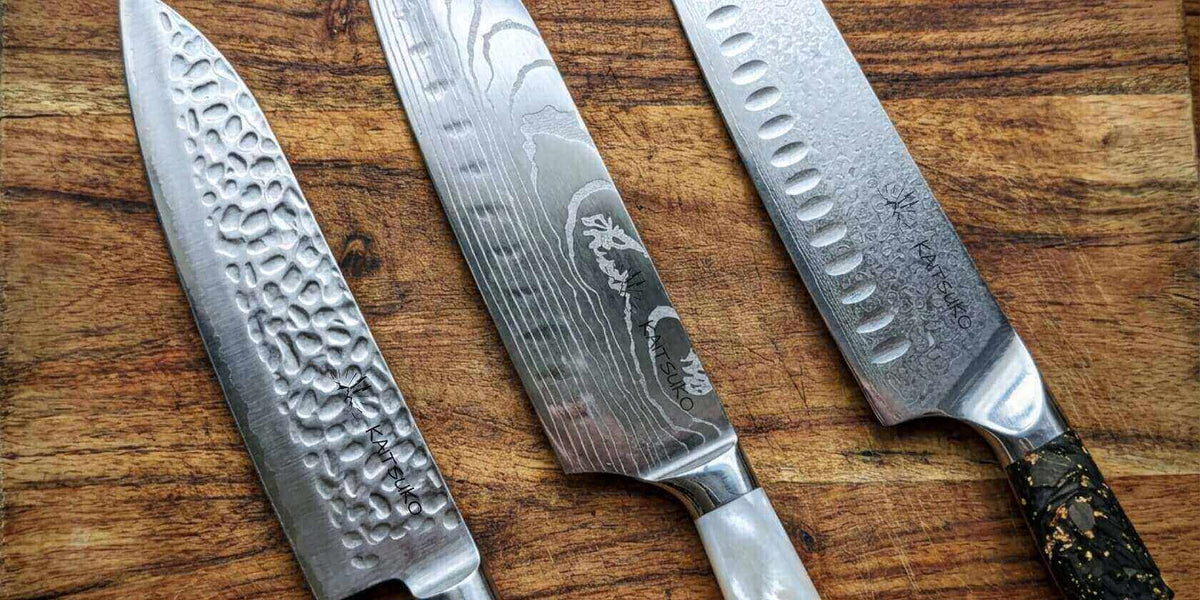
Unlike a simple steel, Damascus steel is made up of several layers of different steels forged together. This process creates the famous wavy patterns visible on the blade.
But beyond the aesthetics, this multi-layer structure also offers several advantages.
It allows combining a very hard and carbon-rich blade core — responsible for the edge — with softer outer layers that reinforce the overall resistance of the blade.
This type of construction achieves a highly sought-after balance: an extremely high-performing edge, while maintaining good durability.
This is precisely the approach used in many premium Japanese knives, particularly in high-carbon Damascus steel blades.
Discover our premium Damascus steel Yakumoto collection!
Why High-Carbon Steels Remain a Reference
In the world of cutlery, the presence of carbon plays a central role.
The more carbon a steel contains, the higher the hardness it can achieve after heat treatment. This hardness allows a very fine and very stable edge to be maintained.
This explains why knives using high-carbon steels are often capable of holding their edge longer.
In premium Japanese knives, this property is leveraged to create blades capable of being sharpened at very fine angles — often between 10 and 15 degrees.
Such a precise angle produces a particularly clean cut, ideal for modern cooking.
Knives using high-carbon steels or well-designed Damascus structures are therefore often considered the pinnacle of culinary cutlery.
Maintenance: a Simple Habit
Even if high-carbon steels require a little more attention than some stainless steels, maintenance remains straightforward.
After use, it is generally sufficient to:
- rinse the blade
- dry it immediately
- avoid leaving it damp for long
These gestures quickly become a natural reflex for anyone who regularly uses quality knives.
In return, the blade maintains a remarkable edge and can remain high-performing for many years.
Steel is Only Part of the Equation
It is important to remember that a good knife does not depend solely on its steel.
Blade geometry, heat treatment, sharpening angle and handle quality all play an equally essential role.
However, the use of a quality steel, rich in carbon and correctly treated, remains one of the determining factors in obtaining a genuinely high-performing knife.
It is this combination of elements that allows premium Japanese knives — particularly those made in high-carbon Damascus steel — to deliver an exceptional cutting experience.
Conclusion: Which Steel Should You Choose?
In 2026, the choice between carbon steel and stainless steel depends primarily on use and personal preferences.
Modern stainless steels offer great ease of maintenance and very solid performance.
But for cooking enthusiasts seeking exceptional sharpness, maximum precision and an authentic experience, high-carbon steels — particularly when integrated into premium Damascus structures — remain an unmissable reference.
These blades represent today the pinnacle of culinary cutlery, combining Japanese tradition, modern technology and cutting performance.
And when a knife is well designed, well sharpened and well maintained, it can accompany its owner for many years in the kitchen.
Rust on a Blade: the 7 Safe Methods to Remove It (and the Ones to Absolutely Avoid)
The Essential Knives for a Professional Kitchen: The Restaurant Owner's Guide (2026)