

This is one of the questions we get most often. Someone has had a Wüsthof or Zwilling for ten years, starts hearing about Japanese knives, and wonders if it's really worth switching. Or they're about to invest in their first real knife and are torn between the two schools.
The good news is there's a real answer. Not a subjective opinion, but measurable technical differences that change the cooking experience. The less good news is that the answer isn't the same for everyone. We explain everything — without pushing one school over the other.
The Real Difference in Two Sentences
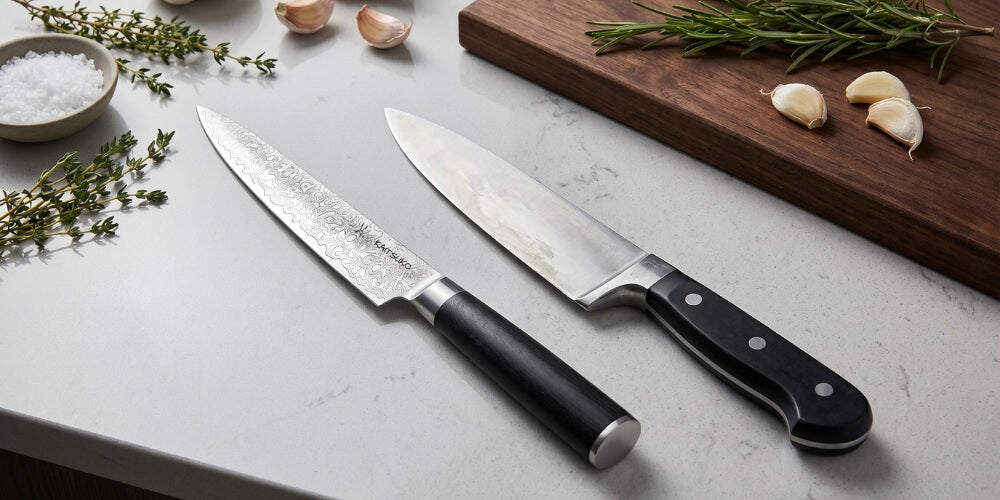
A German knife is heavier, more robust, more versatile for heavy-duty work, but with a less fine edge.
A Japanese knife is lighter, sharper, more precise, but requires a little more care and doesn't like shocks.
That's as simple as it gets. The rest is detail to understand why.
The Real Technical Differences
Four concrete points differentiate these two schools of cutlery. These aren't opinions — they're measurable facts.
The blade's sharpening angle
A classic German knife is sharpened at 20–22° per side. Wüsthof has even developed a recent laser technology that gets down to 14° on their premium ranges, but the overwhelming majority of German knives in circulation are around 20°.
A standard Japanese knife is sharpened at 15° per side. That's less, so the edge is finer, so the cut is cleaner.
In practice: on a ripe tomato, a decent Wüsthof will crush it slightly before slicing through. A Japanese knife goes through the skin without even deforming it. On fresh herbs, same logic: the Japanese knife doesn't bruise, the German one crushes a little.
Steel hardness
This is the biggest difference.
German knives sit around HRC 54–58, generally in X50CrMoV15 steel (a molybdenum-vanadium stainless). This is deliberately softer, so the knife resists shocks and is easy to sharpen.
Japanese knives climb to HRC 58–62, sometimes higher. At Kaitsuko, for example, our 5CR15MoV steel sits at HRC 54±2 in the entry-level Chef Tanaka collection, and our 10CR15CoMoV Damascus steel reaches HRC 60±2 in the Yakumoto, Kyoto, Yellow Sea and Tokyo collections.
Concretely: a steel at HRC 60 resists dulling approximately twice as long as a steel at HRC 54–56. You sharpen less often, you keep your edge longer. The trade-off is that the harder it is, the more brittle it becomes under lateral shocks.
Weight and balance
A German knife is heavy. A Wüsthof Classic 20 cm chef's knife weighs around 270 grams. It has an often prominent bolster (the ring between blade and handle) that balances the blade.
A Japanese knife is light. The same format in Japanese version runs around 180–220 grams. The balance is generally further forward, towards the blade, which favours precision in the movement.
Neither better nor worse. Different. If you're used to German weight, you'll find a Japanese knife "fragile" on first contact. If you switch from Japanese to German, you'll find the latter "clunky". A matter of habit.
Edge geometry
German knives have historically a convex or rounded edge, which requires little maintenance and tolerates classic honing steels.
Japanese knives have a flat V-edge, more precise but more demanding. Maintenance is done mainly on a whetstone, not with a honing steel (which can actually damage them if used incorrectly).
Quick Comparison
| Criterion | German Knife | Japanese Knife |
|---|---|---|
| Sharpening angle | 20–22° (sometimes 14° in premium) | 15° |
| HRC hardness | 54–58 | 58–62 |
| Weight (20 cm) | 250–280 g | 180–220 g |
| Typical steel | X50CrMoV15 | VG10, 10CR15CoMoV, Damascus |
| Versatility (bones, frozen foods) | Good | Limited |
| Cutting precision | Good | Excellent |
| Edge retention | Moderate | High |
| Maintenance | Easy, infrequent | More demanding, on whetstone |
| Average price for a good model | €100–180 | €80–150 |
When the German Knife Still Makes Sense
Let's be honest: the German knife isn't obsolete. There are cases where it's still the right tool.
You cook a lot of bones, whole poultry, game. A Japanese knife at HRC 60 on a chicken bone is risky. The edge is fine, it can chip. A Wüsthof or Zwilling at HRC 56 absorbs the shock without complaint. If your cooking involves a lot of joint or bone cutting, keep a German knife in good shape.
You sometimes cut frozen or very hard foods. Same logic. The German knife forgives, the Japanese one doesn't.
You don't want to deal with specific maintenance. A Wüsthof can go in the dishwasher (even if not recommended), tolerates the classic honing steel, and stays decent for years even with minimal care. A Japanese knife demands more rigour: hand washing, immediate drying, whetstone sharpening.
You've been used to the German weight and technique for 20 years. Changing your entire technique to gain a little cutting precision might not have an enormous return on investment. If your Wüsthof works for you, it works for you.
When the Japanese Knife Becomes Essential
Conversely, here are the profiles for whom switching to Japanese really changes things.
You cook a lot of vegetables, herbs, fish. That's where the cutting precision of a Japanese knife makes the biggest difference. On delicate foods, precision matters. A Japanese knife transforms the experience.
You want to improve your kitchen technique. A good knife doesn't make a good cook, but a precise knife pushes you towards cleaner movements. Many people who switch to Japanese tell us they gain in cutting cleanliness, regularity and enjoyment.
You're willing to learn the maintenance. If you're ready to invest ten minutes a month in proper whetstone sharpening, you'll be richly rewarded. A well-maintained Japanese knife will accompany you for 15 or 20 years with a razor-sharp edge.
You want the best precision-to-price ratio. At an equivalent budget (€100–150), you'll have a Japanese knife technically superior to an entry-level Wüsthof or Zwilling on every precision criterion. Premium German brands (Wüsthof Classic Ikon, Zwilling Pro) quickly climb to €150–200 for performance inferior to a good Japanese knife at €100.
Our Observation After 5 Years and nearly 100,000 Sales
Here's what we consistently see in our customer service.
The vast majority of customers who switch from a German knife to Japanese don't go back. Over thousands of conversations, it's extremely rare for a customer to tell us "I actually preferred my Wüsthof." It happens, yes, mainly with people who cut a lot of bones or don't want to deal with specific maintenance. But it's a minority.
Conversely, many cooks keep a Wüsthof or Zwilling for certain specific tasks. The "bone knife", the one you pull out to carve a whole chicken or trim a rib of beef. And everything else is done with Japanese. That's probably the smartest configuration for someone who cooks genuinely varied meals.
The real click often happens at first use. Someone who has only known German knives for 20 years, you put a well-sharpened Japanese knife in their hand, they cut a tomato, and they get it. It can't be explained in words : it's physical.
How Kaitsuko Positions Itself in This Landscape
Let's be clear: we don't make the most prestigious knives in the world. If you're looking for a hand-forged artisan blade by a master bladesmith in Sakai, buy a high-end Tojiro DP, a Masamoto VG or a Miyabi 5000FCD. These are beautiful objects with a history.
What we do at Kaitsuko is make Japanese technology accessible at a price point where it simply didn't exist before. Our Chef Tanaka Santoku at €61.99 has 5CR15MoV steel at HRC 54±2, a 15° bevel, an epoxy resin handle with unique patterns. For someone who wants to discover the Japanese world without spending €150, it's unbeatable.
For someone wanting to upgrade, our Yakumoto, Kyoto, Yellow Sea and Prestige collections offer genuine 67-layer 10CR15CoMoV Damascus steel at HRC 60±2, between €100 and €150 per piece. At that price point, you'd buy a technically comparable knife from Kai or Global, without the customer service and without the value for money we offer.
That's why we're approaching 100,000 sales in 5 years. Not because we make the best knives in the world, but because we make technically serious knives at a price that genuinely democratises the Japanese world.
Where to Start if You're Switching from German to Japanese
If you decide to make the move, here are our practical recommendations.
Don't throw out your Wüsthof straight away. Keep it for heavy tasks (bones, frozen foods, tough jobs). You'll be glad you have it.
Start with a versatile knife. A Santoku or a Japanese chef's knife is the right entry point. Not a Yanagiba, not a Deba, not a Kiritsuke. A tool that covers 90% of your daily needs. If you're unsure, we have a chef's knife vs Santoku comparison that covers everything.
Also invest in a wooden board and a whetstone. Both are essential for preserving your Japanese knife. A knife at HRC 60 on a glass board is dead in six months. We have an accessories collection that covers the essentials.
Learn the Japanese technique. The vertical push-cut on a Santoku or Nakiri, the controlled rocking motion on a chef's knife. A few YouTube tutorials are enough, but don't force the German technique onto a Japanese knife — you'll lose the whole point.
FAQ
Should you really switch if your Wüsthof has served you well for 15 years? If everything genuinely works for you, no. But many people "satisfied" with their German knife discover what they're missing when they try a Japanese one. Worth testing without committing your whole kitchen.
Which Japanese steel to avoid? Be wary of "Damascus" knives at €30 or €40. The pattern is often laser-etched onto a basic stainless steel, not real forged Damascus. At that price, a basic German knife is more honest. Real Damascus starts around €80–100.
Will a Japanese knife rust? The modern steels used in Japanese cutlery (VG10, 10CR15CoMoV, X50CrMoV15) are stainless. They don't rust under normal use. Pure carbon steels like Aogami or Shirogami require different maintenance and can oxidise, but that's specialist territory.
If a Wüsthof is sharpened to 15° per side, does it become as sharp as a Japanese knife? No. The angle isn't everything. Steel hardness (HRC 56 vs HRC 60) plays a major role in edge retention. A Wüsthof at 15° will be sharp for the first few uses, then lose its edge twice as fast as a Japanese knife. It's physics.
How much does a good first Japanese knife cost? Budget between €60 and €80 for a serious entry-level knife, like a Chef Tanaka Santoku. Between €100 and €150 for real 67-layer Damascus. Above that, you're mostly paying for the artisan signature and prestige, not necessarily major technical gains.
In Summary
The German knife isn't obsolete — it's just made for something else. More robust, more versatile for heavy work, more tolerant of use and maintenance.
The Japanese knife is technically superior in cutting precision, edge retention and accuracy. But it requires a little more care and doesn't like shocks.
The right choice depends on your kitchen. If you cut a lot of bones, game and frozen food, keep a German knife. If you cook varied meals with plenty of vegetables, fish and herbs, switch to Japanese. And ideally, have both — each for its own terrain.
Discover our Japanese knives or explore our complete sets to start with a full kit.
Article written by the Kaitsuko team. For five years, we have been designing, importing and selling Japanese knives across France and Europe. Over 100,000 orders delivered, features in Brut, Konbini, Forbes, M6, Europe 1, Le Parisien, Marie Claire, 20 Minutes. Shipped from our European warehouse, customer service based in France.
Updated 27 May 2026 — Written by the Kaitsuko team, after 5 years of crafting and selling nearly 500,000 Japanese knives across France and Europe.
Travelling with Japanese Knives: Plane, Train or Car
Kiritsuke or Gyuto: Which Chef Knife to Choose?