



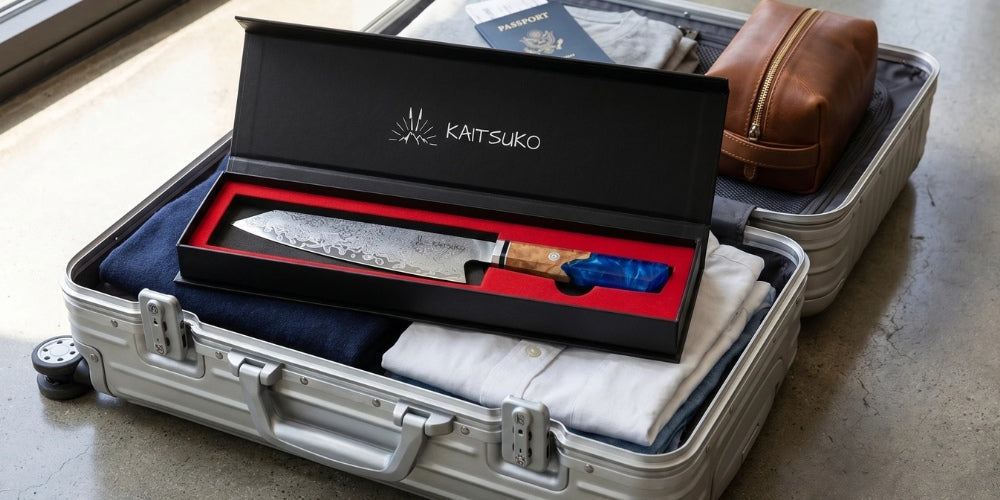
This is a question we regularly receive from customers who travel with their equipment — whether to give a knife as a gift abroad, go on holiday to a property where they enjoy cooking, attend a cooking class elsewhere, or simply move home with their kit. The rules differ depending on the mode of transport, and they often come as a surprise: what is almost always possible by car or train becomes strictly regulated the moment you board a plane.
This article sets out the situation precisely for the three most common modes of transport, with best practices for travelling without worry whatever your journey.
The Key Principle: Carrying Is Not the Same as Transporting
French law distinguishes two clearly different concepts, and understanding this distinction clarifies everything else. Carrying a knife means having it on your person, immediately accessible, in a pocket or on a belt, for example. Transporting, by contrast, means moving it while stored and not immediately accessible, in a locked suitcase, a bag, or a car boot.
Carrying a knife without legitimate reason is prohibited in France, regardless of context. Transporting one, on the other hand, is widely tolerated as long as the knife is properly stored and you have a legitimate reason which is obviously the case for a kitchen knife being moved between two homes, to a holiday property, or for professional use. This distinction explains why a kitchen knife properly packed in a suitcase generally poses no problem, while the same knife drawn and carried on your person would.
By Plane: The Strictest Rules of Any Mode of Transport
This is where the regulations are the most demanding, and the most consistently enforced. No kitchen knife is permitted in cabin baggage, regardless of blade length. European regulations provide a theoretical tolerance for certain small folding knives with blades under 6 cm, but this tolerance almost never applies in practice to a Japanese kitchen knife, which has a fixed blade and almost always exceeds that limit.
In practice, whether it's a 24 cm Gyuto or a small 9 cm paring knife, the answer is the same: no kitchen knife will pass the security check in cabin baggage. If a knife is detected during the screening, it will be systematically confiscated with no possibility of recovery — not even on your return.
In hold luggage, on the other hand, transport is widely permitted, with no limit on blade length or quantity for kitchen knives. The only real requirement concerns packaging: the blade must be protected in a way that poses no risk to baggage handlers.
By Train: Less Systematic Checking, but the Same Caution Applies
Unlike the plane, trains in France do not have systematic security checks at boarding. SNCF does not publish an exhaustive list of prohibited items as airlines do. That doesn't mean a kitchen knife can be transported any which way: the general regulations on edged weapons in category D remain applicable, meaning a knife stored in a closed suitcase or bag, not immediately accessible, falls within the legally tolerated scope of transport.
One notable exception on certain international routes: the Eurostar applies stricter rules than standard SNCF, tolerating only non-locking folding knives with blades under 77 mm. For this type of journey, it's worth checking in advance and, if in doubt, verifying the specific conditions of the relevant rail operator rather than relying solely on standard SNCF rules.
By Car: The Most Flexible Mode of Transport, Under Storage Conditions
For a car journey, transporting a Japanese knife generally poses no difficulty, as long as the same logic of transporting rather than carrying is respected. The knife must be stored in a closed compartment such as the boot or a suitcase and not left accessible on the seat or in the glove box.
This is by far the most flexible of the three modes of transport, since there are no systematic security checks and no blade length restrictions specific to kitchen knives. The only precaution to keep in mind remains the same as for other modes: appropriate packaging protects your knife from impact and avoids any risk of injury if you need to open your boot or suitcase in front of someone.
How to Pack Your Japanese Knife Properly, Whatever the Journey
Whatever mode of transport you choose, good packaging remains the best guarantee for stress-free travel. Always use a rigid case or sheath suited to the blade length, rather than a thin cloth or plastic bag. The aim is twofold: prevent any movement of the blade inside the packaging, and avoid it piercing the fabric of your suitcase or injuring someone during handling. If you're travelling with several knives, such as a complete set, wrap each blade individually rather than grouping them loosely together, even in the same case.
It's precisely for this type of situation that we designed our knife transport bag in durable Oxford fabric. Compact and designed to hold several blades side by side without them touching, it's the most suitable accessory for all your journeys, whether by car, train or plane with hold luggage. It protects your knives from shocks during transit, while preventing them from damaging the rest of your belongings or posing a risk during handling. It's one of our most appreciated accessories among customers who travel regularly with their equipment, whether for holidays, a move, or cooking classes abroad.
Worth noting also: our knives and sets are delivered in handsome rigid presentation boxes, designed originally for gifting, but which prove just as practical for transport. If you've kept the original box of your knife or set, it's a ready-made solution: the interior foam or slots already hold each blade in place, making it a perfectly valid alternative to the transport bag for occasional travel — as long as you secure the box inside your suitcase or boot so it doesn't open during the journey.
Finally, always place your knife or set in the centre of your suitcase or boot, surrounded by clothes or other soft items, rather than at the edge where it could sustain a more direct impact during transport. This precaution protects both the blade itself — which could chip in the event of a violent shock — and the rest of your belongings.
Summary Table: What to Remember by Mode of Transport
| Mode of Transport | Knife Accessible on Person | Knife Stored in Luggage | Main Precaution |
|---|---|---|---|
| Plane, cabin baggage | Prohibited, systematically confiscated | Prohibited, regardless of blade length | Avoid entirely |
| Plane, hold luggage | N/A | Permitted, no blade length limit | Rigid packaging required (transport bag, case, presentation box) |
| Train (standard SNCF) | Prohibited without legitimate reason | Tolerated if stored and not accessible | Check specific rules for international routes (e.g. Eurostar) |
| Car | Prohibited without legitimate reason | Permitted if stored in boot or closed suitcase | Boot or closed suitcase, never on the seat |
Travelling Internationally: Extra Vigilance Required
European regulations on hold luggage or stored transport are broadly permissive for kitchen knives, but that's not the case everywhere in the world. Some countries apply stricter restrictions on certain blade types particularly long fixed-blade knives or knives that may be classified as edged weapons under local legislation.
Before an international trip, particularly outside the European Union, it's advisable to check the specific rules of the destination country and not only those of the departure country. A blade perfectly permitted in hold luggage departing from France may be subject to stricter checks, or even a temporary import restriction, on arrival in certain countries. For international train journeys like the Eurostar, also check the operator's specific conditions, which may be more restrictive than usual national rules.
FAQ - The Most Common Questions About Travelling with a Japanese Knife
Can you put a small paring knife in plane cabin baggage if it's under 6 cm? In practice, no. The theoretical tolerance for blades under 6 cm applies mainly to small folding knives, not fixed-blade kitchen knives, which are almost systematically refused in the cabin.
Can you transport a kitchen knife by train without problems? Yes, as long as it's stored in a bag or suitcase and not carried on your person. Trains don't have systematic security checks like planes, but regulations on edged weapons remain applicable in the event of a check.
Do you need a specific reason to transport a Japanese knife by car? Simply moving your kitchen equipment between two locations — to cook elsewhere or as a gift — constitutes a legitimate reason. The essential point is to store it in the boot or a closed suitcase, never accessible on the seat.
Must you buy a transport bag, or is the original box sufficient? The original box, with its interior foam or slots, already provides good protection for occasional travel. A dedicated transport bag remains more practical if you travel regularly or transport your knives outside their original packaging.
What happens if a knife is found in my plane cabin baggage? The knife will be systematically confiscated at the security check, with no possibility of recovering it later — not even on your return from the trip.
Are the regulations the same in every country? No. European regulations are relatively permissive for stored luggage transport, but some countries apply stricter restrictions on certain blade types. Always check the regulations of your destination country before an international trip.
In Summary: Travelling Comfortably with Your Japanese Knife
The rule that covers everything: a Japanese knife must always be transported stored and inaccessible, never carried on your person, and never in plane cabin baggage. By car and by train, simply storing it in the boot, a suitcase or a closed bag is sufficient in the vast majority of cases. By plane, only the hold is an option, with appropriate rigid packaging.
If you're travelling abroad, take a few minutes to check the specific regulations of your destination particularly outside the European Union, where the rules may differ significantly from those in France. And whatever your journey, a good transport bag or your knife's original box remains the best way to travel without worry for your equipment or those around you.
This article draws on the concrete experience of the Kaitsuko team: 5 years of activity, over 100,000 knives sold across France and Europe, and regular conversations with our customers about practical questions related to transporting and using their knives day to day.
Updated 17 June 2026 - Written by the Kaitsuko team, after 5 years of manufacturing and selling over 100,000 Japanese knives across France and Europe.
Japanese Knife for Beginners: How to Choose the Right One