



Professional knife sharpener
Professional knife sharpener
Description and technical specifications
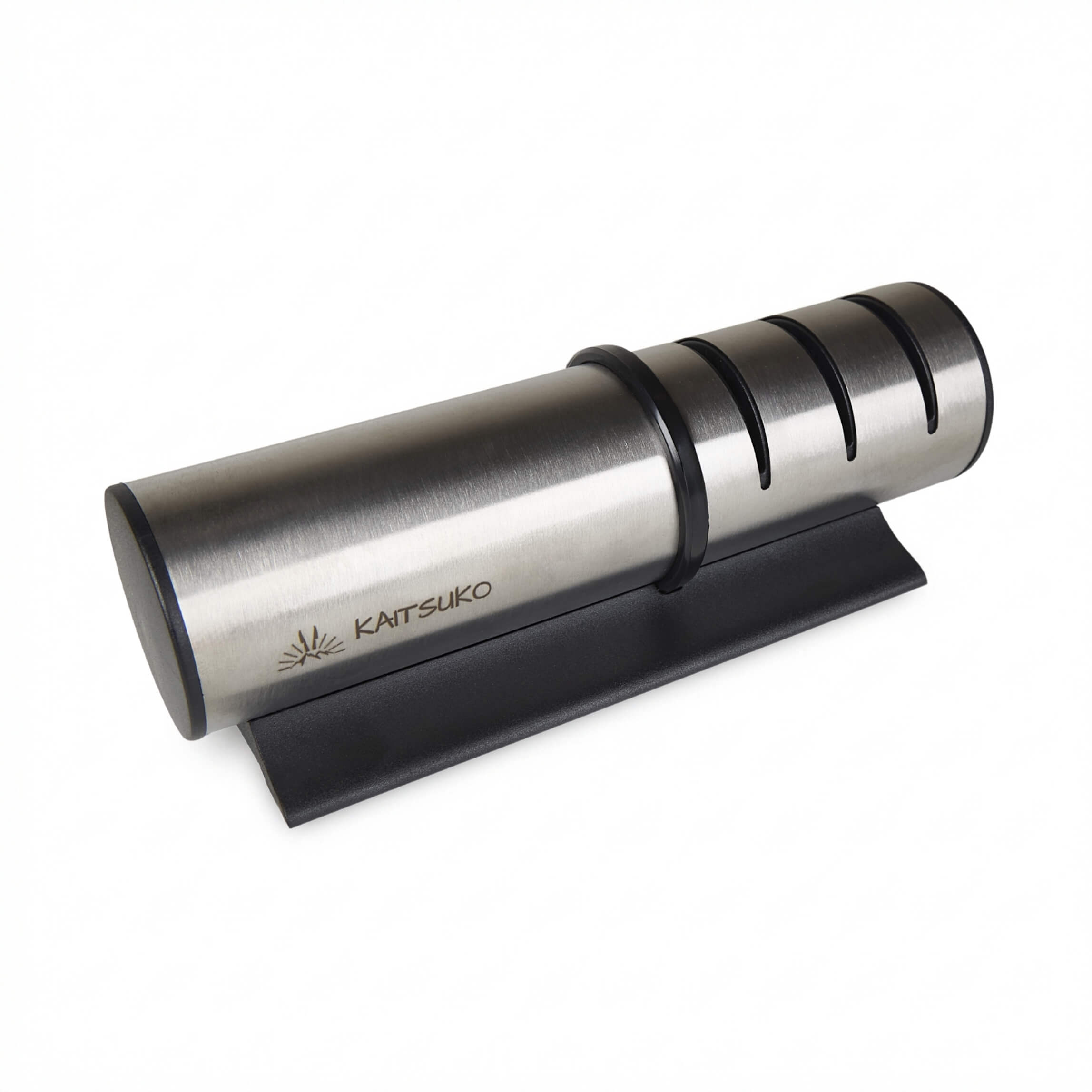
Professional Knife Sharpener: Diamond Precision for Your Blades
Edge maintenance is the non-negotiable condition of kitchen performance. A Japanese knife, however prestigious, loses its effectiveness without regular edge care. Our professional knife sharpener has been rigorously selected to offer a precise and safe alternative to the traditional water stone.
Designed for professional chefs, demanding home cooks, and high-carbon steels (10CR15CoMoV), this sharpener maintains a constant 15° angle. It's a technical solution for those who want the precision of a whetstone without the learning curve of manual sharpening.
Angle Mastery: A Japanese Specificity
Why the 15° Angle Matters
Unlike European knives sharpened at 20° or 22°, Japanese blades (Santoku, Nakiri, Kiritsuke) feature a finer geometry, typically between 12° and 18°. This sharpener integrates preset angles (15°, 18°, 20°, 22°) to accommodate your entire collection. Selecting the 15° angle restores the original surgical sharpness of your 10CR15CoMoV steel with no risk of deforming the blade profile.
Maximum Stability and Safety
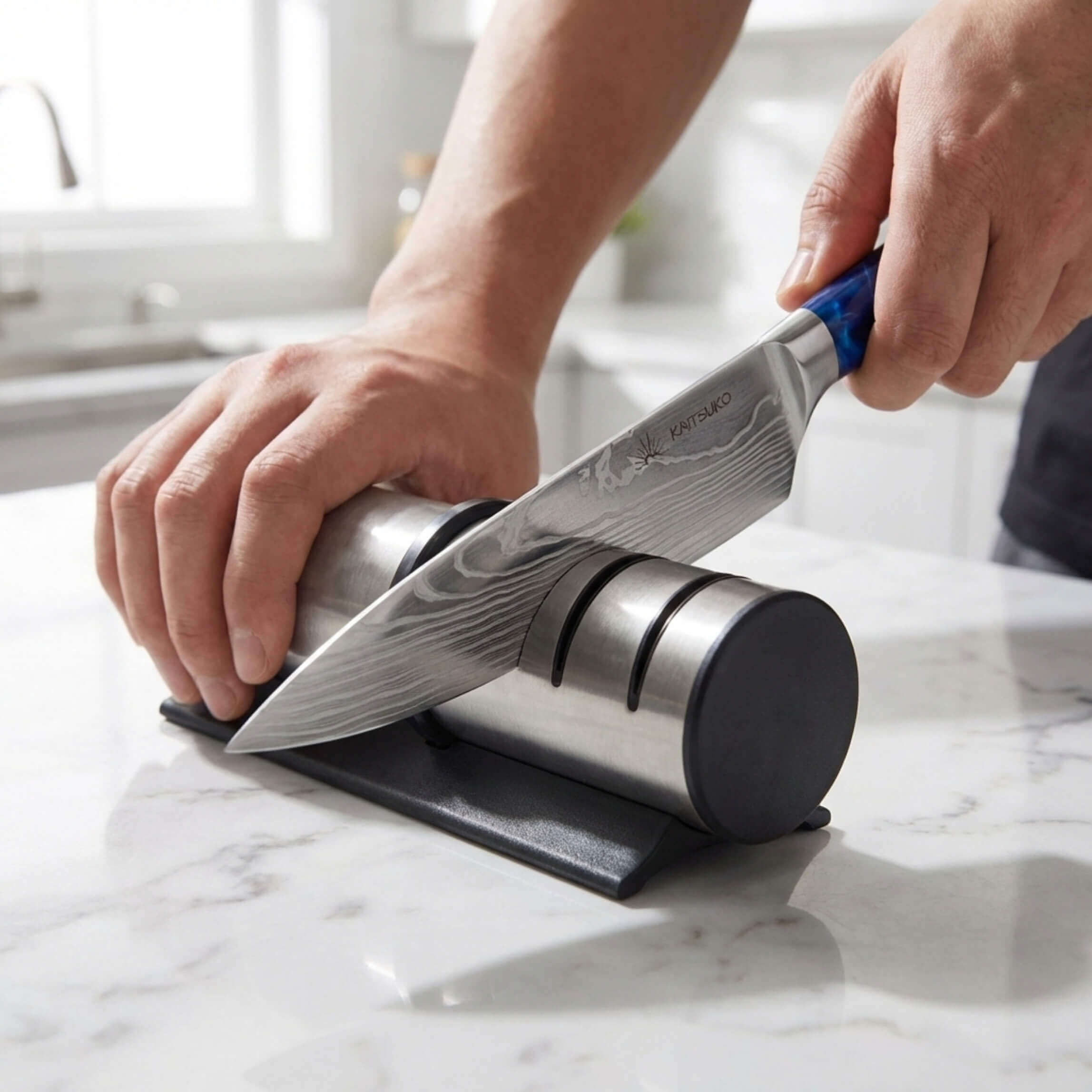
One of the key challenges of manual sharpening is maintaining a consistent angle. Our system solves this with a magnetic base and non-slip coating. The knife stays perfectly secured to the base while the sharpening roller, equipped with a ball-bearing system, ensures a smooth, consistent motion.
Technical Performance: Diamond and Grit
Industrial-Grade Diamond Sharpening Surface
Diamond discs allow treatment of all steel types, including the hardest (HRC 60+). The sharpener offers two essential working stages:
- 300 Grit (coarse): Essential for restoring a dull blade, eliminating micro-fractures, or repairing a damaged edge.
- 600 Grit (medium): Dedicated to finishing sharpening — refining the edge and restoring its daily cutting bite.
Durable Construction and Ergonomics
Made from 430 stainless steel and high-density polypropylene, this 17.7 cm tool is built for intensive use. Its integrated storage function protects the sharpening strips between uses, ensuring extended equipment longevity.
User Guide: Restoring a Razor Edge
Step-by-Step Method
- Setup: Place the magnetic base on a flat surface. Secure your knife at the desired sharpening angle (15° for our Japanese knives).
- Sharpening: Roll the cylinder along the blade edge with regular back-and-forth motions, starting with the 300 grit diamond surface.
- Finishing: Flip the disc to use the 600 grit side to polish the edge. Reverse the knife direction to treat the other bevel (symmetrical sharpening).
Expert Maintenance Tips
To extend the life of your tools, we recommend a quick pass on the sharpener as soon as you feel the blade sliding on a tomato skin. For a mirror finish, follow up with a leather strop or an 8000 grit water stone.
Technical Specifications
| Feature | Detail |
|---|---|
| Materials | 430 stainless steel, polypropylene, industrial diamond |
| Included angles | 15°, 18°, 20° |
| Grits | 300 (repair) / 600 (sharpening) |
| Dimensions | 17.7 cm x 5.5 cm |
| Compatibility | Japanese and European knives (carbon and stainless steel) |
| Maintenance | Wipe with a dry cloth after use. Dishwasher prohibited. |
Tool Comparison: Choosing the Right Sharpening Method
Several solutions exist for maintaining your blades, each addressing a specific need for precision or speed:
- Traditional whetstone: The purist's reference method. It offers total control over material removal, but requires a long learning curve to maintain a consistent manual angle. Our professional sharpener draws inspiration from this method using diamond, while securing the cutting angle automatically.
- Honing steel: Often confused with a sharpening tool, the honing steel primarily serves to "realign" the blade edge between uses. It remains the essential tool for daily edge maintenance without removing material. However, when the edge truly dulls, the diamond sharpener takes over to remove a thin layer of steel and rebuild the cutting angle.
- Manual or electric sharpeners: Standard pull-through models often use carbide plates that can be aggressive and "tear" the steel. Our ball-bearing system prioritizes gentle, controlled abrasion, preserving the structure of your 10CR15CoMoV steel.
- Disc-based sharpeners: This system shares the magnetic roller principle with our model. Our solution stands out through its angle versatility (15° to 22°) and industrial-grade diamond surface, ensuring optimal compatibility with all Kaitsuko ranges.
Usage Tips and Best Practices
Sharpening is a technical skill that improves with time. Here are our recommendations for professional results at home:
- Surface preparation: If using complementary finishing stones, keep the stone constantly wet. Always keep a container of water nearby — water acts as a lubricant and flushes away the sharpening slurry (a mix of stone and steel particles) essential to polishing.
- Technique: When passing along the blade, a slight handle tilt is needed to follow the curve of the tip. This takes some practice, but the magnetic base of our sharpener greatly simplifies this step by stabilizing the body of the knife.
- Frequency and verification: We recommend regular sharpening based on your usage frequency. Do not wait until the blade is completely dull before acting.
- The final test: To validate your work, perform the paper test: the blade should glide and cut through a sheet of paper with zero resistance or tearing. If the paper tears, an additional pass on the finishing grit (600) is needed.
The Kaitsuko Expert Verdict
This magnetic sharpening system is the most rational solution for maintaining a mixed knife collection. Where a whetstone demands years of practice, this tool delivers a razor edge in minutes. We recommend it to durably preserve the technical investment of your blades.
Optimize your edge today!
Our History
Kaitsuko knives are specially selected by our team of enthusiasts. They are designed to offer optimal comfort of use to those who use them. The blades are of impeccable quality .
The strength and durability of our knives will allow you to use them again and again!
They maintain an exceptional sharpness despite daily use.
Kaitsuko knives allow for clean and precise cutting of all your foods. Proper maintenance of your knives will extend their lifespan. This involves careful washing and good sharpening.
Do you have a question? Check out our FAQ to find the answer! If you have another question, our customer service will be happy to answer you from Monday to Friday at info@kaitsuko.fr
-
CUSTOMER SERVICE
Contact us Monday to Friday from 8am to 6pm at info@kaitsuko.fr
-
FAQ
The answer to all your questions HERE .
LEARN MORE
The use of each knife
Kiritsuke Knife : The Kiritsuke knife is a versatile knife that can be used for cutting a variety of foods. Its angled blade allows for precise cuts for slicing vegetables, meat, and fish.
Chef's Knife : The Chef's knife is a versatile tool that features a long, sharp blade, as well as a fine tip for precise and efficient cuts. It is an ideal knife for slicing, chopping, and chop all types of food.
Slicing Knife : The slicing knife is designed specifically for cutting thin slices of meat, poultry, or fish. Its long, narrow blade allows it to glide easily through food. It allows for precise cuts without tearing the food.
Bread Knife : The bread knife is designed to cut through different types of bread without crushing or tearing them. Its serrated blade allows you to slice cleanly through the crispy crust, without crushing the crumb inside.
Santoku Knife : The Santoku knife is also a versatile knife that is ideal for slicing, chopping and cutting different foods. With a wide, straight blade with a rounded tip, it has a large cutting surface. In short, the This knife is perfect for making multiple preparations in the kitchen.
Nakiri Knife : The Nakiri knife is specialized in cutting vegetables. Its straight, rectangular blade offers a wide cutting surface that is ideal for chopping, slicing and mincing precisely. It can also be used as a shovel knife to transfer vegetables into the flat.
Utility Knife : The utility knife is versatile. It is designed to perform several types of tasks in the kitchen. Its size, halfway between a chef's knife and a utility knife, makes it perfect for medium-sized cutting tasks, such as slicing fruit. , vegetables, cheese, peel, or even cut food into small pieces.
Boning Knife : The boning knife is specially designed to remove meat from bones with precision. Its rigid and narrow blade allows it to follow the contour of the bones, thus reducing meat waste.
Paring knife : The paring knife is ideal for precision tasks thanks to its small size and short, pointed blade. It is perfect for peeling and cutting fruits and vegetables, as well as for making delicate cuts. Versatile and handy, the paring knife is often used for detailed work that requires great precision. Whether it's for removing seeds from a fruit, coring tomatoes or chopping herbs, this knife is an essential companion for amateur and professional chefs.
Steak Knife : Steak knives, also called "table knives," are knives designed specifically for cutting cuts of meat during meals. They have a serrated blade that makes it easy to slice through pieces of meat without tearing the fibers.
Knife maintenance
- Never put knives in a dishwasher.
- Wash knives by hand and wipe the blade thoroughly with a soft, dry cloth to maintain the efficiency and quality of the blade.
- Clean the blades with soapy water.
- If the knives have wooden handles, dry them thoroughly before storing.
- Knives do not stay sharp for life, no matter the blade; it is therefore advisable to sharpen them as soon as the edge becomes less sharp.
- Do not use the edge of the knife to push food onto the board. Use the back of the blade instead.
- Never use the abrasive side of sponges to clean blades.
- Cut food on a wooden board to avoid damaging the blade of your knives.
- Do not make any cuts in a pan or baking dish to avoid damaging the blade of the knives.