



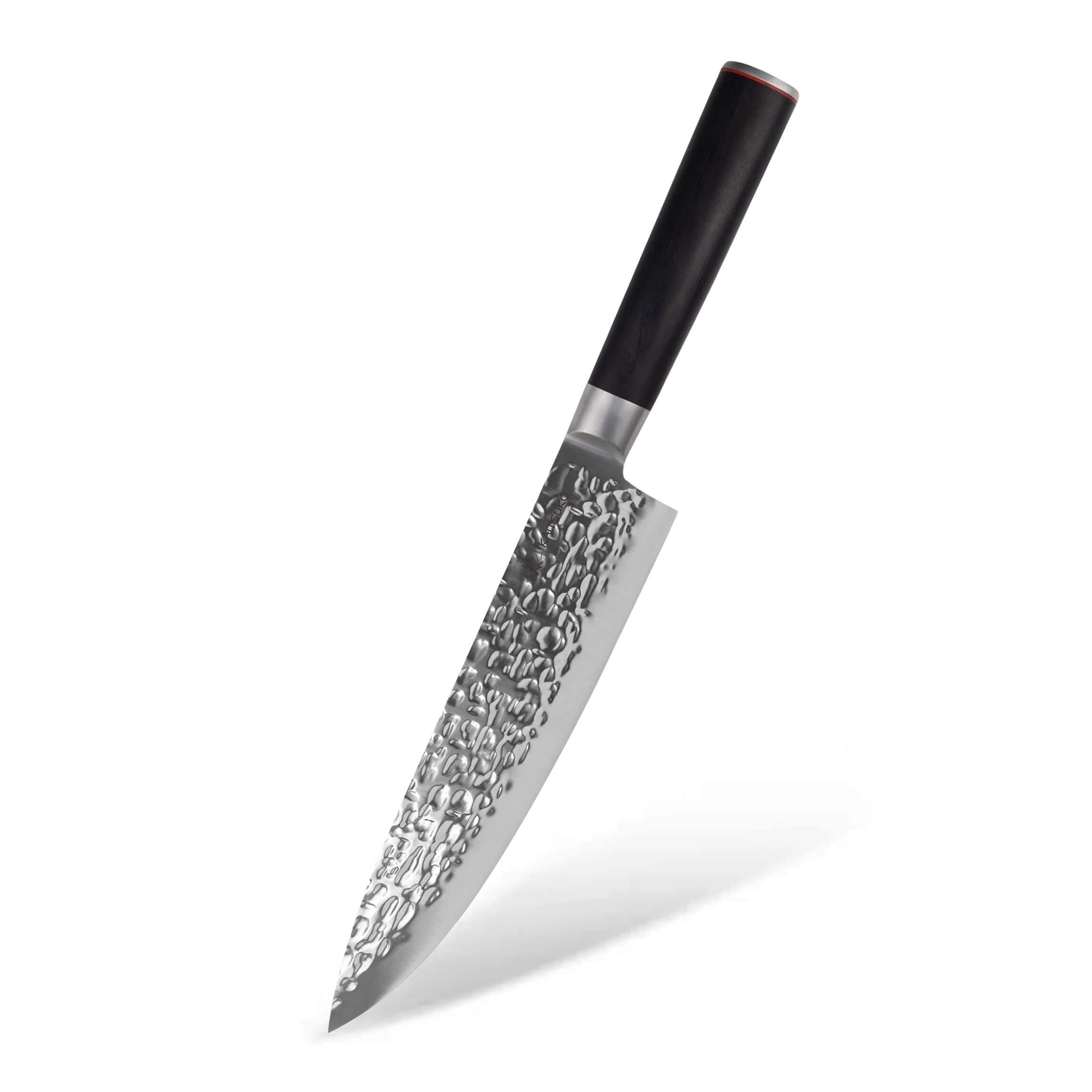
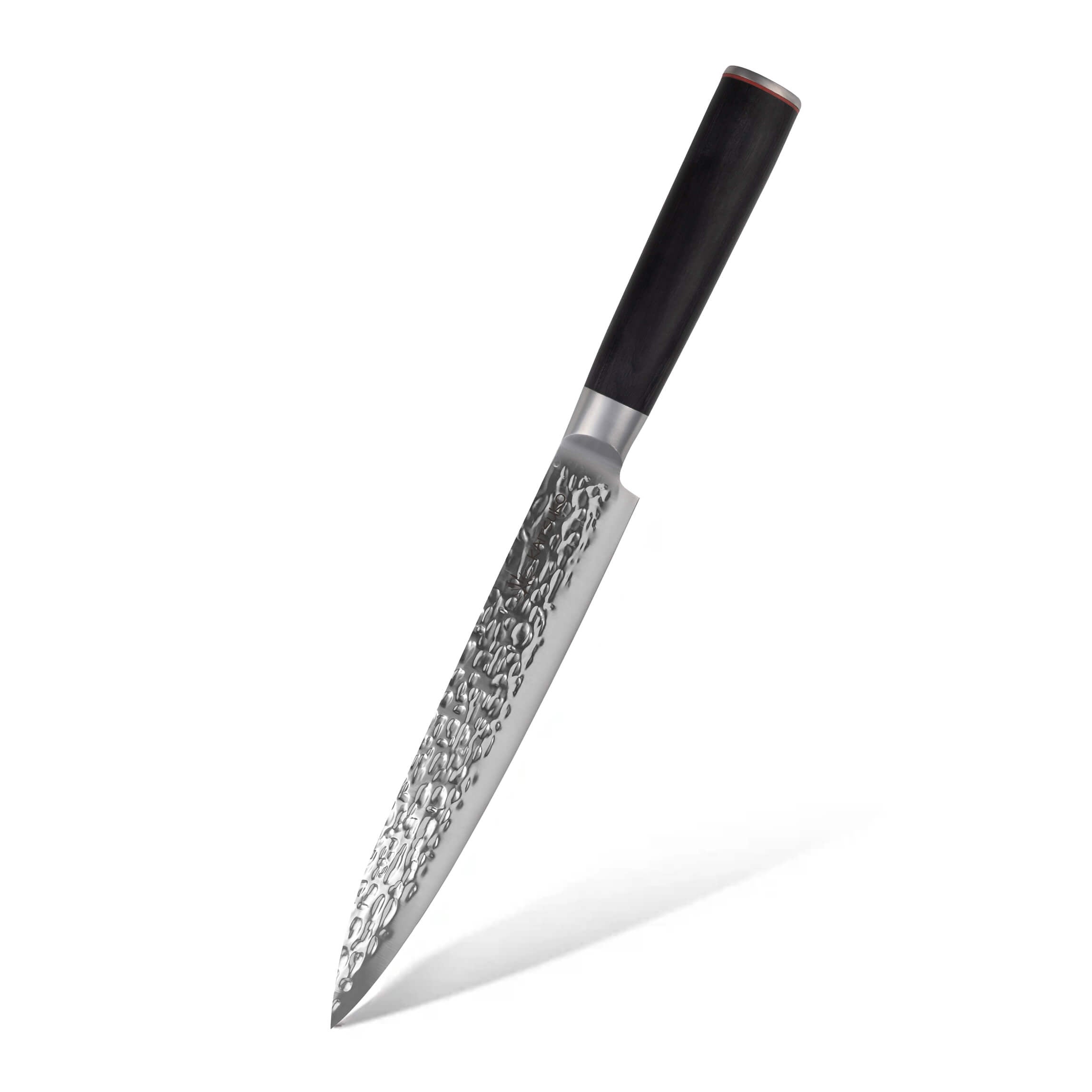


The Individual Kaitsuko Japanese Knife: Technical Mastery and Cutting Performance
Acquiring an individual Japanese knife often marks the transition from a functional kitchen to a precision kitchen. Unlike standard sets, choosing your blade individually allows you to meet a specific technical requirement: the geometry of a Nakiri for vegetables or the versatility of a Gyuto for proteins.
At Kaitsuko, we select high-performance steels such as 5CR15MoV or 10CR15CoMoV (58-60 HRC) to guarantee edge retention that classic Western steels cannot achieve.
Here is a guide to analyzing materials and blade profiles to identify the tool that will serve your gesture.
Blade Profiles: Choosing According to Functionality
The Santoku and the Gyuto: The Pillars of Versatility
The Santoku (literally "three virtues") is designed for slicing, chopping and dicing. Its blade is generally shorter (17-18 cm) and taller than a classic chef's knife. The Gyuto, the Japanese version of the chef's knife, has a more tapered tip, ideal for precision work on meat and fish.
- Technical note: The balance of a Gyuto in 10CR15CoMoV steel is often located at the bolster, facilitating the rocking motion.
- Knowledge: The hollow-edge on our models reduces surface tension, preventing starchy foods (potatoes) from sticking to the blade.
- Performance analysis: The 15°-sharpened bevel offers effortless penetration into flesh, where a standard knife crushes the fibers.
- Expert verdict: The Santoku is ideal for restricted work spaces, while the Gyuto is the indispensable tool for the chef seeking maximum amplitude.
The Nakiri and the Kiritsuke: Specialization and Precision
The Nakiri is recognizable by its rectangular shape. It is an expert in the "push-cut" (vertical cut). The Kiritsuke, with its "K-tip" point, is historically a status symbol in professional kitchens, fusing the capabilities of a vegetable knife and a fish knife.
- Technical note: The 5CR15MoV steel of the Tanaka Collection offers optimal resilience for the Nakiri, withstanding repeated impacts on the board.
- Knowledge: The Kiritsuke of the Prestige Collection uses a San Mai structure: a hard 10CR15CoMoV core protected by 66 layers of softer steel.
- Performance analysis: The straightness of the Nakiri's edge ensures total contact with the board, guaranteeing clean cuts without "accordion" vegetables.
- Expert verdict: The Nakiri is the best ally of vegetarians; the Kiritsuke is aimed at those who already master advanced cutting techniques.
Steel Anatomy: Understanding Durability
| Feature | 5CR15MoV Steel (Tanaka Range) | 10CR15CoMoV Steel (Damascus/Hammered) |
|---|---|---|
| Hardness (HRC) | 53-54 HRC | 58-60 HRC |
| Composition | Balanced Chrome/Carbon | 1.05% Carbon + Cobalt |
| Sharpening angle | 18° - 20° | 15° |
| Main advantage | Robustness and easy maintenance | Razor edge and aesthetics |
| Use | Daily / Beginner | Intensive / Expert |
The Importance of HRC Hardness
The hardness of a Japanese knife is the determining factor in its longevity. A steel at 60 HRC (as on our Kyoto or Yakumoto ranges) allows a very fine sharpening angle to be maintained without the blade edge dulling quickly. The addition of Cobalt in the 10CR15CoMoV alloy reinforces this resistance to mechanical wear.
Comparison: Japanese Knife vs Western Knife
The fundamental difference between these two worlds comes down to one factor: the geometry of penetration into the food.
- Geometry and Angle: Where the Western knife uses a thick "U"-shaped blade with a 25° angle, our Japanese blades are worked in an ultra-fine "V" between 15° and 20°. This fineness drastically reduces the force required for cutting.
- Steel hardness (HRC): A standard European knife is often capped at 55 HRC to favor oxidation resistance. By using high-carbon steels, our knives reach a superior hardness (up to 60 HRC), offering 30% higher cutting efficiency.
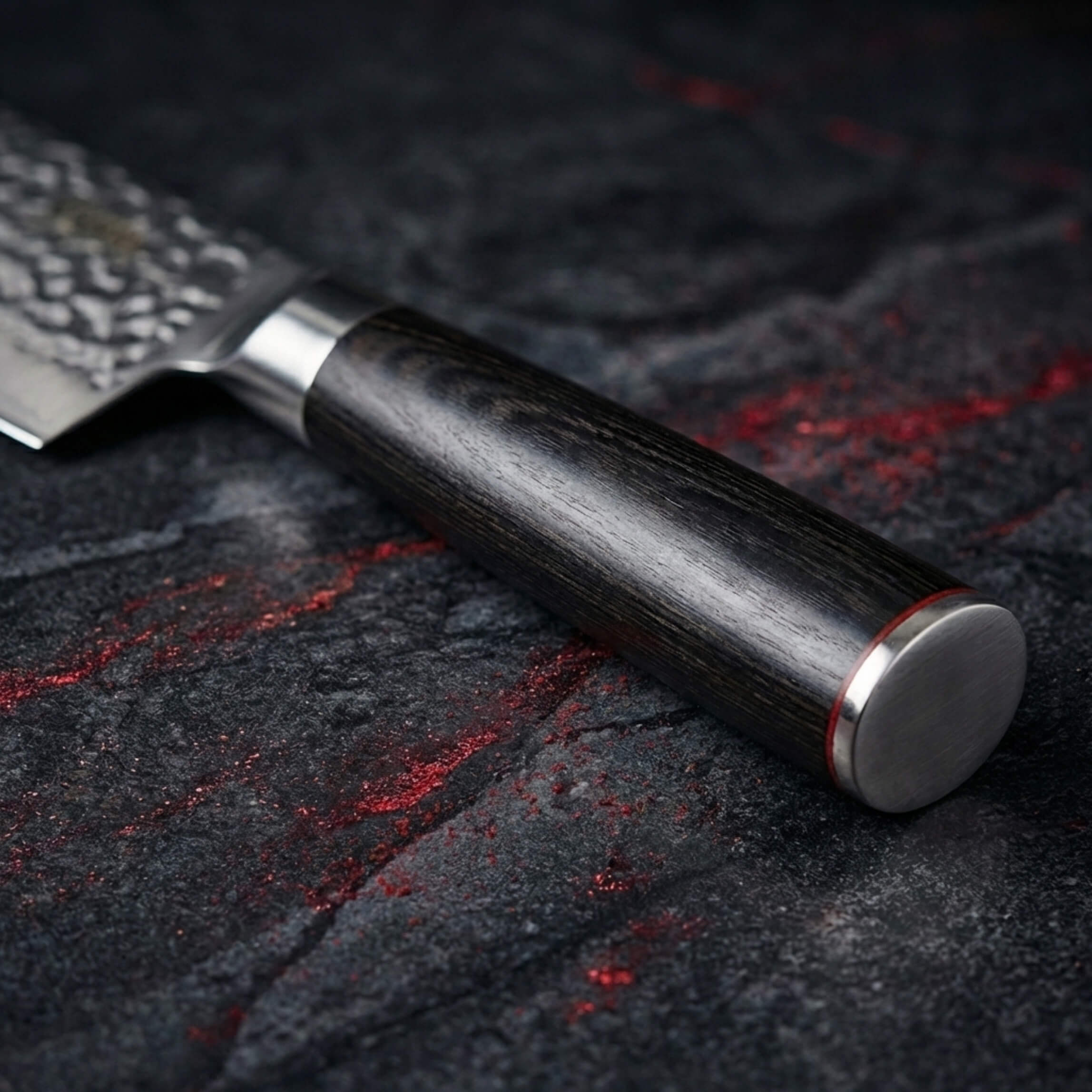
- Balance and Ergonomics: Thanks to lightweight handles (pakka wood or octagonal), the center of gravity is shifted toward the blade. This encourages a "pinch" grip, offering surgical control that heavier Western riveted handles do not allow.
- Expert note: This performance requires discipline. The hardness of these steels makes them more sensitive to impacts: they must never be used on bones, frozen food or very hard crusts, as this risks chipping the blade.
Care and Maintenance: Guaranteeing Longevity
A quality Japanese knife is an investment that requires a strict maintenance protocol to preserve its mechanical properties.
- Washing: Dishwashers are strictly prohibited. Aggressive detergents and heat alter the steel's temper and damage handles made from natural materials. Cleaning with lukewarm water and mild soap followed by immediate drying is imperative.
- Storage: To avoid micro-impacts on the blade edge, opt for a magnetic bar or a storage block. Loose storage in a drawer is the leading cause of premature dulling.
- Sharpening: We recommend using water whetstones (1000/6000 grit). For 10CR15CoMoV steel, the use of a steel honing rod is not recommended; prefer a ceramic honing steel or a stone to respect the metal's hardness.
Expert Verdict for Your Selection
For a first purchase: The Chef Tanaka collection in 5CR15MoV steel offers the best technicality-to-price ratio. It forgives maintenance errors while offering sharpness superior to industrial standards.
For the demanding aesthete: The Kyoto Collection with its 67-layer Damascus finish showcases 10CR15CoMoV steel. It is the choice of pure performance and edge retention.
Every individual knife at Kaitsuko undergoes rigorous quality control to ensure that the balance between steel hardness and assembly flexibility meets the standards of modern cooking.
The Selector's Expertise: Material Mastery and Manufacturing Rigor
Our know-how rests on a rigorous selection of steels and mastery of cutting-edge heat treatments. Kaitsuko bridges traditional forging techniques and the concrete needs of the modern cook, guaranteeing a stable molecular structure for each blade.
- Technical note: Steel hammering (Tsuchime), visible on our blades, is not just an aesthetic choice; it creates air pockets that prevent food adhesion.
- Knowledge: Manufacturing relies on successive quenching, a precise heat treatment that freezes the molecular structure of 10CR15CoMoV steel to reach 58-60 HRC without making it brittle.
- Performance analysis: Unlike an industrially stamped blade, the 67-layer assembly (San Mai) ensures a forge weld that protects the blade core through softer flanks.
- Expert verdict: Artisanal manufacturing is recognized by the perfect balance between bolster and handle, enabling prolonged use without muscle fatigue.
History and Culture: From the Samurai Era to Your Kitchen
Japanese culinary art is based on the philosophy of respect for food. This tradition is intrinsically linked to the samurai era: in 1876, following the ban on carrying swords (Haitōrei), master blacksmiths transferred their know-how to domestic cutlery.
- Culinary philosophy: A clean cut does not merely divide the food; it seals the juices and preserves the flavors by avoiding cell crushing. This is the very essence of the art of Sashimi.
- Heritage: Owning a Damascus steel knife means extending this historical evolution where the combat tool became a creative tool.
Expert FAQ: Your Technical Questions
How to recognize a genuine quality Japanese knife?
An authentic tool is certified by the clarity of its specifications. A serious manufacturer always indicates the steel type (e.g.: 10CR15CoMoV) and the HRC hardness. The quality of our Damascus steel rests on the layering of 67 layers surrounding a 10CR15CoMoV core, offering an optimal balance between edge retention and mechanical resilience. A genuine Damascus displays organic wave patterns born from the multi-layer forging process.
What is the average price of a good individual Japanese knife?
For a reliable knife in 5CR15MoV steel (robust range for beginners), expect between €40 and €64. For a premium blade in 10CR15CoMoV steel with 67 Damascus layers and a hardness of 60 HRC, the investment generally falls between €90 and €160. Below this, the quality of the steel or heat treatment is often sacrificed.
Which Japanese knife brands are the most reliable?
At Kaitsuko, we focus on the rigorous selection of materials (high-carbon and cobalt steels) to offer collections like Kyoto or Yakumoto, which rival the biggest names in terms of edge retention and technical balance.
Why are Japanese knives sharper and more durable?
The answer is chemical: their high carbon content (1.05%). The richer a steel is in carbon and cobalt-enriched, the more it can be sharpened at a closed angle (15°) without deforming. This hardness allows the blade's "edge" to be maintained much longer than a standard steel, provided the dishwasher is avoided and wood or soft polymer boards are used.