



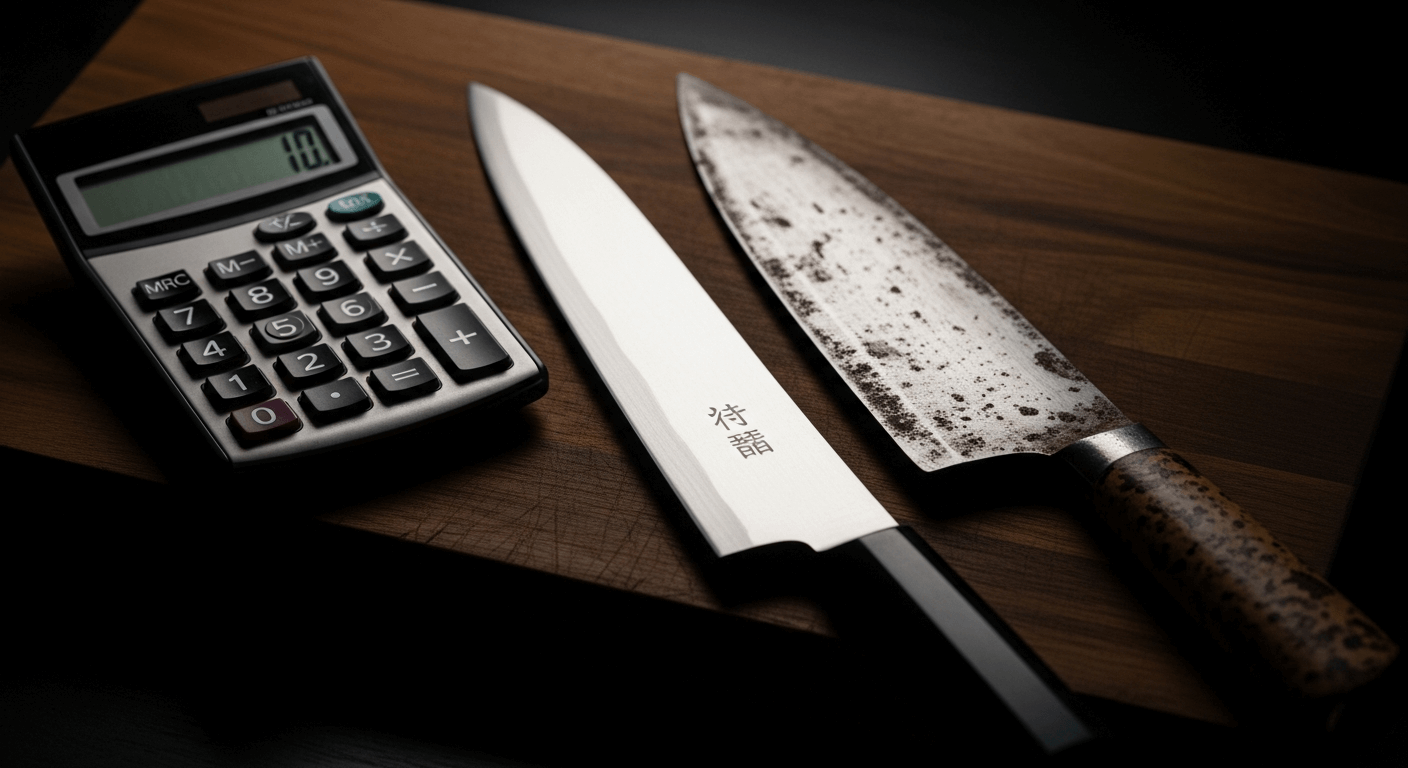
When buying a kitchen knife, we almost always focus on the displayed price. Fifteen pounds, twenty pounds, sometimes thirty. At that point, the reasoning is simple: the knife cuts, it's new, it does the job, and we tell ourselves there's no need to invest more in such a mundane object. Yet this reasoning is based on an extremely short-sighted view of the problem. A knife is not a one-off purchase like a decorative accessory or a kitchen gadget used occasionally. It is a central tool, used almost every day, sometimes several times a day, for years. And when you start thinking over that timeframe, the purchase price becomes almost secondary compared to the real cost of use.
In the majority of households, the scenario is always the same. You buy an entry-level knife, often from a supermarket or online, for around twenty pounds. The first few weeks, everything seems fine. The blade is shiny, the cut is acceptable, the object is new. Then, gradually, without really noticing, the sharpness disappears. Tomatoes get crushed rather than sliced, herbs get torn, meat requires more effort, and every gesture becomes a little less fluid. You press harder, force slightly, unconsciously compensate with your wrist.
At this point, two reactions are possible: either you continue using the knife regardless, getting used to this loss of performance, or you end up buying another one, telling yourself the previous one was simply a bad purchase.
With a mid-range knife, problems almost always appear quickly:
• the blade loses its edge within a few weeks • you need to press harder to cut • soft foods get crushed • herbs get torn instead of being cleanly cut • precision gradually disappears
These are small details taken separately, but together they turn every preparation into a series of micro-frustrations.
Over ten years, this logic almost always leads to the same result. A basic knife is rarely kept for more than a year in regular use. Some last a few months, others a little longer, but few make it through several years without becoming genuinely unpleasant to use. On average, this means a knife replaced every twelve months. At twenty pounds each, that already amounts to two hundred pounds over ten years. But in reality, this figure is often higher: you sometimes buy several different models, try alternatives, replace sooner than planned, accumulate mediocre knives in a drawer. It is very common to reach three hundred, even four hundred pounds, without ever having truly owned a knife you were fully satisfied with.
To this financial cost is added a factor rarely discussed: time. A blunt knife wastes time at every preparation. It forces you to go over the same spot several times, reposition food, correct cuts, slow down movements. Five minutes a day may seem insignificant, but over a year, that already represents more than twenty hours. Over ten years, you easily exceed two hundred and fifty hours. More than ten full days simply spent compensating for a mediocre tool.
There is also the question of safety. Contrary to popular belief, it is not very sharp knives that cause the most domestic accidents, but tired ones. A blade that no longer cuts properly forces you to press harder, force the trajectory, adopt less natural movements. The blade slips more easily, the food moves, and precision disappears. Many cuts happen precisely under these conditions.
Over time, a basic knife almost systematically leads to:
• several successive replacements • time wasted at every preparation • more physical effort when cutting • increased wrist fatigue • a less enjoyable cooking experience
These are invisible costs, rarely measured, but which accumulate year after year.
But beyond money, time and safety, there is an even more important aspect: the experience. A bad knife turns cooking into a series of constraints. You try to finish quickly, avoid certain recipes, cut roughly, take no pleasure in preparation. Conversely, a good knife radically changes the relationship with the gestures. Cutting becomes precise, fluid, almost instinctive. You dare more, take care of the presentation, take your time.
Many still think that all knives are more or less equal. In reality, a knife's performance depends on very concrete elements: the type of steel used, its heat treatment, the sharpening angle, the balance between blade and handle, the overall ergonomics and the quality of the finish. Two visually similar knives can offer totally different sensations.
That is exactly why at Kaitsuko, every model is conceived as a true precision tool, with specific work on balance, sharpness and ergonomics according to use. We have also brought together all our models in a dedicated collection, so that everyone can find the knife that truly matches their way of cooking, whether for everyday or more demanding use.
Discover our complete collection of Japanese knives
Rather than buying several mediocre knives over time, some choose directly a coherent set, designed to cover all essential uses from the start. This allows for a solid and homogeneous foundation, without multiplying successive purchases or dealing with tools of variable quality.
This is notably the approach chosen by those who opt for our Kaito knife set, a set designed to durably accompany a demanding daily kitchen.
Many of our customers also start with a versatile model, capable of handling vegetables, meat and fish alike. This is often the ideal entry point to immediately feel the difference a good knife makes in everyday cooking, particularly with our Japanese chef's knife.
If you objectively compare the two approaches over ten years, the result is clear. On one side, cheap knives replaced regularly, for a total cost often between three hundred and four hundred pounds, without ever reaching real comfort of use. On the other, a good knife, bought once, for around one hundred and fifty pounds, properly maintained, kept for years, and offering a far superior experience every day. Financially, the quality option is already more attractive. Humanly, it is even more so.
This reasoning is all the more striking when compared with other common expenses. Many people do not hesitate to invest several hundred pounds in a phone, a television or a coffee machine. Yet the knife is often the most used tool in a kitchen. Seen from this angle, investing in a good knife simply becomes logical.
For those who wish to fully equip their kitchen with complementary and perfectly balanced models, it may be more rational to invest once in a complete set rather than proceeding with fragmented purchases over the years. This is for example the case with our 5-knife Kyoto set, designed to cover all common cuts with consistency and precision.
At Kaitsuko, we very often observe the same reaction from our customers after a few weeks or months of use: they realise how much a good knife changes everything. Many tell us they now always use the same knife, that their old models remain at the bottom of a drawer, and that they regret not having taken the plunge sooner.
A good knife is not a luxury object reserved for professionals. It is a working tool. You can do without one, of course. But once you have experienced a truly well-designed tool, going back becomes difficult.
In the end, a bad knife seems economical at the time of purchase, but over ten years, it costs more, tires you out more, wastes time and takes away part of the pleasure of cooking. A good knife, on the other hand, accompanies your daily life, simplifies your gestures, improves your preparations and lasts over time. It is not an impulsive expense: it is an investment in your comfort and your culinary experience.
And when you add it all up, you often realise that the real luxury is not buying a good knife… but continuing for years to use bad tools.
Knife Sharpening Angle: How to Choose?
How to recognise a quality knife in less than 30 seconds