

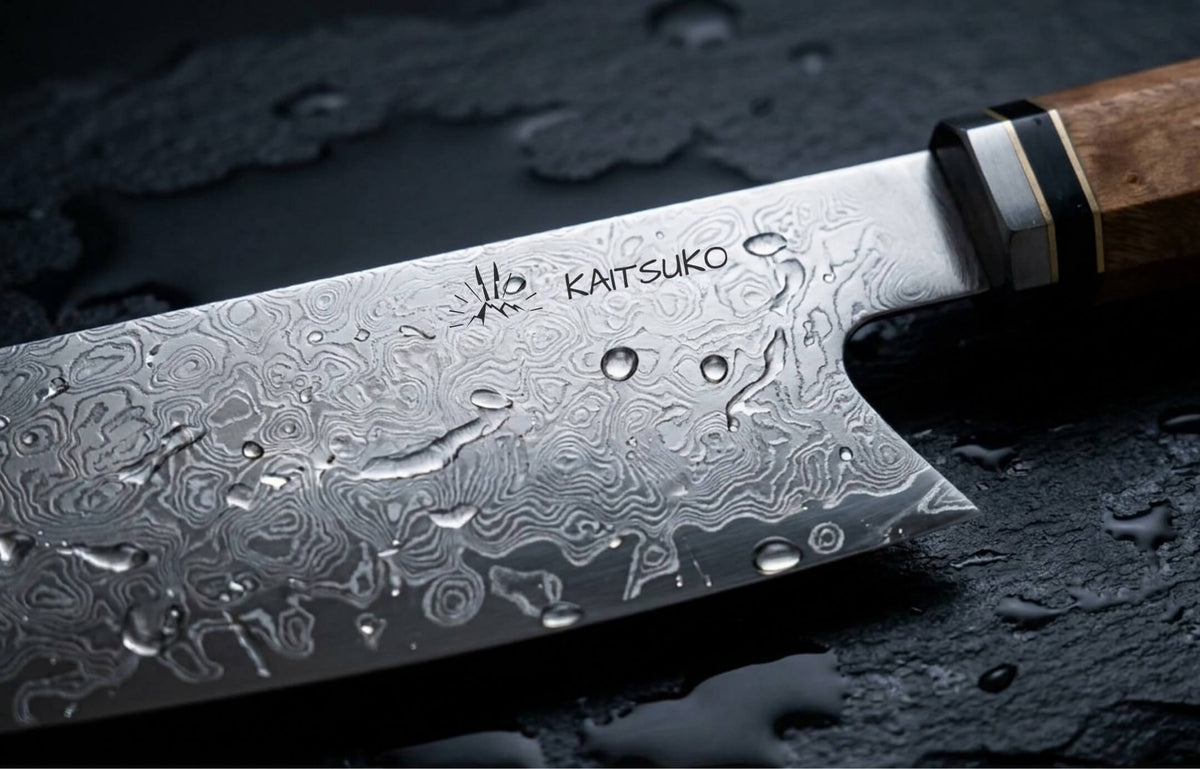
Yes, a Damascus steel knife can rust, but it all depends on the steels its layers are made of. A Damascus made of carbon steels oxidises quickly if it stays wet. A stainless Damascus resists better, without being indestructible. Our Damascus blades, with a stainless but high-carbon 10Cr15CoMoV core, stain if they are left wet or dirty.
Rest assured: almost all stains come from a few habits that are easy to correct, and a stain caught early comes off without leaving a trace. Here we explain why steel rusts and what the layers really change, then how to recognise a stain, treat it without damaging the pattern and, above all, avoid it.
| The question | The short answer |
|---|---|
| Does a Damascus knife rust? | Yes if it is carbon steel, rarely if it is stainless and well looked after |
| Do the layers protect against rust? | No, it is the composition of each steel that counts |
| The most common cause | A blade left damp, or a run through the dishwasher |
| The right reflex as soon as a stain appears | Hot soapy water, a soft sponge, immediate drying |
| What to avoid on a Damascus pattern | Vinegar, lemon, steel wool, scouring pads, bleach |
| Prevention | Wash by hand, dry straight away, store somewhere dry |
Why steel rusts
Rust is an iron oxide. It forms when the iron contained in steel comes into contact with both water and oxygen. Salt and acids speed up the reaction, which explains why a blade rusts faster after cutting fish, a lemon or marinated meat than after slicing bread.
Steel becomes stainless thanks to chromium. Above about 10.5% chromium, an invisible, very thin film of chromium oxide forms on its surface, sealing the metal off from air and water. This film re-forms by itself as long as oxygen can reach it. That is why stainless steel "breathes" better in the open air than in a damp drawer.
High-end cutlery steels face a trade-off. To obtain a hard blade that holds its edge for a long time, the carbon content is increased. But part of the chromium then bonds with the carbon to form very hard carbides, and less of it remains to protect the surface. A knife steel with 1% carbon and 15% chromium therefore remains stainless, but it tolerates moisture less well than a stainless steel fork. A fork does not need to be hard: its steel contains very little carbon, and almost all of its chromium remains available to protect the surface.
This is exactly the case with the core of our 67-layer Damascus blades. 10Cr15CoMoV contains about 1% carbon and 15% chromium, along with cobalt, molybdenum and vanadium. It is classed as stainless and copes very well with everyday cooking. What it does not cope with is being left in water for hours or covered in lemon juice. If you are still hesitating between the two main families of steel, our comparison of carbon steel vs stainless steel sets out their strengths and constraints.
Does Damascus steel rust more than other steels?
A common belief holds that stacking layers makes Damascus more resistant to rust. That is not the case. A layered blade resists corrosion no better than the steels it is made of, and it is the least resistant of them that marks first. If those steels are carbon steels, the blade rusts like a carbon steel. If they are stainless, it behaves like a stainless steel.
| The type of Damascus blade | The steels involved | How it behaves with moisture |
|---|---|---|
| Artisan carbon Damascus | Carbon steels, often combined with a nickel steel | Oxidises quickly, develops a patina, needs regular oiling |
| San Mai Damascus with a carbon core | Carbon core, sides more or less stainless | The edge can rust, even if the sides resist |
| Stainless San Mai Damascus | Stainless core and sides | Stands up well to normal use, can stain if neglected |
To find out which category your knife belongs to, read its product page. It should state the core steel. If it only says "Damascus", ask the seller: it is one of the reflexes we also recommend to recognise a real Damascus knife.
The pattern does, however, have one particularity. It is revealed by an acid etch that bites slightly deeper into some layers than others. The surface of a Damascus blade therefore has a micro-relief, invisible to the eye but real. This relief holds on to a little more water and residue than a mirror-polished surface. Nothing serious, but one more reason to wipe the blade carefully, over its full height.
Our 67-layer Damascus blades, all of San Mai construction, have a core of 10Cr15CoMoV, a high-carbon stainless steel. It is what carries the edge, and the layers wrapping around it on each side form the pattern. As with any Damascus, it is the least resistant steel in the blade that will mark first, hence the importance of the habits that follow. To understand the role of each layer, our article on 67-layer Damascus and San Mai construction goes into detail.
Rust, patina or simple stain: reading what you see
Not every mark on a blade is rust. Before rubbing anything, take a minute to identify what you are looking at.
First wash and dry the blade, as a food residue can look like a stain. Then examine it in daylight, tilting it so that the light skims across the surface: any hollow or bump then shows up clearly. Finally, run the corner of a white, slightly damp cloth over the mark. An orange trace on the fabric gives away rust. A mark that leaves nothing and does not come off is more likely to be discolouration or a pit.
| What you see | What it probably is | Severity | What to do |
|---|---|---|---|
| Whitish rings after air drying | Limescale left by the water | None | Wash, rinse, dry with a tea towel |
| A dull film after citrus fruit, tomato or onions | A slight surface reaction to acids or sulphur compounds | Low | Wash straight away, dry |
| Small orange or brown dots that come off with a cloth | The start of surface rust | Low | The gentle method described below |
| A dark spot that does not come off, with a hollow visible under a magnifying glass | A corrosion pit | Medium | The gentle method, then keep an eye on it |
| A brown crust, a rough surface, flakes | Advanced corrosion | High | Seek a professional's opinion |
That leaves patina. On carbon steel, a grey, bluish or brownish tint develops over time and even protects the blade a little. It is distinct from rust, does not come off with a cloth and does not need to be removed. On stainless steel, this phenomenon is much more discreet, and a marked discolouration rather indicates a blade left in contact with an acidic food for too long.
The most common causes of stains on a Damascus knife
In the vast majority of cases, a stain on a Damascus blade comes down to one of these situations.
The dishwasher. It is one of the most frequent causes. Dishwasher detergents are highly alkaline, the cycle combines heat with prolonged moisture, and the blade knocks against the other cutlery. The pattern dulls, the edge goes blunt, the handle suffers. As our care guide points out, this damage is not covered by our warranty either.
The sink and the dish rack. A blade left soaking at the bottom of a sink, or drying in the air on a dish rack, stays wet for hours. The drops evaporate, leaving limescale, and sometimes a rust spot where the water sat, often near the handle.
Acidic and salty foods left on the blade. Lemon, tomato, vinaigrette, onion, raw fish, marinated meat: the length of a meal is enough to mark a blade that has not been rinsed. The risk is not cutting these foods, it is leaving the knife dirty on the board while you sit down to eat.
Incomplete drying. A quick wipe with a tea towel often leaves water at the heel, where the blade meets the handle. That is where most of the first rust spots appear.

Damp storage. A blade put away still damp in a closed case, a drawer or a poorly ventilated block stays in a confined atmosphere, without enough oxygen for the protective film to re-form. A leather sheath, which holds moisture, makes the problem worse.
Chlorinated household products. Bleach and some worktop cleaners contain chlorides, which are particularly aggressive towards stainless steel. They attack the chromium film in places and cause pitting. A single spray near a knife holder can be enough to mark a blade.
Salty air and steam. A kitchen by the sea, or a blade hanging right above a boiling pan, lives in permanent humidity. Nothing alarming, but care needs to be a little more rigorous there.
Removing rust from a Damascus blade without damaging the pattern
The more recent the stain, the more easily it comes off. On a Damascus blade, the aim is twofold: remove the oxidation without scratching the surface and without attacking the pattern. Here are the steps we recommend, from the gentlest to the most vigorous. Stop as soon as the stain has gone, then go straight to the last step.
- Wash the blade in hot water with washing-up liquid, using the soft side of a sponge, then dry it immediately. The start of surface oxidation often comes off at this stage.
- If the stain persists, make a paste with a spoonful of bicarbonate of soda and a few drops of water. Apply it with a soft cloth, to the stain only, rubbing without pressing along the length of the blade. Rinse, dry.
- For a more stubborn spot, a fine-grit rust eraser, used locally and with a light touch, deals with most superficial pitting. Be aware that it can slightly lighten the pattern where it is used.
- Finish with a drop of neutral food-grade oil, spread over the whole blade with a cloth, then wipe off the excess.
Some remedies doing the rounds should be avoided on Damascus. Vinegar, lemon and cola work through acid, and it was precisely an acid that revealed the pattern. It attacks the most reactive layers faster than the others, which can make the contrast uneven. The lemon and coarse salt mixture adds an abrasive effect and chlorides, which encourage pitting. Steel wool, green scouring pads and scouring creams scratch the surface and dull the pattern. Bleach, as we have seen, causes pitting. Finally, never scrape a rust spot with the tip of another knife.
For a mono-steel blade, other methods remain possible, and we have compared them in our article on 7 safe methods to remove rust from a blade. Just bear in mind that on Damascus, gentleness wins over effectiveness.
If the pattern has lost its contrast after years of use or overly vigorous cleaning, it can be revived by a new, controlled chemical etch. This is a job for a cutler, which requires protecting the handle and the edge, controlling the acid and then neutralising it: we advise you against trying it at home.
Caring for a Damascus knife: the anti-rust routine
Treated well, a Damascus blade stays immaculate for years. Prevention comes down to a routine of a few minutes, to follow after each use.
- Rinse or wash the blade as soon as you have finished cutting, especially after acidic or salty foods. Use hot water, washing-up liquid and the soft side of the sponge, keeping the edge facing outwards.
- Dry immediately with a microfibre tea towel, on both faces, the spine and the heel. Pay particular attention to the base of the blade, against the handle, where water likes to collect.
- Leave the blade in the open air for a minute or two if you are then putting it away in a case or a drawer, to let any residual moisture evaporate.
- Store it somewhere dry, on a block or a holder where air circulates.
A magnetic wall rack has a real advantage here: the blade stays in the open air, dries completely and rubs against nothing. Our 40 cm magnetic wall rack holds several kitchen knives side by side. Hang it away from the hob and from steam.

For long-term storage, or if you live in a humid environment, add a thin layer of oil to the blade before putting it away. A neutral, food-grade oil is suitable, such as camellia oil, traditional in Japan, or food-grade paraffin oil. Avoid olive or sunflower oil, which go rancid and sticky. Check the blade every two or three weeks. Our guide to caring for and washing your Japanese knives covers the complete routine, handle included.
If you live by the sea or your kitchen is often full of steam, three adjustments are enough. Dry the blade with a dry tea towel, not the one already used for the washing-up. Apply a drop of oil once a week rather than only before long periods of storage. And choose a storage spot away from the cooker hood, the sink and the dishwasher, whose opening releases a cloud of hot steam.
Finally, use matters as much as care. A knife used every day, washed and dried straight away, is often in better condition than a knife left for months in a drawer. Oxidation thrives on neglect far more than on use.
When a stain is no longer harmless
Most stains are superficial. Three situations, however, call for more attention.
First, there are deep pits. If a corrosion spot has dug a small crater visible to the naked eye, cleaning removes the oxide but not the hollow. On the sides, it is mainly cosmetic. On the edge, it is more of a problem, because a pit at the edge creates a weak point that eventually chips.
Next comes rust on the edge. An oxidised edge cuts less well and deteriorates faster. Light sharpening on a whetstone generally removes the affected area and creates a clean edge. If the rust has eaten into the edge over several millimetres, deeper regrinding is needed, and it is best entrusted to a professional. We have compared the different options in our guide on where to get your knives sharpened.
That leaves the junction between the blade and the handle. Rust that appears at this point and keeps coming back despite cleaning may signal water trapped under the ferrule. Dry this area with particular care, and if the problem persists, write to us with photos.
More generally, if your blade stains quickly even though you wash it by hand and dry it straight away, contact us. The warranty terms and the procedure to follow are set out in our FAQ on warranty and care. One photo too many has never bothered us, and we do not want to leave any customer in doubt about their blade. So that we can reply quickly, attach a photo of the stain taken in daylight and a photo of the whole blade. Add the date of your order and a few words on how the knife is washed and stored.
Ultimately, Damascus is neither more vulnerable nor more resistant to rust than any other steel of the same composition. It calls for the same habits, with a little more gentleness to preserve its pattern. To choose a Damascus blade knowing its steel and hardness in advance, browse our collection of Damascus steel knives.
FAQ: rust and Damascus knives
Can a Damascus steel knife rust?
Yes, if the steels it is made of are not stainless, or if it is neglected. A carbon Damascus oxidises quickly on contact with moisture. A stainless Damascus stands up well to normal use, but can stain if it is left wet, dirty or in prolonged contact with acidic and salty foods.
Can a stainless Damascus knife rust?
Yes, but less often than a carbon Damascus. Stainless does not mean indestructible: a blade left wet, dirty or in contact with acidic foods can stain. The core of our 67-layer Damascus blades is 10Cr15CoMoV, a stainless steel with about 15% chromium, which calls for hand washing and immediate drying.
Can you put a Damascus knife in the dishwasher?
No. Highly alkaline detergents, heat and prolonged moisture dull the pattern, encourage stains and damage the handle. Knocking against the dishes also blunts the edge. Damage caused by a run through the dishwasher is not covered by the Kaitsuko warranty.
How do you remove a rust stain from a Damascus blade?
Start by washing it in hot soapy water with a soft sponge. If the stain persists, rub it without pressing with a bicarbonate of soda paste and a soft cloth, then rinse and dry. For a stubborn spot, use a fine-grit rust eraser locally. Finish with a drop of food-grade oil.
Does vinegar damage a Damascus knife?
It can alter the pattern. The design of a Damascus blade was revealed by an acid, which attacks some layers faster than others. Renewed prolonged contact with vinegar or lemon can make that contrast uneven. On Damascus, use bicarbonate of soda or a fine rust eraser instead.
Which oil should you use to protect a Damascus blade?
A neutral, food-grade oil, such as camellia oil or food-grade paraffin oil. A few drops spread with a cloth are enough, then wipe off the excess. Avoid olive oil and sunflower oil, which go rancid over time and leave a sticky film on the blade.
Why does my blade stain after cutting citrus fruit or onions?
These foods are acidic or rich in sulphur compounds, which react with the surface of the steel. If the blade stays dirty for a few minutes, a dull film or a ring may appear. Rinse the knife as soon as you have finished cutting, dry it, and the mark will not set in.
Does rust damage the edge?
Yes, if it reaches the edge. Oxidation at the edge makes it less clean and creates weak points that chip more easily. Light sharpening on a whetstone generally removes the damaged area. If the rust has eaten deep into the edge, entrust the knife to a professional.
Is rust covered by the warranty?
Our knives come with a two-year warranty, subject to the terms and exclusions of our terms and conditions of sale, and our care guide specifies that dishwasher damage is not covered. If a blade stains abnormally despite hand washing and immediate drying, contact us with photos.
Japanese knife prices: how much to spend, and what for?